Time-to-Production Benchmarks for Document AI Platforms
Four phases determine when document AI actually reaches production.

An engineer who signs a contract on the strength of a two-week deployment promise and finds the project still unresolved in month three has not been misled by a lie so much as by an incomplete number. The vendor's timeline describes one phase of a four-phase process: integration, configuration, validation, and compliance. Each phase has its own bottleneck, so each needs a different kind of engineering work to fix it. Compressing one phase while ignoring the other three does not shorten the total time to production. It moves the stall to wherever the next phase's work was left undone. This pattern is visible at the industry level, too: only a minority of organizations have moved a substantial share of their AI pilots into production, and the friction responsible is rarely the model itself. It is the integration and governance layers surrounding the model, the parts no demo ever has to pass through.
Integration: connecting to documents where they live
Integration is where many deployments lose their first month, because production documents are never sitting in one tidy place. Data should stay where it already lives and get processed in place, because forcing a reorganization around the platform's preferred input format is not the sounder architectural choice.
This is where API design determines speed more than almost any other factor in the early weeks. Platforms built API-first, with SDKs across multiple languages, let engineers plug into existing codebases directly. Extend's SDKs cover Python, TypeScript, Java, and Go, alongside an open-source CLI and a Model Context Protocol server built for AI coding agents, so engineers connect from whatever stack they already run. File format support matters just as much at this stage: Extend's Parse API handles more than 35 file types across every plan tier, which removes format normalization as a task the implementation team would otherwise have to build by hand.
Teams that underestimate the integration phase are usually the teams that mistook the vendor demo for a representative environment. Production processes a dozen file types from a dozen sources, several of which nobody mapped out until the second week of the project.
The configuration phase: where template-based systems still stall
Configuration is the phase that generational shifts in document AI architecture have changed the most. For years, the dominant approach required a separate template for every document layout, each one built, tested, and maintained by an implementation team before a single live document could be processed. That per-layout template burden was historically the single largest source of delay in the whole deployment process, and it routinely stretched projects into months before production work had even begun.
Third-generation vision-language architectures can read documents without needing a template per layout, and they have genuinely changed that math, so the compression from months to weeks is real for any team working with diverse or unpredictable document formats. Schema design, prompt iteration, and output structuring still take engineering time, and platforms differ sharply in how much of that work they automate for you versus leave to you. A frontier foundation model handling the reasoning is necessary but not sufficient for production document processing. State the comparison or condition directly instead of routing it through "the difference" framing.
Extend's Composer agent is built around that distinction. If the underlying platform can reason about document-level structure rather than treating every page as an independent unit, it can split a loan document running past a thousand pages into hundreds of correctly bounded subdocuments in under five minutes. A platform that handles page-level extraction well but has no concept of document boundaries will configure quickly for simple forms and stall badly on anything longer.
Why accuracy benchmarks do not straightforwardly predict production behavior
Accuracy is not a single number, and the gap between what a benchmark reports and what a platform does on a specific team's documents is large enough to function as a planning variable. A 2025 Fraunhofer IAIS study running eight multimodal models across three public invoice datasets found that the same model scores very differently on clean documents versus scanned documents of the same type, and that this gap tracks document quality far more closely than it tracks which vendor built the model.
Benchmark construction compounds the problem. At least six separate companies publish benchmarks, and on each one, their own products come out on top. The documents inside a benchmark matter as much as the metric the benchmark reports. RealDocBench addresses this directly by building its question-answering track from real regulated documents, 1,356 field-level questions spanning 581 documents across four domains, each paired with a typed gold-standard answer, which makes the benchmark considerably harder to game than one built from synthetic or pre-cleaned documents. ParseBench extends that same critique: it covers thousands of pages but evaluates individual parsing tools as the unit of measurement, and that is a meaningfully different test than evaluating a full agentic pipeline end to end, the unit that actually determines production outcomes.
Extend publishes its own open-source benchmarks, RealDoc-Bench, LongArray-Extract, and PoliTax Split, reporting strong results on Document Q&A, a substantial F1 improvement over the raw underlying model on document splitting, and high mean per-document accuracy on large array extraction. Because the methodology is open, those numbers can be reproduced. One failure mode the standard leaderboards miss almost entirely is the silent dropping of rows during large-array extraction: a pipeline that quietly loses a meaningful share of rows from a large table can still look accurate in aggregate while failing completely for any downstream process that depends on the table being complete. None of this means benchmarks are useless. It means a benchmark score answers the question "how did this platform do on these documents," and the only benchmark that fully predicts production behavior on a given team's documents is one run against that team's own documents.
The validation phase: what confidence scoring does for deployment timelines
Validation is where production readiness gets established: confidence scoring either resolves this phase in days or leaves it dragging on indefinitely. Confidence scoring converts raw extraction accuracy into something closer to a production service-level agreement, because it routes each output by how certain the system is instead of sending every document through the same maximally cautious path at the same cost.
A calibrated three-tier routing model sends high-confidence outputs straight to downstream systems, routes medium-confidence outputs to human review queues, and sends low-confidence outputs to manual re-entry. Human-in-the-loop review has become a required part of most production deployments: the share of organizations requiring human validation of AI agent outputs rose sharply through 2025 and into 2026, turning HITL into a staffing and workflow commitment that teams have to plan for.
If a platform treats confidence scoring as an afterthought, teams have to build their own routing logic from scratch, and that extends validation by months. Platforms that ship calibrated confidence scores and review infrastructure as standard features compress it. Extend includes confidence scoring, a Review Agent that checks every output for potential errors before it reaches a user, and human-in-the-loop workflows across all plan tiers, so you don't have to build the validation infrastructure in-house before go-live.
Regulatory pressure is beginning to convert validation best practices into legal obligations. The EU AI Act requires human oversight for high-risk AI systems, including credit scoring, employment screening, and medical devices, with enforcement beginning December 2027 for standalone high-risk systems and August 2028 for product-embedded systems such as medical devices. Explainability and documented model lineage will be binding requirements for enterprises operating in Europe, which sets up the compliance phase as a distinct, and increasingly unavoidable, piece of the deployment timeline.
The compliance phase: how security and certification requirements affect deployment timelines in regulated industries
Compliance is routinely discovered partway through a deployment, after integration and configuration work is already finished, and that late discovery forces architectural rework that a different platform choice would have avoided. Compliance requirements in regulated industries are predictable well in advance, but teams often don't check for them until a security review surfaces them midstream.
The certifications that gate production deployment in regulated industries, SOC 2, HIPAA, GDPR, are not available across every document AI platform, and a platform missing one forces the team to build compensating controls, a months-long engineering effort in its own right. BYOC (bring your own cloud) and self-hosted deployment options shift that burden from an open-ended compensating-controls project to a configuration decision made up front. Extend's Enterprise tier includes BYOC and hybrid deployment, a custom MSA, DPA, and SLA, a HIPAA BAA, and a zero data retention policy, so regulated teams don't have to negotiate each of those capabilities individually or engineer them from scratch. The EU AI Act's enforcement timeline turns this into a near-term planning concern rather than a distant one: organizations will need to document model lineage, rationale outputs, safeguards, and bias testing results for any high-risk AI system in scope.
Compliance is the phase where the gap between "go live in days" and "go live in months" is most often decided, and it is the phase vendor benchmarks discuss least.
How deployment timelines differ by industry vertical
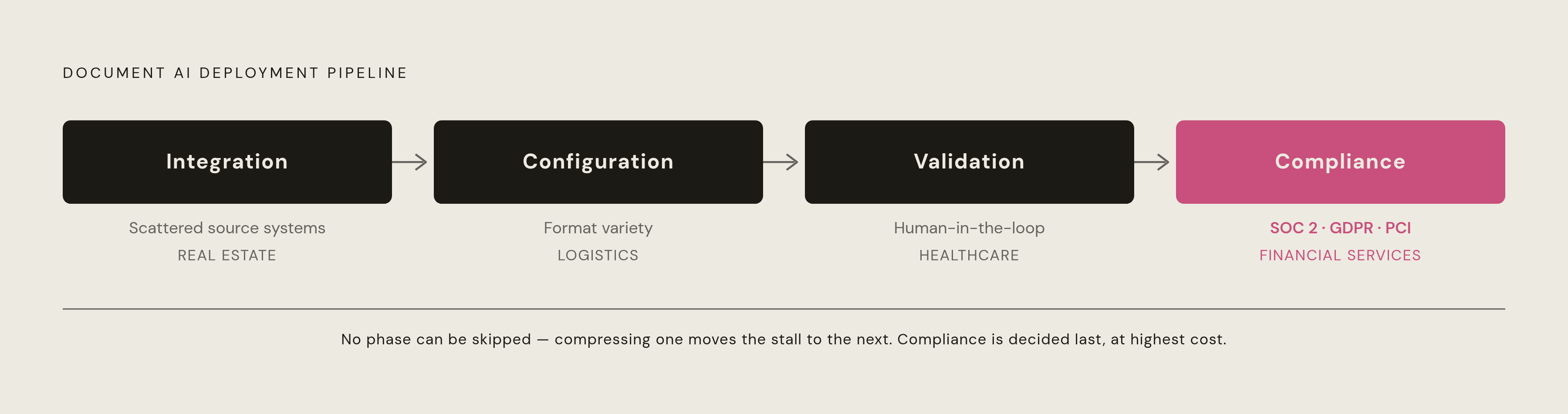
Which of the four phases acts as the binding constraint depends heavily on industry, and if you misidentify that constraint, your regulated-industry implementation will likely run longer than you expect.
In financial services, configuration tends to move quickly because documents like invoices, credit applications, and contracts are high-volume and structurally consistent, so schemas stabilize fast. Compliance is the real constraint: SOC 2, GDPR, PCI, and data residency requirements all have to be settled before a platform ever touches customer financial data. Brex uses Extend to power document workflows across its customer base, and Square, Mercury, Checkr, Upstart, First American, and Column Tax are also named Extend customers, evidence of production deployment at real scale in this sector.
In healthcare, validation is the binding constraint. Amgen is a named Extend customer in the pharmaceutical and life sciences space, and Flatiron Health documented compressing six months of work into two weeks.
In real estate, integration is usually the constraint, since workflows span title reports, lease agreements, appraisals, and inspection reports scattered across many source systems and formats. Opendoor is a named Extend customer in this space, and that shows production use at meaningful volume.
In logistics, configuration is complicated less by volume than by variety: bills of lading, shipping manifests, and customs forms differ by carrier and by jurisdiction, which makes template-free architecture a bigger timeline advantage here than in more uniform document categories. Robinson is a named Extend customer, and it processes logistics documents in production at significant scale.
A realistic framework for comparing deployment timelines across platforms
A deployment comparison that only evaluates one phase, usually configuration, because it's the phase most visible in a sales demo, will underestimate total time to production and won't predict which platform is actually fastest for a given team's situation. Four questions, one per phase, give a more complete picture.
For integration: does the platform offer SDKs in the languages a team already uses, and does it support the team's document sources and file types without requiring migration or consolidation first? For configuration: does it eliminate per-layout templates, and does it automate schema design and prompt iteration, or does it leave that work to manual tuning cycles? For validation: does it ship calibrated confidence scoring, human-in-the-loop routing, and an evaluation environment as included features, or does the team have to build those from scratch? For compliance: does it hold the certifications the industry requires on day one, and does it offer deployment options like BYOC or self-hosting that satisfy data residency rules without custom engineering?
On integration, it offers SDKs in Python, TypeScript, Java, and Go, an open-source CLI, an MCP server for AI coding agents, and support for more than 35 file types across every plan. On configuration, it runs a template-free architecture, with the Composer agent handling automated schema refinement and three distinct per-processor modes (fast, cost-optimized, maximum-accuracy) so teams aren't locked into one global tradeoff across an entire pipeline. On validation, confidence scoring, the Review Agent, human-in-the-loop workflows, and Studio evaluations are included across every plan tier, backed by the open-source RealDoc-Bench, LongArray-Extract, and PoliTax Split benchmarks for claims that can be independently checked. On compliance, the platform holds SOC 2, HIPAA, and GDPR certification, runs a zero data retention policy, offers BYOC and self-hosted deployment, includes a HIPAA BAA on the Enterprise tier (available as an add-on on Scale), supports PCI compliance through self-hosted deployment, and provides custom MSAs and DPAs at the Enterprise level. Pricing starts with a free tier that gives you 10,000 credits and full product access, with no contract and no sales call required, so you can start the integration phase before your budget approval even clears.
For a team that wants evidence before committing to any platform, the more defensible approach is to run the vendor's published benchmark methodology, not just read its reported score. Extend's open-source RealDoc-Bench, LongArray-Extract, and PoliTax Split benchmarks are built for exactly that: a reproducible evaluation framework against production-realistic documents, rather than the synthetic or best-case datasets that make almost any platform look strong on a leaderboard.