Total Cost of Ownership for Homegrown Document AI Pipelines
Hidden operational costs dwarf upfront spending on homegrown document AI.
An engineering lead gets approval to build a document AI pipeline in-house instead of buying one, and the number attached to that approval is almost always wrong. The sticker price, models, compute, cloud, is only a small fraction of the pipeline's true cost over its life. The dominant costs sit outside the frame at the moment the decision gets made, invisible on any spreadsheet a team would build before deployment. That is not a failure of diligence. The costs that end up dominating total cost of ownership are operationally contingent: they depend on the system running under real production pressure, with real documents, real edge cases, and real users, none of which exist yet when the build-vs-buy memo gets written. A team evaluating the decision can only price what can be seen and quoted in advance, infrastructure, model access, initial development time, and has no comparable line item for the maintenance burden, the compliance retrofit, or the reliability engineering that production traffic will eventually demand. The scale of the miss is not a fringe phenomenon. A December 2025 IDC InfoBrief commissioned by DataRobot found that nearly all organizations deploying generative AI and agentic AI faced higher costs than they expected, the overwhelming norm rather than a struggling minority. The pattern repeats across company size and industry, so no amount of careful scoping fixes it on its own. The cost structure itself hides the real figure until the build decision is already irreversible.
The cost breakdown of a production document AI system
The mental model most teams carry into a build decision, model cost plus cloud cost, understates what a production system actually requires. In one modeled year-one rollout for a regulated organization, platform, model, and cloud costs added up to roughly a sixth of total first-year spend. Everything else, the much larger remainder, was the work of making the system usable and trustworthy in production. Labor and integration together make up the majority of total implementation cost, leaving the models and infrastructure as the comparatively cheap layer of the stack.
That remainder breaks into six components, and each compounds differently over time: infrastructure and inference hosting, data engineering and pipeline processing, talent acquisition and retention, ongoing model maintenance and drift management, compliance and governance overhead, and integration complexity with existing systems. Data engineering, covering pipeline processing and quality monitoring, alone accounts for 25 to 40 percent of total spend, making it the single largest non-labor cost category in most deployments. Compliance obligations evolve as regulators update guidance. Integration surfaces expand as more of the organization adopts the tool. Each of these adds new demand on compute, storage, and monitoring month over month. A cost model built for launch day is obsolete within a quarter of going into production.
Why technical labor surprises teams most
Technical labor is the single largest line item across a homegrown pipeline's five-year cost of ownership, and teams discount it most aggressively when they build the initial estimate. Part of the reason is staffing math that does not match how engineering teams usually think about headcount. A production document AI pipeline is not a job for one generalist engineer bolted onto an existing team. It typically requires dedicated infrastructure engineers and at least one model engineer in the first year alone, with security and project management responsibilities layered on in the years that follow.
Senior AI engineers are among the most expensive hires in engineering by fully loaded cost, and they are slow to bring on board: roughly four months to hire, followed by additional months of ramp time before they are producing at full capacity. They also carry a meaningful probability of leaving within the first year, and each departure restarts that ramp clock from the beginning. Annual compensation for these specialized roles runs $200K-$500K+, and attrition risk compounds the cost because institutional knowledge of a bespoke pipeline is not easily transferred to a replacement hire. The pipeline itself becomes a retention problem over time. Engineers maintaining a hand-rolled document processing system built years earlier, with limited documentation and no greenfield upside, have less reason to stay than engineers working on new problems elsewhere in the organization. That dynamic creates a slow drain toward exactly the kind of legacy maintenance work that is hardest to backfill.
The data pipeline problem that compound costs before the first user sees a result
Production document AI systems routinely process far more raw data than the models at the center of them ever actually consume, and every byte of that excess gets paid for. A manufacturer implementing predictive AI found that its data pipeline was processing 847 gigabytes a day while the models themselves consumed only 12 gigabytes of processed output. Closing that gap produced significant monthly savings in compute and storage once the team identified where the waste was occurring.
For document AI specifically, that gap is structural rather than accidental. Raw documents have to be ingested, run through OCR, parsed, normalized, deduplicated, and routed, all before a model ever sees a single token of the content. Each of those steps carries its own failure mode, its own retry logic, and its own storage cost, and all of it accumulates before the part of the system anyone demos ever runs. Token density compounds the problem further than most teams expect going in. A single deep extraction call, pulling structured data out of a complex document using vision and OCR, can consume a very large number of tokens on its own, and a full automated processing run across a document set can run far higher still. Those costs accumulate across every document in the queue, beyond just the ones used for testing.
Infrastructure overhead multiplies again at the operations layer. A single GPU inference endpoint has a straightforward baseline cost, but load balancing, monitoring, alerting, disaster recovery, and on-call staffing around that endpoint multiply the effective cost several times over. Model inference itself typically accounts for only 10 to 15 percent of total infrastructure spend. The pipeline and monitoring layer surrounding it accounts for the rest. None of this appears in a pilot, because a pilot rarely runs at the volume or duration needed to expose it.
Moving from a working pilot to a reliable production system multiplies cost
A pilot that extracts data accurately in a demo environment has skipped most of the engineering work that production reliability actually demands. Gartner found that closing the gap between a good-enough pilot and production-grade accuracy can multiply implementation effort by up to five times, and pilots typically cost only a fraction of what production deployment costs precisely because they bypass most of that reliability work. Document AI makes this gap unusually expensive because its failure modes are quiet rather than loud. A pipeline that drops rows out of a large table extraction, misreads a field relationship on a dense form, or loses reading order on a multi-column layout does not throw an error a team can catch in logs. It produces structured output that looks correct and is wrong, which is a far more dangerous failure than a crash.
Closing that gap requires drift monitoring, evaluation suites, retraining pipelines, and rollback infrastructure, and none of these are optional extras layered on later. None of them appear in a pilot budget, because a pilot is not designed to run long enough or at enough volume to need them. Reliability does not improve on its own as underlying models get better, either. Research tracking 24 months of frontier model releases found that reliability improved far less than raw accuracy did and plateaued at similar levels across vendors, so teams building on top of frontier models do not automatically inherit production-grade reliability just because the model underneath got better. Annual maintenance for a production AI system runs well into the double digits as a percentage of the original build cost in standard deployments, and climbs toward half the original build cost in heavily regulated sectors, an ongoing tax the pilot's cost estimate never surfaced.
The cost of compliance and governance for document AI in regulated industries
Compliance and governance are not a box a team checks once before launch. The obligation recurs and scales with the number of models deployed and the volume of documents processed. It grows as the system succeeds rather than shrinking after the initial build. Healthcare organizations feel this acutely around HIPAA audit logging infrastructure, a cost that pilots consistently leave out entirely. The setup cost is material on its own, and the ongoing obligation includes audit trails, access controls, and business associate agreements that require every vendor touching the stack to participate.
Financial services carries a comparable burden in a different form. Regulatory-grade model explainability documentation runs hundreds of hours per model, and financial services teams saw a large surge in AI-related regulatory updates in a single recent year, nearly doubling the prior volume of such updates. The documentation burden is not a fixed cost paid once. It grows as regulatory activity grows. Healthcare compliance taken as a whole, spanning HIPAA, FDA, and EU MDR requirements, adds 30 to 50 percent to baseline development cost, and the regulated pipeline required for an FDA-authorized AI-enabled medical device runs from the hundreds of thousands into the millions of dollars.
Real estate document workflows carry their own version of this problem. Leases, purchase agreements, inspection reports, and financial disclosures often arrive as handwritten or scanned inputs with no standardized format, which forces custom parsing logic that has to be maintained and audited separately from the extraction model itself. Logistics faces a parallel compliance surface: shipping manifests, bills of lading, customs forms, and purchase orders cross jurisdictional boundaries, and each jurisdiction imposes its own requirements for retention, format, and auditability. Across every one of these industries, skipping compliance work during a pilot feels like a savings in the moment. Discovering the gap after deployment means retrofitting audit infrastructure into a system that was never designed to hold it, which costs consistently more than building it in from the start.
The build-vs-buy math once the full cost stack is visible
Once labor, data engineering, compliance, maintenance, and reliability infrastructure are all counted, the economics of building a document AI pipeline in-house shift materially against the build option for most teams. TCO models that include these components show a vendor solution can produce meaningful savings over a five-year horizon compared with a fully loaded do-it-yourself build, and the reason is not that the vendor is cheaper feature for feature. The hidden costs on the build side are simply larger than the visible costs on the vendor side once every component gets counted honestly.
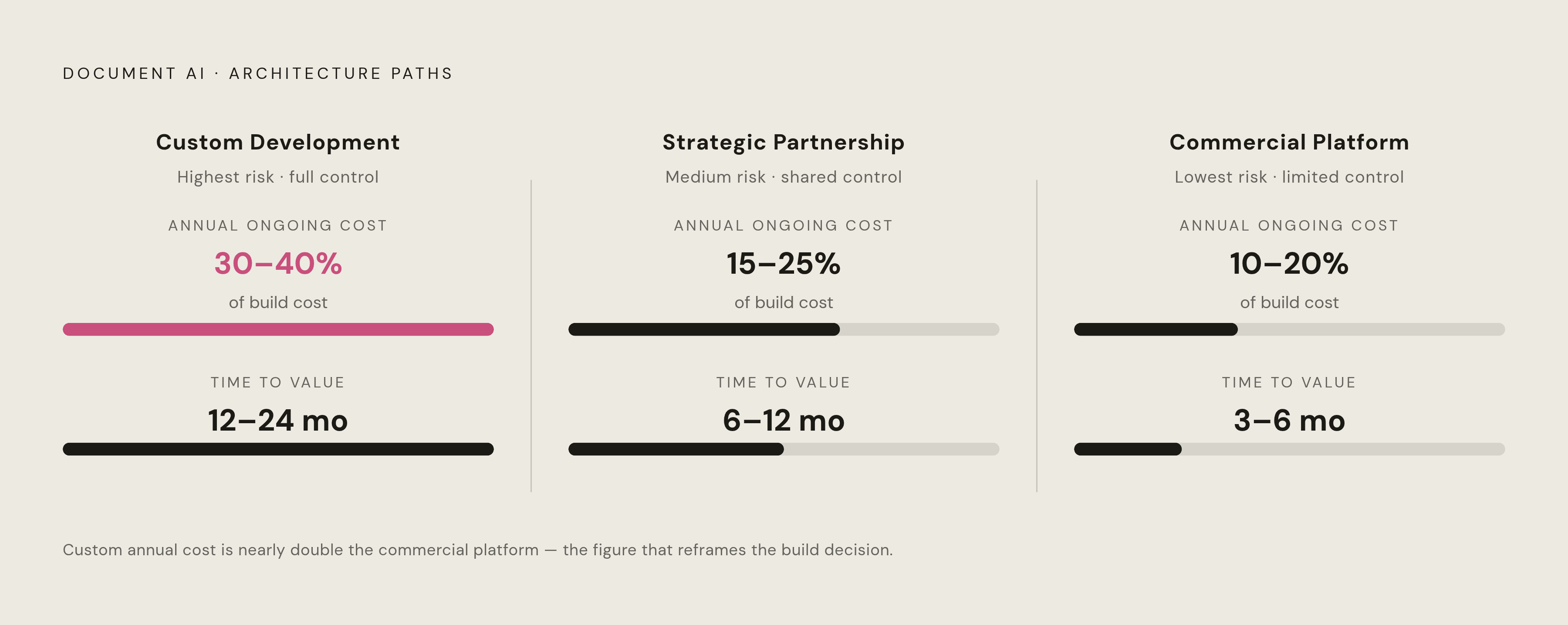
This comparison rests on three distinct architecture paths, each with its own cost and control profile. Custom development carries the highest initial investment and the highest ongoing costs, running 30 to 40 percent of the build cost annually, and it offers maximum control over the system along with a 12 to 24 month time to value and meaningfully high technical risk. A strategic partnership sits in the middle on every dimension: medium initial investment, ongoing costs of 15 to 25 percent annually, shared control between the organization and its partner, a 6 to 12 month time to value, and medium implementation risk. A commercial platform has the lowest initial investment and the lowest ongoing cost, 10 to 20 percent annually, a 3 to 6 month time to value, and low technical risk, with limited control and a dependency on the vendor's roadmap.
The control argument for custom development is not baseless, but it gets overstated more often than it holds up. Teams that build homegrown pipelines frequently discover that controlling the model layer does not give them control over the reliability layer, the compliance layer, or the maintenance layer, and those three are exactly where the cost and the risk actually concentrate. The build-vs-buy decision is also not the same decision as on-premises versus cloud inference, and conflating the two leads teams astray. Lenovo's 2026 TCO analysis found that on-premises infrastructure reaches breakeven against hyperscale cloud in as little as four months for workloads with sustained high utilization. That advantage only materializes when utilization stays consistently high, and on-premises setups carry power, cooling, and maintenance overhead that adds meaningfully to total ownership cost the moment utilization fluctuates. Building or buying rarely has one right answer for every team. It is closer to building only the piece where genuine comparative advantage exists and buying the infrastructure layer that is not the organization's core differentiator.
Production-grade infrastructure for a document AI pipeline
A production-ready document AI pipeline is defined by what surrounds the model, not by which model sits at its center. It is defined by everything built around that model: parsing, extraction, classification, confidence scoring, human-review routing, compliance controls, and evaluation infrastructure all have to be present before the system can be trusted at real scale. Confidence scoring and evaluation infrastructure are core instrumentation, not optional polish. They are the mechanism that tells the pipeline when to route a document to a human reviewer instead of silently shipping wrong structured output, and without that mechanism, accuracy measured in a demo says nothing reliable about accuracy under production load.
Benchmark claims for document AI deserve scrutiny on the same grounds. Trustworthy benchmarks penalize the failure modes that actually matter in production, dropped rows in large table extraction, broken field relationships on complex layouts, and reading-order errors on multi-column documents, instead of rewarding raw character-accuracy scores measured on clean printed text that bears little resemblance to what a production queue actually contains. Open benchmarks built specifically to stress-test these failure modes, including OmniDocBench from CVPR 2025, give teams a way to evaluate a system against the conditions it will actually face rather than the conditions a vendor demo is built to flatter. Every cost component traced through this piece, the labor, the data pipeline overhead, the compliance burden, the reliability gap between pilot and production, lands on the same conclusion: the question a team should be asking is not which model to use, but whether the system around that model has been built to survive contact with real documents, real regulators, and real production volume.
Sources
- On-Premise vs Cloud: Generative AI Total Cost of Ownership (2026 Edition) > Lenovo Press
- AI Software Development Costs 2026: Enterprise Spending, TCO, and ROI Analysis | Keyhole Software
- Total cost of ownership for enterprise AI: Hidden costs | ROI factors
- The Total Cost of AI Ownership (AI TCO) | Cohere