Model Context Protocol for Document AI Agents
A standard protocol for document AI agents eliminates custom connectors.
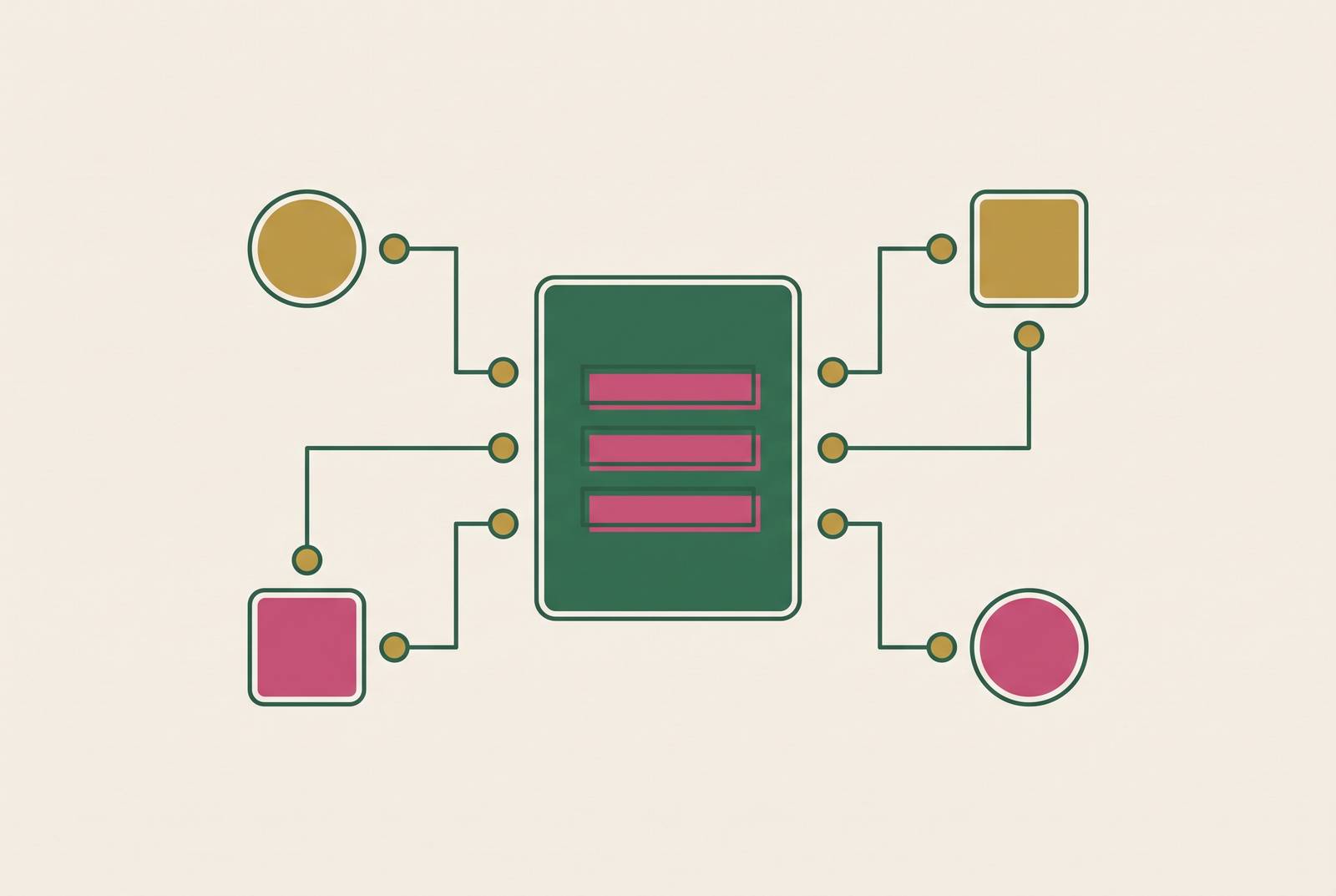
MCP gives document AI agents a standard way to call extraction, parsing, and classification tools, so teams don't need to build custom connectors by hand. Before MCP, each AI application wrote its own function-calling setup or plugin system, so document AI teams rebuilt the same connectors over and over for every orchestrator they touched, and none of those integrations composed with each other. Anthropic introduced MCP in November 2024, and the protocol is now governed by the Linux Foundation's Agentic AI Foundation. It defines a two-way communication interface between LLM host applications, called clients, and external capability providers, called servers, and it standardizes how agents find, call, and chain tools together. The common comparison holds up well: MCP acts like a universal port, the kind that lets a wide range of devices connect to a wide range of hosts without custom wiring for each pair. Under the hood, the protocol passes messages over JSON-RPC 2.0, using stdio or HTTP with Server-Sent Events as transport, and it defines primitives for tool use, resource access, and prompt templates. A 2026 review of agent-to-agent collaboration protocols names MCP alongside ACP and A2A as one of three foundational agent communication standards, which places it as infrastructure rather than a framework competing for the same job. That distinction matters directly for document processing: extraction pipelines, parsers, classifiers, and form-filling services are precisely the kind of external capability providers MCP was built to connect to orchestrating agents, and MCP gives all of them a shared interface so no downstream agent framework has to write a bespoke connector for each one.
Where MCP Fits in a Document Processing Pipeline
MCP belongs at the orchestration and routing layer of a document pipeline. It connects extraction systems to the rest of the workflow, and it does not replace the extraction engines themselves. A document pipeline built around MCP runs through a consistent set of layers: an agent orchestrator deciding what happens next, an MCP client issuing the calls, an MCP server exposing the available tools, an extraction or parsing engine doing the actual document work, and a downstream system receiving the result. High-volume, deterministic extraction work, such as invoice line items processed at scale or structured form parsing, runs better through a purpose-built extraction pipeline with a confidence threshold and a human review queue than through an agent reasoning freely over each document. MCP's job is to connect that pipeline to everything around it, not to substitute for the pipeline's own logic.
The right way to decompose a document workflow into MCP tools follows naturally from that principle. An MCP server exposes separate, discrete tools: one to parse a document, one to extract named fields, one to classify document type, one to submit results to a downstream system. The agent calls them in sequence, branching based on confidence scores or document type as it goes. Industry practice already reflects this design. A multi-agent document processing pipeline studied through January 2026 processed most documents end-to-end with no fallback needed, but it routed a small fraction, usually ones in unrecognized formats or with severely degraded images, to legacy OCR systems or manual portals instead. That split shows MCP-orchestrated agents doing what they're suited for: handling the common case directly and routing the exceptions elsewhere rather than forcing every document through the same brittle path.
Healthcare offers a clean illustration of the tool decomposition. An MCP server can expose one tool to retrieve clinical notes from an EHR, one to query payer rules, one to submit a prior authorization request, and one to check approval status. The agent chains these calls together, and no single tool needs to know anything about the others, which keeps each piece simple to build, test, and replace independently.
Scaling this approach introduces its own cost. As the number of MCP servers in a deployment grows, injecting every server's JSON schema into the system prompt at once creates real context overhead, so responses slow down and tokens burn on tool definitions the agent may never call. Research in 2026 has started exploring semantic, vector-based tool discovery to fix this, so an agent can search for the right tool instead of having to hold every tool description in context at once.
OCR and Parsing Accuracy as the Floor for MCP Orchestration
MCP can route a document to the right tool, chain multiple tools together, and retry a failed call, but none of that can produce accuracy the parsing layer never generated. The choice of underlying OCR and extraction model is the most consequential engineering decision in a document AI pipeline, more consequential than anything in the orchestration layer sitting above it.
The benchmark landscape for OCR has matured enough to guide that decision with real numbers. The olmOCR-Bench leaderboard functions as the dominant open-source standard for measuring extraction accuracy, with olmOCR itself scoring 82.4 overall. A 2026 cross-model comparison scores Mistral OCR 3 at 81.7, Chandra from Datalab at 82.0, and PaddleOCR VL 1.5 at 79.3, figures close enough to each other that no single model dominates across the board. Every model tested shares the same weak point: old scans with degraded ink and bleed-through, where scores fall to a range of 33.7 to 49.2, less than half what the same models achieve on clean documents. No amount of retrying the call through MCP fixes that gap. Only better preprocessing or a better-suited model closes it. Benchmarks also tell an incomplete story on their own: typed text scores near-perfect accuracy across engines, but handwritten pages show wide variance between models, and real-world documents that mix both tend to land well below what the clean benchmark numbers suggest.
If you are building or selecting an extraction engine to expose through MCP, you have several open-source models worth tracking. LightOn OCR, released in October 2025, targets complex multi-stage pipelines that tend to score well on benchmarks but resist adaptation to real document variety. dots.ocr, released in July 2025, and Qwen2.5-VL, released in January 2025, round out a set of models that E2E Networks' coverage says reach accuracy levels matching or exceeding proprietary services. Commercial cloud extraction services are moving too: an independent IDP benchmark shows measurable year-over-year improvement on invoice processing tasks, confirming that the accuracy floor for extraction keeps shifting rather than settling.
That movement carries a direct design consequence. Pipelines should be built so the underlying extraction model can be swapped without re-architecting the MCP layer sitting above it. In practice, that means exposing model selection and confidence thresholds as configurable parameters on the tool itself rather than hardcoding them into the tool's behavior. An operator or an orchestrating agent can then route a high-stakes document to a slower, more expensive, more accurate model without touching the tool interface. Separating the MCP interface from the model behind it is what keeps a document pipeline maintainable as the extraction landscape keeps changing underneath it.
Human-in-the-loop as a first-class MCP tool, not an afterthought
If a document AI agent cannot issue a structured request for human review when its confidence drops too low, it has no business running in production. MCP's tool model makes that review request a first-class primitive built into the protocol's own vocabulary.
The pattern itself is straightforward. When an extraction tool returns a confidence score below a set threshold, the agent calls a separate tool built just to request human review. That tool sends a notification, whether through Slack, email, or an in-app inbox, a human then approves or rejects the extraction, and the workflow resumes from where it paused. All of it runs as standard MCP tool calls, with no special-case logic outside the protocol itself.
A deployment processing invoices in Singapore uses exactly this pattern in production: automatic classification runs when confidence is high, and the system routes to a finance reviewer when the vendor is new or the invoice amount crosses a set threshold. That design has led to materially less manual invoice work across the deployment. The multi-agent document processing pipeline study referenced earlier puts a number behind what well-designed human routing achieves at scale: the large majority of documents complete end-to-end with no fallback, and the remainder gets routed explicitly to defined non-AI paths. Those are designed handoffs, not silent failures the system happens to produce.
Building the review tool correctly means giving the human reviewer everything needed to act without reopening the original document: the extracted fields, the confidence scores attached to them, the document's identifier, and the specific fields that triggered the review. A notification that just says something needs review forces the reviewer to start over from scratch, which works against the purpose of routing the exception. Confidence scoring itself belongs in the product, not off to the side as a monitoring concern layered on after deployment. Building it directly into the extraction tool's return schema means every MCP consumer downstream can branch on that score, and that single design choice separates pipelines that handle uncertainty deliberately from ones that quietly drop low-quality extractions into systems that have no way to catch them.
How MCP security threats manifest specifically in document workflows
Document AI agents built on MCP face a distinct threat profile: the tools they call handle regulated data at every step of the pipeline, and because of MCP's compositional design, a single compromised extraction or classification tool can cascade through an entire document workflow without raising any visible alarm.
The MCPSHIELD framework catalogs 23 distinct attack vectors spread across 4 attack surfaces relevant to MCP deployments generally. The MCPSHIELD 2026 analysis tracks one trend that bears directly on document workflows: action tools, meaning tools capable of directly modifying something outside the agent's own sandbox, grew from roughly a quarter of all registered tools to 65 percent by February 2026. Document submission, form filling, and EHR write-back all fall squarely into that action-tool category. The fastest-growing class of MCP tools is also the class with the most capacity for damage if compromised.
Several attack patterns matter most for document pipelines specifically. Tool poisoning embeds malicious instructions inside a tool's own description, and the LLM then follows them as though they were legitimate guidance, a risk that grows sharply when an agent discovers extraction tools dynamically from a registry it doesn't fully trust. Rug pulls happen when a tool's behavior changes after installation, as when an extraction tool quietly starts altering field values or dropping rows well after it passed initial review. Cross-server data exfiltration happens when a compromised classification tool leaks document contents to an external endpoint while it still appears to return an ordinary label to the caller. Privilege escalation through tool composition happens when a low-privilege document reader gets chained to a high-privilege submission tool in a way that bypasses authorization checks on the write path.
AI agents can be manipulated through natural language into bypassing the controls built around them, so traditional firewall rules and authentication tokens stay necessary but stop being sufficient on their own. When document pipelines pass extracted text back through the LLM before acting on it, they sit directly in that exposure path.
None of this argues against using MCP for document work. It argues for specific, enforceable design discipline. CoSAI's practical controls map onto document AI cleanly. Every request should stay traceable across its full execution path, from the user through every MCP server it touches to the final document action, using emerging standards like SPIFFE/SPIRE for cryptographic workload identity. Every MCP server response, whether a tool definition, an extracted field, or a classification label, should be treated as untrusted input that requires validation. When MCP servers write to downstream systems such as EHRs, claims platforms, or financial systems, they need to run in isolation, and containers alone don't meet that bar for high-security deployments. Each document tool should carry a single, clearly defined purpose with explicit field-level boundaries, rather than existing as a general-purpose "process this document" tool that the LLM can direct however it chooses. Mandatory code signing for every MCP server before installation, a centralized inventory of what's deployed, and automated discovery to catch shadow deployments round out the baseline. These are solvable engineering problems with known answers, and the gateway is where that enforcement happens systematically.
The gateway and compliance layer that makes regulated document workflows possible
You enforce compliance in an MCP document pipeline at the gateway, not by hoping every individual tool behaves correctly on its own. Regulated industries, healthcare, finance, and government among them, cannot route document workflows through a standard MCP deployment without that gateway layer in place.
A gateway built for document AI needs to provide several things. Per-tool access control should allow-list which agents can call which extraction, classification, or submission tools, and that access needs to tie back to a specific authenticated identity. Request-level audit logs need retention policies that match the regulatory requirement attached to the data involved: financial services commonly require seven years of retention, while healthcare under HIPAA commonly requires six. Self-hosted or bring-your-own-cloud deployment matters because regulated document workloads, clinical notes, loan files, and tax documents among them, cannot route through a third-party SaaS gateway without raising the same custody questions the regulation exists to prevent.
The regulatory clock is already running on this. The EU AI Act's provisions for high-risk systems become fully enforceable in December 2027, and any MCP gateway routing to tools that touch healthcare, financial services, employment, or critical infrastructure falls within that conformity-assessment scope. A gateway that lacks logging, access control, and human-oversight hooks built in makes that assessment considerably harder to pass when the deadline arrives.
Several open-source gateway options give you a starting point for evaluation. IBM ContextForge federates multiple MCP servers behind a single endpoint, supporting HTTP, JSON-RPC, WebSocket, SSE with configurable keepalive, stdio, and streamable-HTTP transports. Its plugin framework supports content filtering and policy enforcement through pre- and post-hooks, and you get Helm charts and Kubernetes deployment paths if you run it at scale. Bifrost from Maxim AI, Lunar.dev's MCPX, Microsoft's Azure API Management with MCP support, and Docker's MCP Gateway each offer different tradeoffs on deployment model and feature set, and the right choice depends on what a given deployment already runs on.
Context governance works as a complementary layer alongside the gateway. ContextNest formalizes the problem of provenance and version identity in agent knowledge pipelines, and an MCP server can integrate live data through the ContextNest specification to give the agent a governed, audit-reconstructible view of exactly which document version informed a given decision. For regulated document review workflows, knowing the specific version of a source document can decide whether a decision holds up under audit, so that provenance layer turns out to matter as much as the access controls sitting around it.
Sources
- A Formal Security Framework for MCP-Based AI Agents: Threat Taxonomy, Verification Models, and Defense Mechanisms
- From LLM Reasoning to Autonomous AI Agents: A Comprehensive Review
- Securing the AI Agent Revolution: A Practical Guide to Model Context Protocol Security - Coalition for Secure AI
- ContextNest: Verifiable Context Governance for Autonomous AI Agent
- Intelligent Document Processing (IDP) Models Benchmark