When to Build Custom Document Parsing vs. Use an API
Know the three scenarios where building beats buying a document parser.

Whether to build a custom document parsing pipeline or buy a production API is an architectural decision with consequences that outlast whatever budget line first prompted it. A vendor invoice can arrive with column positions shifted two pixels from the expected bounding box, a field drops before it reaches the approval engine, and nothing logs an error because nothing was built to recognize this kind of failure as a failure. The opposite mistake looks just as reasonable at the start: a team swaps out open-source parsing for a raw LLM API and discovers it still owns output schema enforcement, error handling, webhook delivery, multi-engine fallback, and compliance logging, none of which arrive bundled with a single API call. Both paths fail for the same underlying reason. Teams treat parsing as a narrow technical task to be solved once, when it functions as infrastructure that every downstream agent or workflow depends on for as long as the system runs. If you read a few concrete signals correctly, you can settle this question before either failure mode reaches production.
What document parsing requires in production
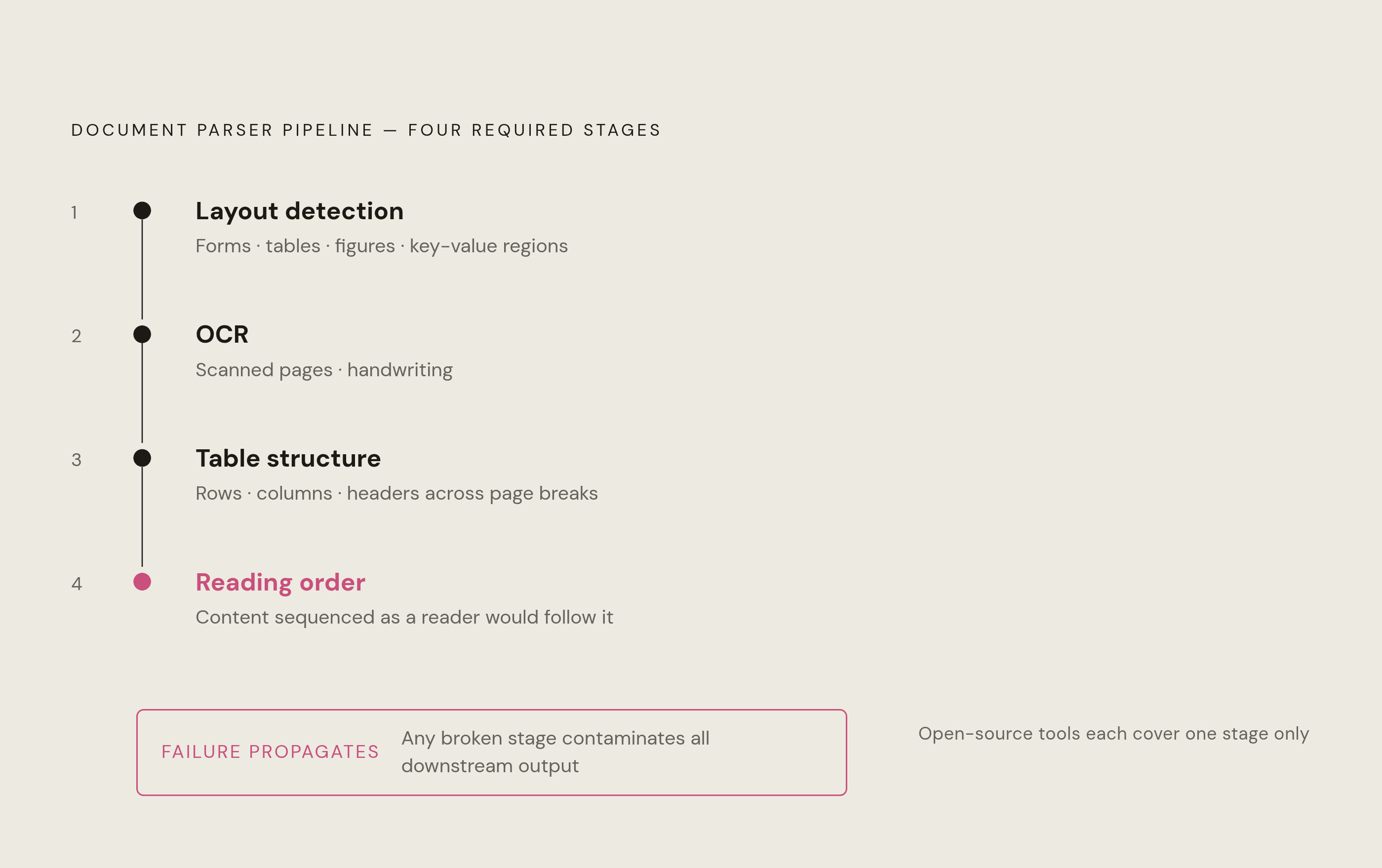
A parser earning the word "production" has to execute four distinct jobs correctly, and a failure in any one of them propagates into everything built on top of it. It has to detect layout: forms, tables, figures, and key-value regions, each identified correctly before any text gets pulled from them. It has to perform OCR accurately on scanned pages and handwriting, not just on clean digital text. It has to reconstruct table structure: rows, columns, and headers that stay aligned even when the source document doesn't cooperate. And it has to preserve reading order, keeping content in the sequence a person would actually follow down the page.
Tables are where open-source parsers break most often. Merged cells confuse row-boundary detection. Headers that span a page break lose their column mapping and come back as orphaned rows with no home. Right-aligned numeric columns drift when the PDF generator that produced the document changes its font rendering, a detail invisible to a human reader and fatal to a script expecting fixed coordinates.
The open-source landscape reflects this gap: each tool solves one narrow piece of the four-job list well, and none solves all four. PyMuPDF (fitz) extracts text, images, and metadata with low latency and minimal dependencies, but only on clean, digitally native PDFs. It cannot read a scanned document without a separate OCR engine bolted on. pdfplumber handles structured PDFs capably but ships with no OCR support. Apache Tika covers a wider range of document formats but drags JVM infrastructure into the stack to do it. None of this makes these tools poorly built. It means each solves a slice of the problem, and production document workflows rarely stay inside one slice. The difficulty occurs where format variability, processing volume, and the field-level accuracy the workflow demands intersect, not on any one of those axes alone.
The three signals that determine whether building makes sense
Building a custom pipeline is the right call in exactly three situations, and outside those three, it is the wrong default to reach for.
The first is strict data residency. HIPAA and similar localization mandates sometimes leave self-hosted open-source as the only path that keeps regulated data entirely inside an organization's own infrastructure. Consumer-tier LLM products like ChatGPT Free, ChatGPT Plus, and Claude.ai don't carry HIPAA business associate agreements, so they can't legally touch protected health information. Several major LLM APIs, including the OpenAI API, Anthropic's Enterprise API, AWS Bedrock, Azure OpenAI, and Google Vertex AI, do offer HIPAA-eligible agreements. When a managed vendor can't provide both a HIPAA BAA and a self-hosted deployment option, open source remains the only compliant choice for that document type.
The second signal is low volume paired with consistent, predictable layouts. When a document type rarely changes shape and volume stays low enough that manual handling of the occasional failure is tolerable, the overhead of maintaining an open-source stack is proportionate to what the team gets back. That calculation flips fast as layout variability climbs. Even small layout shifts reduce extraction accuracy without throwing an obvious error, and at scale, those silent failures compound into something a team notices only after it has already cost them.
The third signal is genuine need for customization at the library level: you need custom OCR fine-tuning, proprietary preprocessing, or domain-specific table logic that a managed API would otherwise abstract away. This signal is rarer than most teams assume. Most teams believe their documents are more specialized than they actually are, and the benchmark gap between fine-tuned custom models and well-designed production APIs has narrowed enough that the specialization rarely pays for itself.
Where the hidden engineering cost of building accumulates
The engineering surface of a custom build runs larger than almost any team estimates before starting, and the cost appears in stages that stay invisible at prototype time.
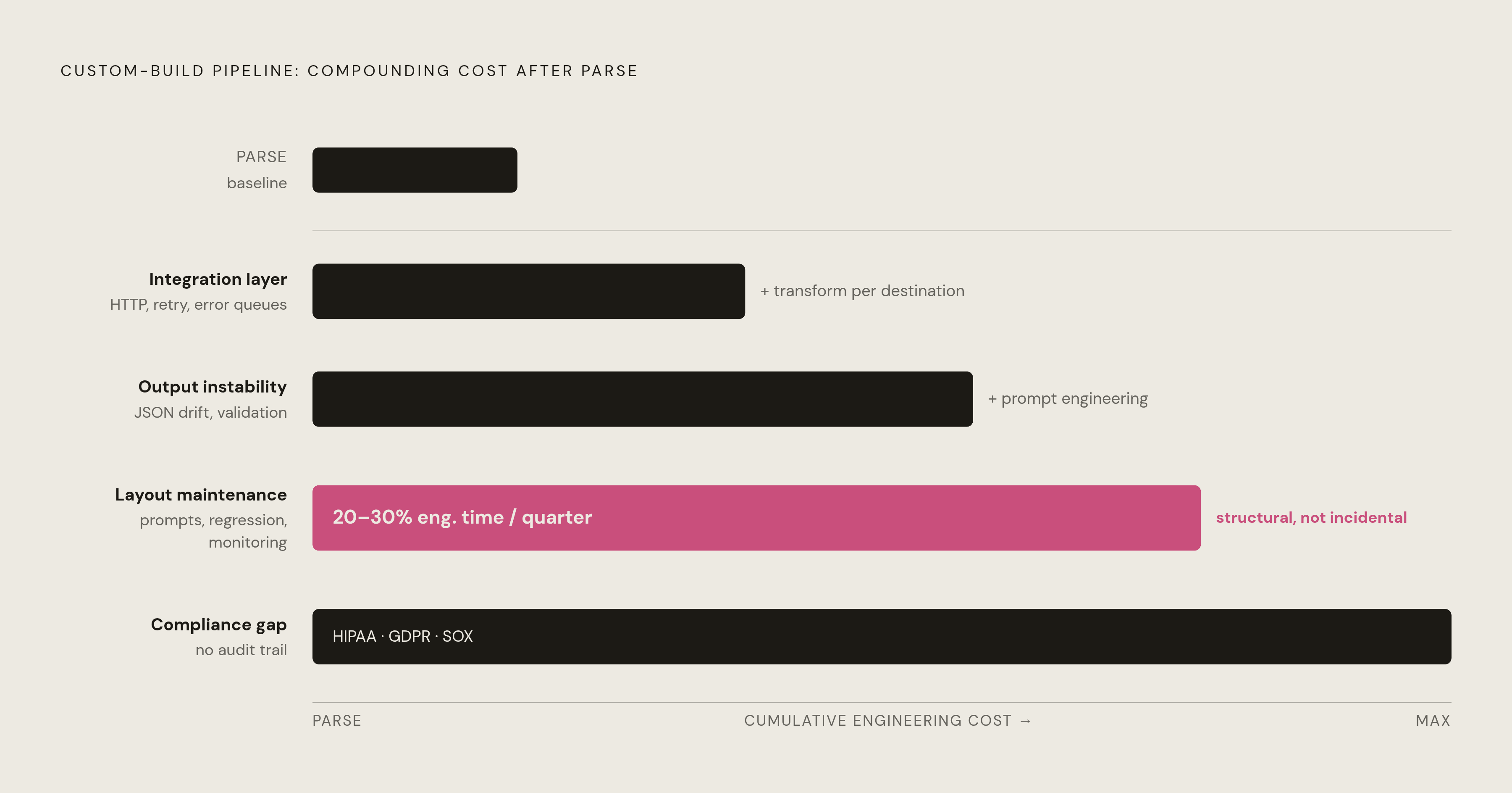
Parsing a document is only the first step. Getting the structured output into a database, a CRM, a spreadsheet, or a downstream webhook is the rest of the actual workflow, and with a raw API, a team builds all of it from scratch: HTTP clients, retry logic, error queues, dead-letter handling, and separate transformation logic for every destination system it needs to feed. This integration layer often takes more engineering time than the parsing step it supports.
Output instability compounds the problem. LLMs don't return identical JSON structure call after call: field names drift, optional fields appear and vanish, nested structures change shape between responses. Downstream code breaks in ways that get harder to trace as document variety grows, and fixing it demands increasingly elaborate prompt engineering, validation logic, and retry handling, each layer added on top of the last.
Layouts keep changing after launch, too. Suppliers update invoice templates, banks redesign statements, and a DIY pipeline needs someone owning prompt maintenance, regression testing, and monitoring to catch silent regressions before they reach downstream systems. Self-hosting open-source parsing runs 20 to 30 percent of an engineer's time per quarter on dependency management and accuracy regression handling, Extend found, on top of ongoing infrastructure costs that don't show up in the initial build estimate.
Compliance brings its own gap, and it's the one custom builds miss most often. An AI system accesses regulated data under a service account or API key, and no log records which individual actually directed that access. That gap violates HIPAA's unique user identification rule, GDPR's accountability principle, and SOX's audit trail requirements all at once, and service account logging alone can't satisfy any of the three. None of these four stages gets cheaper with a better engineering team or more runway. The cost is structural, built into what a custom pipeline has to own by definition. That is why the three signals above function as a standing decision tool rather than a calculation a team runs once and forgets.
Layout variability, volume, and the API threshold
Layout variability and volume don't act as separate inputs to this decision. How they interact decides whether a production API's accuracy advantage is worth its cost against building.
Open-source parsers degrade architecturally, not just statistically, as layout variability climbs. These tools extract what the PDF specification exposes directly: text positioned at known coordinates, structure the format makes explicit. Anything that requires inferring layout or resolving context across pages falls outside what they were designed to do, not a weak spot they handle poorly but a boundary they were never built to cross. That two-pixel shift in a vendor invoice's column position is the clearest version of this: a coordinate-dependent extractor has no mechanism for noticing the shift, so the field just drops, and the approval engine downstream never learns a value was expected.
The practical difference between the two approaches lies in the kind of error each produces. Open-source tools fail silently on structural problems, dropped fields, misaligned cells, orphaned rows, and nothing in the pipeline flags that anything went wrong. A production API built with confidence scoring surfaces those same failures explicitly, so they get routed for review before they ever reach a downstream system. Platforms like Extend are built around exactly this intersection: they unify layout detection, OCR, table structure reconstruction, and reading-order preservation into one system, so a team isn't debugging failures at the seams between four separate open-source tools, and built-in confidence scoring catches the silent failures that coordinate-dependent extraction otherwise hides.
Volume changes what a silent failure costs. At low volume, a human catching the occasional dropped field by hand is a reasonable cost of doing business. As volume scales, the cost of those same silent failures scales with it, and accuracy drift from undetected layout changes turns a tolerable edge case into a production reliability problem that someone has to own.
That gives the decision a practical test. If a team expects its document layouts to shift within the first quarter, or if volume has already made manual exception handling impractical, the maintenance overhead of the open-source path exceeds the cost of an API before the first regression cycle even completes.
Why agentic workflows raise the stakes on parsing accuracy
In an agentic pipeline, a parsing error at the input layer doesn't stay contained to the step that produced it. It propagates through every reasoning step that follows, because an agent can't correct what it was never able to read correctly. Picking a parsing API for agents isn't a matter of finding one that hands back a primitive. It comes down to whether the parse holds up on messy real documents, whether the developer experience lets a team ship quickly, and whether cost, latency, and accuracy can be tuned to the use case at hand.
Token economics make the stakes concrete. If you feed raw file content directly to an LLM, you send along whitespace, repeated headers, encoding artifacts, and structural noise the model has to wade through before it gets to anything useful. A parsing API that strips that noise and returns clean, structured content cuts both cost and latency on every agent run, and that saving compounds across a large document corpus rather than staying flat.
Agentic systems have gotten better at handling uncertainty than the traditional systems they're replacing. Where a traditional pipeline escalated to a human the moment confidence dropped below a set threshold, an agentic system can look for the same value elsewhere in the document, check it against a known pattern, or attempt clarification before escalating. But none of that works if the underlying parse has already lost the document structure those fallback strategies need to function.
Multi-step agentic pipelines introduce a new integration layer on top of all this. The Model Context Protocol, or MCP, lets an agent call any function, including a parser, as a composable tool through its standard Tools primitive. That lowers the integration cost for a well-designed API considerably, and it adds a compatibility requirement that any custom build now has to meet to participate in agent frameworks.
How to evaluate a production parsing API before committing
Choosing an API without testing it against production-representative documents repeats the same mistake as shipping a custom parser with no regression tests behind it. Accuracy on a demo's clean PDFs says nothing about accuracy on the actual documents a production system will encounter.
A proof of concept has to run on a team's own documents and measure field-level accuracy, not character accuracy, since character accuracy can look strong while masking the field-level failures that actually break downstream systems. The test set needs scanned documents, multi-column layouts, and tables that cross page boundaries instead of only the clean PDFs that make any parser look good.
Confidence scoring at the field level is what makes human-in-the-loop triage workable in practice: high-confidence extractions move through untouched, while uncertain predictions route to a validation queue instead of straight into production. Deterministic business rules still belong alongside that scoring. Duplicate invoice numbers, failed three-way matches, and changed bank details should route to a person no matter how confident the model sounds, because confidence is a measure of the model's certainty, not a guarantee of correctness.
Benchmark transparency has to come before a vendor's accuracy claims can inform any decision. A benchmark built only from clean documents says nothing about failure on the layout-variable documents a real workflow will actually throw at it. Open benchmarks run on real-world documents let a team check the numbers independently: Extend's RealDoc-Bench evaluation, for instance, drew on 1,500 real-world samples, a different proposition from a proprietary demo score a team has to take on faith.
How fast a team can actually ship depends on the integration surface and developer experience. A team building agentic workflows needs a parser with a clean API, structured JSON output, and ideally an MCP server for native tool integration. Email-first tools and tools with no webhook support simply can't participate in that kind of pipeline. SDK availability, CLI tooling, and how long it takes to get a first real parse running on an actual document predict total deployment time far better than any feature list does.
Compliance and deployment model round out the evaluation, and for regulated industries, this isn't a box to check at the end. A vendor needs a HIPAA BAA, SOC 2 certification, GDPR compliance, and a self-hosted or BYOC deployment option on offer, and healthcare workflows in particular have no room to treat any of these as negotiable. For teams carrying HIPAA or strict residency requirements, self-hosted open source used to be the only road that was compliant. Document ingestion platforms built for production, Extend among them, now offer self-hosted and BYOC deployment that meets HIPAA BAA and GDPR requirements, which closes much of the distance between the compliance guarantees of on-premise infrastructure and the operational reliability a managed API provides. The maintenance tax is the cost most teams underestimate going in: as document types evolve, layouts shift, and volume grows, a team running open source has to keep retuning thresholds, adding fallback logic, and rebuilding error handlers indefinitely, a burden that developer-first platforms absorb as part of the infrastructure itself, freeing engineering time for the agents and workflows the business actually needs built.