Compliance Certification Costs for Self-Built Document AI
Building your own document AI means absorbing all compliance costs and audit obligations alone.

A decision to build a document AI pipeline in-house is also a decision to take on every compliance obligation attached to the data that pipeline will touch. That second decision rarely appears on the engineering roadmap, and it almost never appears in the initial budget.
Document AI systems process exactly the kind of material that regulators care most about: invoices with vendor bank details, medical records, insurance claims, loan applications. A pipeline built to extract fields from those documents doesn't need to be sold to a hospital or a bank to trigger obligations under HIPAA, GDPR, or the EU AI Act. It only needs to process patient data, employee records, or regulated financial information, which most document pipelines do by the nature of the job. HIPAA in healthcare, SOC 2 for enterprise software sales, GDPR for any processing that touches an EU resident's data, and the EU AI Act for systems classified as high-risk are legal requirements, not optional controls a team can adopt later once the product proves itself. Building the pipeline yourself doesn't hand these obligations to a vendor. It concentrates them inside the building organization, which must now satisfy every certification, every audit, and every contractual demand on its own, with no one else to share the liability.
The weight of that obligation isn't evenly distributed. A team building a pipeline for strictly internal use, with no regulated data in the mix, carries a lighter load than a team selling into healthcare or financial services. But even an internal tool crosses into compliance territory the moment it touches employee records or any data covered by a privacy statute, and few internal document workflows avoid that. Each one is a separate system, with its own audit cycle, its own legal exposure, and its own maintenance tail that doesn't end when the certificate is issued.
The compliance stack a self-built document AI pipeline must clear, framework by framework
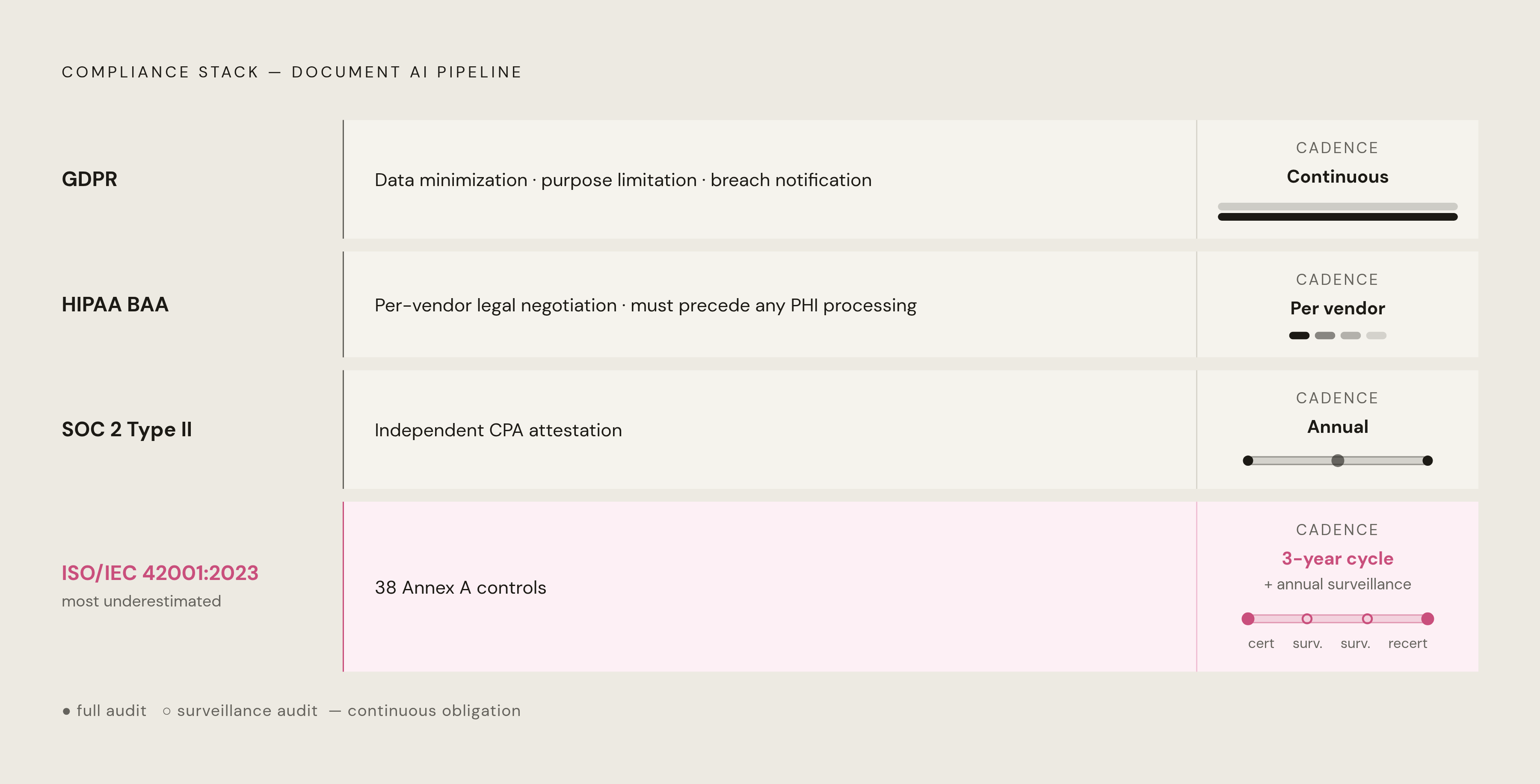
Four frameworks make up the core of what a self-built pipeline is likely to face, and each operates on different terms.
SOC 2 Type II is an attestation report, not a certification in the formal sense, but enterprise buyers treat it as one. It covers security controls as a mandatory baseline, with availability, processing integrity, confidentiality, and privacy controls added depending on scope. Most enterprise contracts now require a SOC 2 report as a condition of doing business, and the report has to come from an independent CPA firm. A team cannot self-attest its way into this one.
GDPR applies the moment a pipeline processes personal data belonging to an EU resident, regardless of where the company building the pipeline is headquartered. It imposes data minimization, purpose limitation, retention limits, and breach notification duties, which have to be designed into the system from the start.
ISO/IEC 42001:2023 is the newest entry and the one most teams underestimate. It's the first certifiable international standard for AI management systems, and it covers AI risk management, transparency, and governance across 38 Annex A controls. Certification runs on a three-year cycle with annual surveillance audits in between, so the obligation doesn't stop after the first pass. It stands apart from the NIST AI RMF, which is voluntary and produces no certifiable credential, only self-assessed documentation of alignment. ISO 42001 produces an actual certificate, and enterprise procurement teams are increasingly asking for it by name.
Then there are BAA negotiations, which aren't a certification at all but a legal process that has to be completed separately with every model API vendor, every cloud provider, and every data subprocessor the pipeline touches. Consumer tiers of most major model APIs don't come with HIPAA BAAs attached. If a team plans to process protected health information, it has to negotiate a BAA with an enterprise API tier or avoid those models for that workload. Each negotiation carries its own legal cost and its own timeline, and processing PHI before the BAA is signed is a federal violation in its own right, independent of anything else the pipeline does well.
The Cost of Each Layer of the Compliance Stack
Looked at individually, each framework's cost looks manageable. Added together, the total changes the economics of the build decision.
ISO 42001 certification has several cost components, which are incurred at different stages. A readiness assessment or gap analysis comes first, and its cost depends heavily on how wide the AI management system's scope is and whether outside consultants are brought in. Implementation follows: drafting policies, standing up controls, training staff, running an internal audit, all of which scale with how mature the existing controls already are and how much new infrastructure has to be built to support them. The certification audit itself runs in two stages, a documentation review followed by a full review of the AI management system by an accredited body, and its cost depends on the size and complexity of the organization being audited. Taken together, initial ISO 42001 certification typically runs from several thousand dollars up into $75,000 or more, and that figure excludes what you need to maintain the certificate afterward.
The EU AI Act adds its own cost structure for any system classified as high-risk. Average initial compliance costs per high-risk system are substantial before ongoing monitoring is even counted, and third-party conformity assessments add a separate expense on top. Infrastructure built to support real-time logging and traceability isn't a one-time expense either; it adds a meaningful cost increase year over year as the system scales. Teams deploying AI in healthcare and finance face proportionally higher costs across all of this, because validation requirements in those sectors are stricter than the baseline. A self-builder occupying both the provider and deployer role at once, which is the common position for a team that builds its own pipeline rather than buying one, can see total compliance costs rise well above what a deployer-only organization would pay for the same system.
SOC 2 and HIPAA costs stack on top of all of this for any team selling into enterprise accounts or handling PHI, adding their own audit cadence, their own internal hours, and their own legal review cycles. BAA negotiations add a cost that's easy to miss at the planning stage: each one requires outside counsel time, and signing with a vendor that offers HIPAA eligibility sometimes means moving to a more expensive enterprise API tier than the one used in prototyping. None of these costs are one-time purchases. ISO 42001 requires annual surveillance audits. SOC 2 reports expire and have to be renewed. HIPAA risk assessments need to be repeated. The EU AI Act's monitoring and incident reporting duties run for as long as the system stays in production. Every framework in the stack has a maintenance tail, and that tail bills the organization again every year the pipeline stays live.
How compliance costs stack and compound across multiple frameworks
A document AI pipeline serving healthcare or financial services doesn't pay these costs one at a time. It pays all of them at once, and the overlap between frameworks adds work that no single framework's cost estimate accounts for.
GDPR, HIPAA, and the EU AI Act each set their own rules for retention limits, audit logging, and breach notification, and those rules have to be satisfied simultaneously. They don't always agree with each other on the technical level, and resolving a conflict between, say, a retention limit under one framework and a logging requirement under another takes legal and engineering time that neither framework's cost estimate includes on its own. The European Parliament's own 2025 study on the interaction between the AI Act and other EU digital legislation found that the Act's obligations frequently overlap with adjacent regulatory instruments and identified a number of frictions in how they interact. The overlap with GDPR, NIS2, and other frameworks wasn't designed away. It was left as a source of friction that organizations subject to multiple frameworks now have to resolve themselves.
Each framework also demands its own documentation set, its own control evidence, and its own audit trail. A single evidence package rarely transfers cleanly from one framework's audit to another's, so the same underlying control, say, access logging, has to be documented and evidenced separately for ISO 42001, for SOC 2, and for a HIPAA risk assessment, even though the control itself hasn't changed. That repetition consumes engineering and legal time multiple times over for requirements that substantially overlap in substance but not in paperwork.
A talent cost recurs every year rather than once, because maintaining this compliance posture takes dedicated headcount or outside consultants on an ongoing basis, not a single sprint before launch. Each framework gets costed in isolation during planning, then lands on the pipeline all at once in production, compounding the burden even when no single framework is unaffordable on its own. Retrofitting compliance into a pipeline that wasn't built with it in mind costs considerably more than building it in from the start, because encryption, audit logging, access controls, and data residency requirements often demand a redesign of the underlying architecture.
Compliance Obligations and Document AI's Accuracy and Reliability Requirements
Compliance frameworks for high-risk AI systems don't stop at paperwork. The EU AI Act and HIPAA both impose technical requirements on accuracy, auditability, and human oversight, and a pipeline has to be built around them, not bolted on afterward.
The EU AI Act requires automatic logging, traceability, and human oversight mechanisms for systems classified as high-risk, and these are architectural requirements, not policy statements. A pipeline has to be built to produce the logs and the traceability the Act demands; a written policy describing what the system should do doesn't satisfy an auditor who wants to see the mechanism itself.
Confidence scoring sits right at the center of this requirement. A pipeline that extracts fields from a document without producing any reliability signal on those extractions has no way to demonstrate human-oversight compliance, because the system needs a mechanism to flag a low-confidence output for review before it sends it downstream automatically. Without that signal, every extraction gets treated as equally trustworthy, but that isn't true of any real-world document pipeline, and it leaves an obvious gap for an auditor to find.
That gap widens because of how these models actually perform outside a controlled test set. OCR and extraction models can score well on clean benchmark documents, but accuracy drops considerably once the system meets the scan quality, inconsistent layouts, and multi-page reference structures that occur in production document flows every day. Compliance frameworks judge the pipeline on how it behaves in production, not on its benchmark score, so a team that only tested against clean samples has built a system that looks compliant on paper and fails the standard it's actually held to.
If you document accuracy methodology and keep evidence of ongoing evaluation, that's itself a compliance artifact under both ISO 42001 and the EU AI Act. Building a document AI pipeline and building a compliant document AI pipeline are different scopes of engineering work: confidence scoring, logging, and evaluation records are parts of the system that a prototype can skip and a production system cannot.
Realistic total cost of ownership for a compliant self-built document AI pipeline over three years
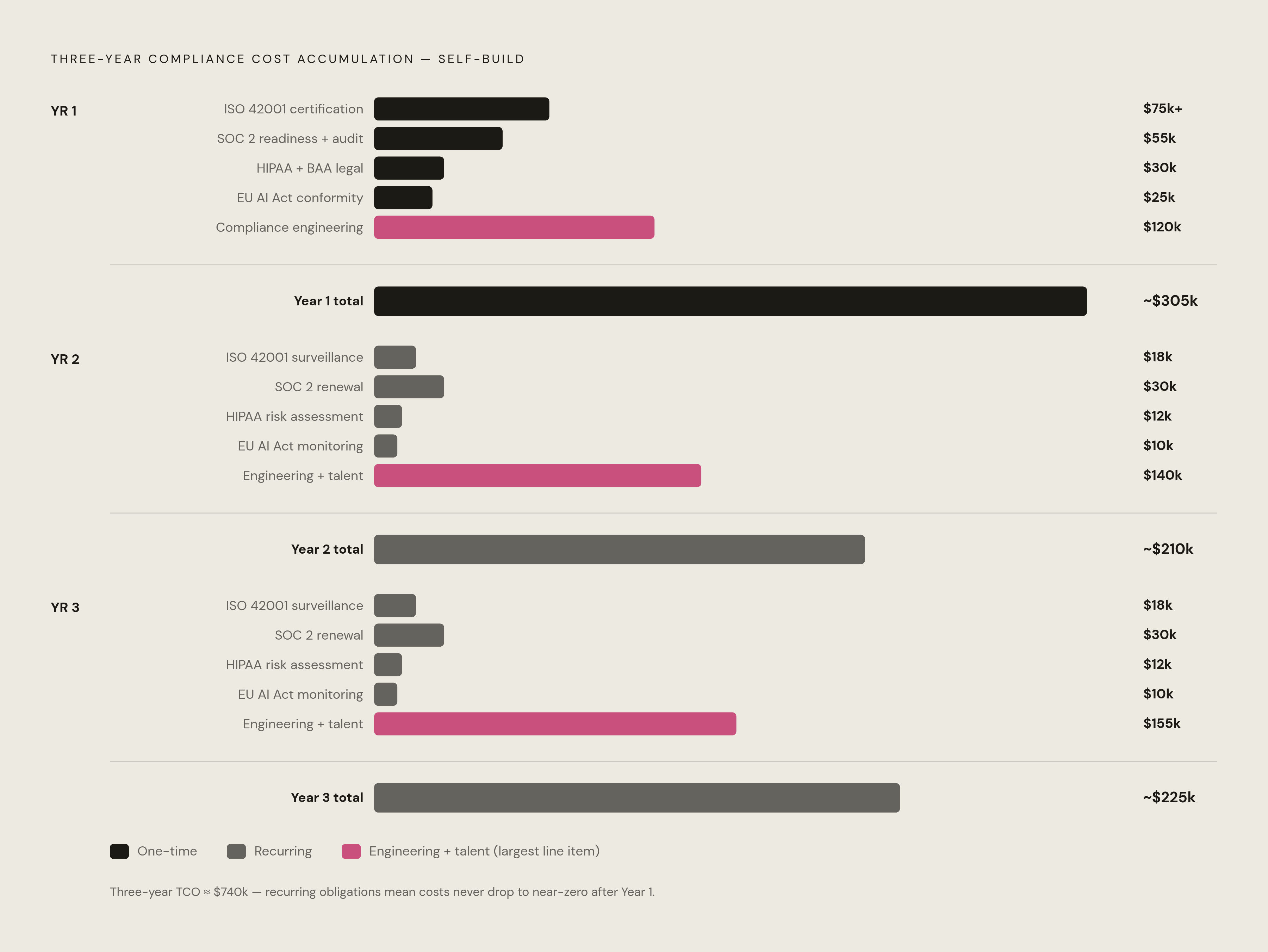
Engineering time, compliance costs, talent, and maintenance accumulate across three years, so the total cost of a compliant self-built pipeline runs well past the number in the original build estimate, with the gap growing wider each year as maintenance obligations stack on top of each other.
Year one carries the heaviest one-time costs: initial certification fees across every framework the pipeline needs, which can include ISO 42001, SOC 2, HIPAA setup, and an EU AI Act conformity assessment where the system qualifies as high-risk. BAA negotiation legal costs are incurred in year one as well, alongside the engineering time needed to build the compliance architecture itself, audit logging, encryption, access controls, confidence scoring, plus any premium paid for compliant hosting infrastructure.
Years two and three don't repeat the full cost of year one, but they don't disappear either. ISO 42001 requires annual surveillance audits. SOC 2 reports need renewal. HIPAA risk assessments have to be repeated on an ongoing basis. The EU AI Act's monitoring and incident reporting duties continue for as long as the system operates. Engineering time keeps getting spent updating documentation and controls as the pipeline changes, adds document types, or takes on new customers.
Talent is usually the largest line item across all three years. Maintaining a compliant pipeline takes ongoing engineering ownership, not a single build sprint followed by maintenance mode, and the compliance surface area grows every time the pipeline scales into a new document type, a new customer segment, or a new jurisdiction. The strongest argument for building in-house is that once the core architecture is paid for, recurring costs scale with raw infrastructure and per-seat licensing fees disappear. That argument only holds if the compliance maintenance burden was estimated accurately at the start, and the evidence above suggests it rarely is.
Purpose-built document AI infrastructure as an alternative compliance model
A purpose-built document AI infrastructure platform moves a large share of this burden off the engineering team and onto the vendor, and that shift matters most exactly where self-build costs run highest: certification maintenance, security architecture, and BAA availability.
A vendor that already holds SOC 2 Type II, HIPAA, and GDPR certifications has already paid for the readiness assessment, the implementation work, and the audit costs that a self-builder would otherwise have to pay independently. That vendor keeps paying the annual maintenance costs too, but spreads them across many customers instead of billing them against a single internal pipeline.
A vendor that offers a HIPAA BAA removes the legal negotiation cost on that one surface entirely and closes the exposure window that otherwise sits between finishing the build and getting the BAA signed, a window where processing any PHI would be a federal violation.
Self-hosted and bring-your-own-cloud deployment options matter if your compliance posture requires data residency guarantees or zero-data-retention commitments. A vendor offering those options extends compliance coverage down to the infrastructure layer itself, not only the application sitting on top of it, which gives a team the same control over where data lives without having to build and certify that infrastructure from scratch.