Migration Cost From Legacy OCR to Modern Document AI
Hidden integration costs and licensing exit fees often outweigh the software savings.
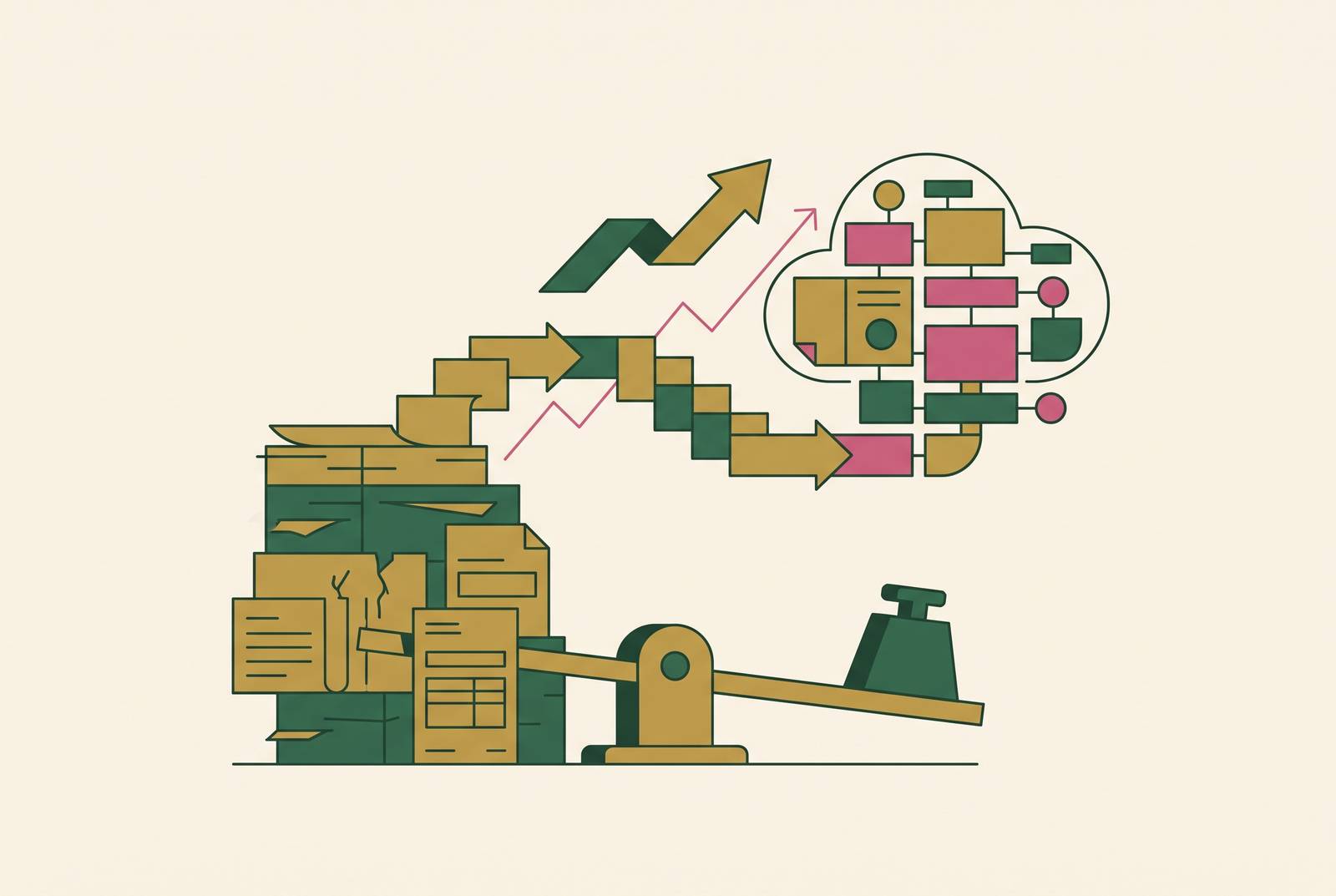
Legacy OCR systems rarely crash, freeze, or stop producing output. They keep running for years past the point where they should have been replaced, and that is precisely what makes the decision to migrate so hard to justify on paper. The failure is economic: a straight-through processing rate that handles the bulk of documents without incident, an exception rate that catches the rest, and a cost structure where the exception tail quietly eats more money than the straight-through volume saves. Every document that falls into the exception pile gets routed to a human reviewer, and that reviewer's time carries a fully loaded labor cost that, at scale, erodes the savings automation was supposed to deliver. Mittelstand accounts payable teams today manage roughly triple the number of supplier templates they handled in 2020, and that growth alone is enough to worsen the economics of a legacy system even when nothing about the software itself has changed.
A fixed cost accrues no matter how well the system performs, and it drives that rising exception rate. The architecture behind these systems is why the math gets worse with time instead of better. That architectural gap is why legacy systems keep running while scaling worse every year. They scale worse every year, quietly, while still technically working.
The real cost of a migration
Most teams scope a migration the way they'd scope a software purchase: compare license prices, pick the cheaper or more capable option, move on. That approach captures just one of four distinct cost layers a migration actually carries, so the budget is wrong before anyone writes a single integration ticket. License comparison answers a narrow question when the real one spans licensing exit, integration rework, parallel-run validation, and the retraining cost the new system eliminates.
These four layers don't sit side by side as independent estimates to be added up. The terms locked into the existing contract determine what licensing exit looks like. How much of the current workflow was built around the legacy system's output format determines how much integration rework follows. How carefully you do that integration work determines how long and how expensive parallel-run validation needs to be. If validation confirms the new system's accuracy before cutover, the retraining savings get realized; if it doesn't, they stay theoretical. Treating the layers in order, rather than summing four separate guesses, is what makes a migration budget something a finance team can trust and a project timeline something an operations team can hold to.
Layer one: what leaving a legacy license costs
The first layer a migrating team runs into is leaving the existing license, and it costs far more than canceling a subscription. If you leave a legacy IDP contract, you usually absorb exit penalties, you pay for the legacy system to run in parallel during the transition, and you keep paying license fees for however many months the migration takes to complete. That exit penalty, parallel-run cost, and extended license fee don't appear in a simple license-to-license price comparison.
Enterprise IDP contracts are typically structured as multi-year, volume-based agreements, and that structure makes timing a real financial variable. In the ASEE case, this kind of unpredictable, volume-driven cost growth was a specific and documented driver behind the urgency to migrate at all, because it meant the baseline cost teams were comparing against kept moving even before any migration decision was made.
Layer three, the parallel-run validation period, adds a cost to Layer one that gets missed constantly: the legacy system has to stay live and licensed throughout validation, so license fees keep accruing well after the migration decision has already been made. Alongside that overlap cost sits a less visible one: the technical debt that's built up on the legacy system over years of patching, workarounds, and custom integration shims. Legacy systems demand constant patching and stopgap fixes just to keep functioning, which drains IT time and often leaves security gaps open in the process, and all of that disappears the moment the system is decommissioned. One more item belongs in this layer: if the legacy system's audit trail is incomplete or can't be exported, the team has to build a retrospective logging effort before the old system can be safely shut down, and that work has to be planned and paid for before decommissioning, not after.
Layer two: the integration rework that follows every output format change
Modern document AI doesn't just pull text out more accurately than legacy OCR can. It extracts and structures information in a fundamentally different format, and every downstream system built to consume the old format, ERPs, data warehouses, workflow tools, has to be updated to read the new one. That update work sits entirely outside the cost of the new platform itself, and it's the layer migration budgets underestimate most consistently.
The integration surface is wider than most teams expect going in. A document pipeline touches ingestion channels, field mapping logic, validation rules, exception routing, and archival systems, and a change to the extraction engine can ripple through every one of those. Adding new intake channels compounds the surface further. The ASEE deployment built multi-channel intake, scanning, email, and eInvoice, from scratch as part of its migration, and that work had no equivalent on the legacy side to offset it against.
A full OCR extraction pipeline runs through at least four layers: ingestion, preprocessing, the extraction engine itself, and output formatting. If you change the extraction engine, each of those four layers can become a point of rework. The format difference matters here in concrete terms, not cosmetic ones. Legacy systems typically output raw text blocks that need post-processing before any downstream system can use them. Modern AI systems output structured JSON or structured markdown instead. Consuming that correctly means changing every downstream system that was previously written to parse raw text, and that's engineering labor, not configuration.
Layer three: what it takes to trust the new system
Parallel-run validation is the step where a vendor's benchmark accuracy claims meet an organization's actual document population, and teams cut it short most often. Skipping or shortening it is the fastest route to a new system that quietly inherits the same exception rate the old one had.
The gap between benchmark accuracy and production accuracy is a well-documented problem in the document AI field. The gap isn't evenly distributed across a document either. One document intelligence model processing bank statements showed confidence scores that varied materially from field to field within the same document type, so an overall accuracy figure can look strong even when failure concentrates in a small number of high-stakes fields the aggregate number never reveals.
Confidence scoring is what makes parallel-run validation economically possible, and it's not a theoretical nicety. A tiered fallback built on confidence scores can route documents above a set threshold to auto-accept, documents in a middle band to a secondary review step, and only the lowest-confidence documents to full human review. Without that scoring mechanism, validating in parallel means reviewing every single document by hand, which defeats the purpose of running the parallel period. The parallel run also does something else: it establishes the real exception rate on the new system while the legacy system is still live, so if that rate comes in higher than expected, the migration can pause without any operational disruption. How long the parallel run needs to last depends on document volume and variety, not a fixed number of weeks on a calendar. A team processing one narrow document type at high volume can validate in a matter of weeks. If a team processes many document types at lower volume per type, it needs months to gather samples large enough to say anything statistically meaningful about every variant.
Layer four: the retraining cost that migration eliminates (and how to account for it correctly)
Maintaining a template-based legacy OCR system costs more as supplier template volume grows, so every year a migration gets delayed, the baseline it's compared against gets worse, and the value of avoiding that cost grows with it. That avoided cost belongs in the migration budget as a credit, and teams that leave it out are systematically understating what migrating is actually worth.
Template maintenance on a legacy system is recurring engineering work, not a cost paid once at implementation and then forgotten. Every new layout and every new supplier format triggers another retraining cycle, and that cycle repeats for as long as the legacy system stays in place. Because it's recurring, the retraining-avoided benefit belongs in the budget as a recurring annual credit, not a one-time line item, since it reflects engineering work that would otherwise have continued every single year the legacy system remained in production. The ASEE migration shows what this looks like once it's realized: onboarding new document types and business processes got measurably faster after migration, and the shift to an exception-based validation model meant operators spent their time only on documents that actually needed attention, cutting the labor cost that exception routing had been imposing under the old system.
One distinction needs to stay precise here, because it's the detail most migration business cases get wrong. Zero-shot AI systems still need schema maintenance when business requirements change, but they don't need template retraining when a document layout shifts the way legacy systems do. Schema review cycles should be budgeted as a smaller, real, ongoing cost on the new system, one that replaces template maintenance rather than eliminating the need for maintenance of any kind. Conflating the two, treating the new system as maintenance-free because it's maintenance-light, is how a credible migration case turns into an inflated one.
How the four layers produce the true migration budget
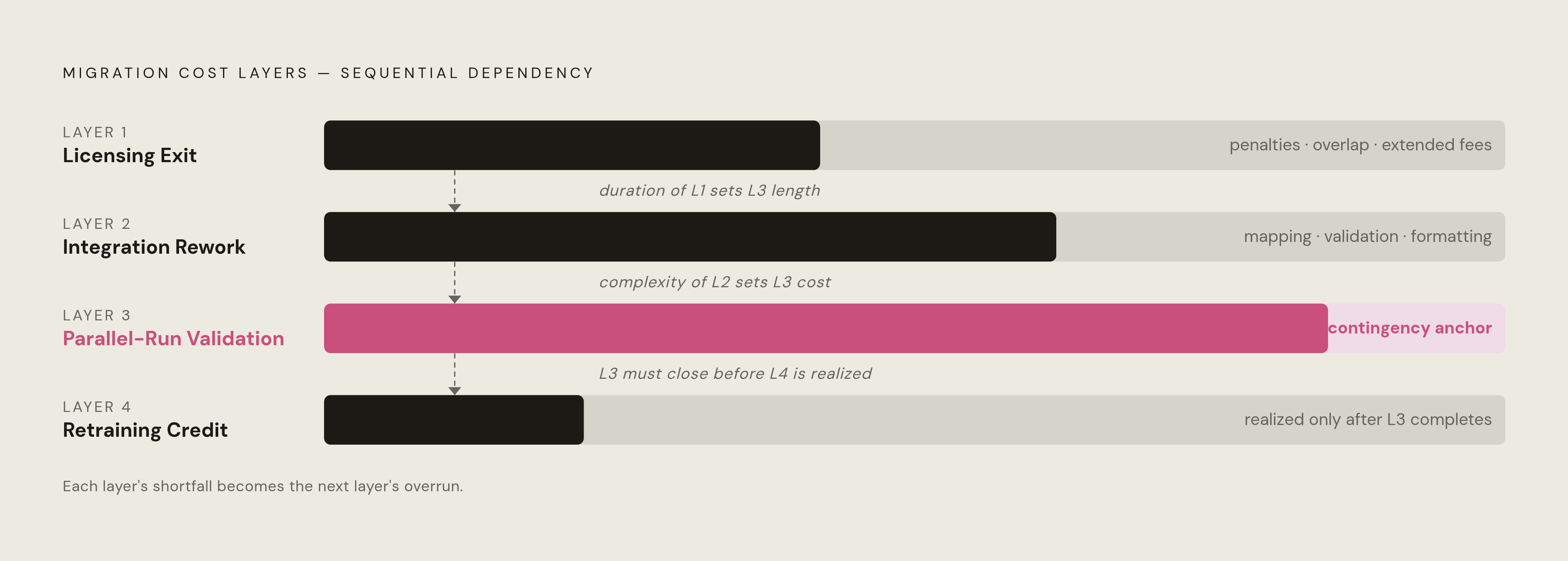
A migration budget built by adding up four separate estimates will be wrong in ways that are predictable in advance. The four layers are sequentially dependent, so contingency has to be sized around the layer carrying the most uncertainty: parallel-run validation.
Most migration budgets break where the layers interact. A team that compresses parallel-run validation to hold down Layer 3 cost runs the risk of discovering, after cutover, that exception rates are higher than anyone expected, and fixing field mapping or routing logic at that point creates unbudgeted Layer 2 rework that wouldn't have existed if validation had run its full course. A team that underestimates integration rework in Layer 2 ends up extending the parallel-run period in Layer 3 to compensate, and that extension stretches out the dual-licensing cost from Layer 1 for however many additional months the parallel run now takes. Each layer's shortfall becomes the next layer's overrun.
Change management, workflow redesign, and staff retraining cut across all four layers simultaneously, and software-centric estimates leave them out constantly. Regulatory compliance adds a further overlay, and its weight scales with how sensitive the documents being processed are. Organizations in healthcare or financial services need audit trail continuity, role-based access controls, and data residency guarantees that hold throughout the transition period, not just once the new system is fully in place. The EU AI Act adds a hard deadline to this calculation: its enforcement obligations for high-risk automated decision systems become applicable in December 2027, and organizations that don't build compliant audit trails into their document pipelines during migration will face retroactive remediation costs once that deadline arrives.
If you apply the retraining-avoided credit from Layer 4 as a recurring annual offset against the annualized cost of Layers 1 through 3, you get a net-present-value estimate of the gross migration figure. Gross cost, calculated without that credit, overstates what migrating actually costs, sometimes by a wide margin, because it ignores the recurring expense the migration permanently removes.
A phased migration built on a correct budget
The four-layer framework isn't just a way to diagnose cost after the fact. It tells a team the order in which to sequence the actual work. Migrating one document class first, validating it completely, and only then expanding to the rest is what keeps the budget controllable, because it keeps the parallel-run risk contained to a bounded scope before the full integration rework budget gets committed.
A 90-day migration of a first document class is achievable as a prove-and-expand pattern, and which document class gets chosen first determines how much rework and risk carry over into later phases. The simplification opportunity that comes up during migration is real and worth taking, but it has to be scoped on purpose. Teams should decide, before migration starts, whether simplification is in scope for the first phase or deferred to a second one.
Platform selection affects how much Layer 2 rework a team is signing up for. API-first infrastructure that supports common SDK languages like Python and TypeScript lets downstream systems consume the new outputs through standard interfaces, cutting integration rework time compared to building custom parsers one at a time. Security and compliance configuration needs to be validated during the parallel-run period itself, not treated as a step that happens after cutover. HIPAA, GDPR, SOC 2, and data residency requirements all need to be confirmed while both systems are still running side by side, so the new system is compliant the day it goes live. For organizations in healthcare or financial services that can't route documents through third-party cloud APIs at all, self-hosted or bring-your-own-cloud deployment options are a requirement, not a preference, and that requirement has to shape platform selection back in Layer 1, before any other cost in the budget gets modeled.
The cost of standing still is not neutral. Every year a legacy system stays in place, its exception rate climbs, its template count grows, and its fixed license cost rises against a declining return. Migration cost, by contrast, is a one-time event with a payback period that can be calculated in advance. Measured against each other, one of these costs compounds and the other doesn't.