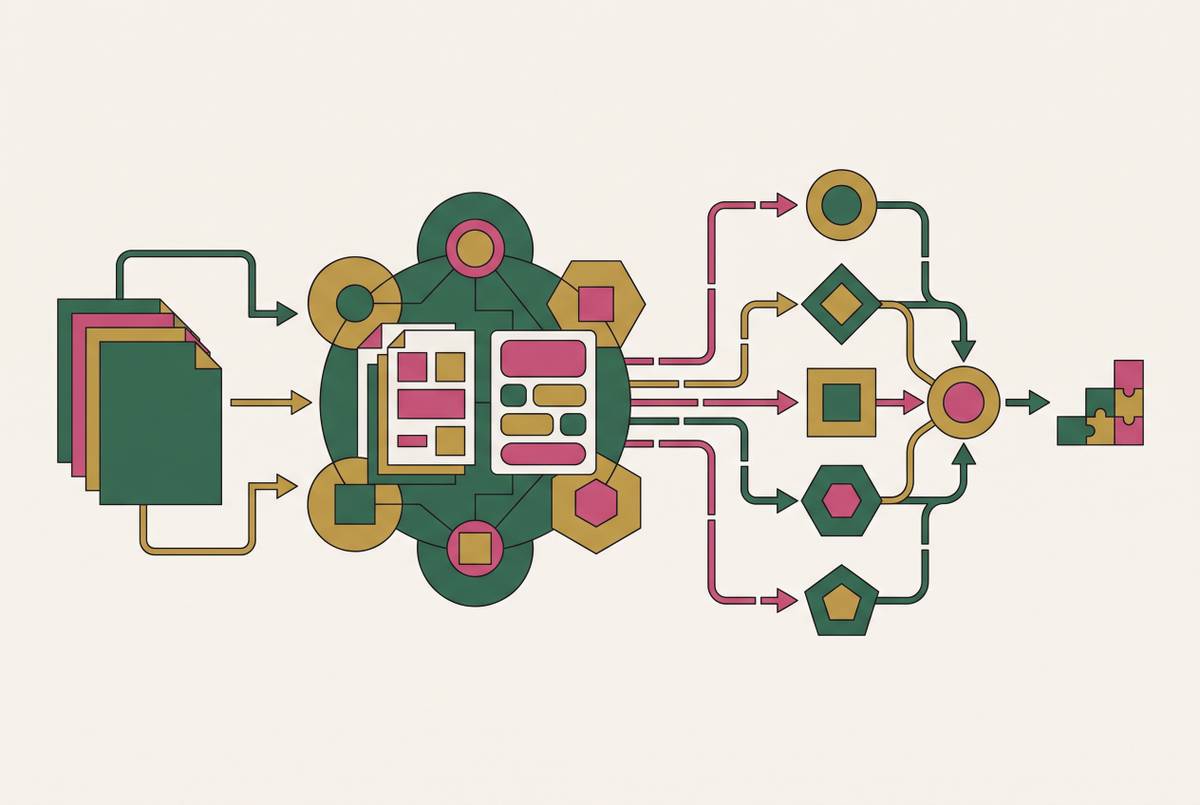
Document Splitting Strategy for Long and Composite Documents
Breaking documents into logical parts prevents extraction errors downstream.

Splitting long documents into their logical parts is infrastructure. It's infrastructure, and if it fails, the rest of a document pipeline produces garbage instead of usable output. The problem sits upstream of extraction, upstream of retrieval, upstream of anything an agent does with the text, and if it goes wrong, everything after it inherits the mistake.
Why long and composite documents break standard processing pipelines
OCR does one job: it turns pixels into text. It reads a scanned page and gives back characters a machine can search and copy. What it cannot do is tell you where one logical section ends and the next one begins. A fifty-page PDF that contains four separate invoices from four separate vendors comes out of OCR as one long stream of words, no different in kind from a single forty-page contract. The text is readable. The structure is gone.
Multi-invoice PDFs stapled together by an accounts-payable clerk, contracts running several hundred pages with exhibits and amendments folded in, loan application packages that mix the application form with pay stubs and a photo ID, clinical case files that combine lab results with referral letters and visit notes, insurance claims where medical records get interleaved with the claim form, and legal discovery packages that dump thousands of pages from a dozen different sources into one export widen this gap the most.
Once a document has been digitized but not split, it functions as a single undifferentiated block. Extraction models don't know which fields belong to which sub-document. Classification models see one blob and have to guess a single label for something that contains five different document types. Any agent downstream, whether it's routing a claim or filling out a loan file, is working from the wrong unit of information.
Two distinct failure modes follow from this, and they call for different fixes. The first is packet segmentation failure: the system never detects that a boundary exists at all, so two or three logically separate documents get treated as one. The second is semantic coherence failure: a boundary does get placed, but it lands mid-section, cutting a document in half and severing context that extraction or retrieval needs intact. A missed boundary and a misplaced boundary are both failures, but they break different things downstream.
Why rule-based and header-driven splitters fail on real documents
Two older approaches have historically been used to attack this problem, and both run into the same wall: production documents.
The first relies on human-engineered textual features, meaning someone sits down ahead of time and decides which patterns in the text signal a boundary, then builds preprocessing around those choices. This works fine right up until the document format changes, the font shifts, or a handwritten form shows up in the batch. Every one of those events breaks a rule that a person had to anticipate in advance, and no one anticipates everything.
The second relies on section-header detection: look for consistent, machine-readable headers and split there. That works when documents are clean and well-formatted. It fails the moment a document is a scanned image with no real header text to detect, a form with no headers at all, or a case where the logical break in the content doesn't line up with any typographic marker to begin with.
Real intake batches throw harder problems at these systems than either approach was built for. Pages from the same document appear out of order, physically scattered through a scanned packet because someone fed a stack into a scanner without checking page sequence first. Two different documents get interleaved with no separator anywhere in between. Some documents simply have no visual or textual signal marking where they end, nothing a rule could latch onto even in principle.
A rule-based system is really just one expert's mental model of what a document should look like, written into code. That model can't generalize across the sheer variation that occurs across inboxes, upload portals, and flatbed scanners run by people with no reason to care about downstream processing. And the cost of getting a boundary wrong isn't a single error. A bad split affects both sides of the incorrect boundary, and each resulting segment then feeds its own extraction error further down the pipeline.
The three distinct sub-tasks that any splitting system must handle
Recent benchmark work, notably DocSplit, breaks the splitting task into three separate capabilities, and treating them as one undifferentiated problem is a big part of why so many systems underperform.
The first is boundary detection: finding where one document stops and another starts. The second is document type classification: labeling each segment once it's been isolated as an application form, an income verification letter, or a photo ID. The third is page ordering, or sequence reconstruction: putting pages back in the right order when they've been scattered or interleaved within the source file.
These are genuinely separate skills, and a system can be strong at one while weak at another. A model might detect boundaries accurately but still shuffle the pages within a correctly identified segment. A model might classify document types well but still miss the boundary between two documents that happen to share the same type, like two invoices from the same vendor stacked back to back. DocSplit's results show that current multimodal large language models don't reliably handle all three together: a system needs all three sub-tasks working in concert, not just one of them working well.
First American Financial's patented approach (US Patents 11,935,316 and 12,217,525) shows how a production system handles this decomposition in practice. Rather than asking one model to do everything, it runs separate models on separate feature streams: separate models on separate feature streams drawn from visual layout, document structure, and OCR text output. Those independent predictions then get combined through an ensemble approach to produce a final start-page and document-type call. The architecture itself is an admission that no single feature stream carries enough signal on its own.
What the classifier outputs is a routing instruction. It's a routing instruction. Whichever document type gets assigned at split time determines which extractor the segment goes to next, which template gets applied, which prompt gets used. Get the classification wrong, and the extraction that follows runs against an entirely different template, one built for a wholly different document type.
Document type and layout complexity's effect on splitting approach
Not every document needs the same treatment, and matching the splitter to the job matters as much as the splitter's raw accuracy. Two things determine which approach fits: what kind of document it is, and how complex its layout is.
Fixed-format, high-volume documents from a known source, like the same invoice template arriving from the same supplier every month, don't need much sophistication. A template-based or pre-trained parser is faster, cheaper, and more predictable than an agentic, reasoning-heavy pipeline, because there's no real variation to account for. Multi-step reasoning adds cost here without adding accuracy, since the format never moves.
Composite packets built from a known, finite set of document classes, like a mortgage file containing an application, income verification, and a photo ID, call for a class-aware splitter trained on that specific taxonomy. Google Cloud Document AI's Custom Splitter is a working example of this pattern: define a schema of classes ahead of time, train (or use a pre-trained) model against it, and route each detected segment to a class-specific extraction processor. The tool's release history reflects an active product line: pretrained-splitter-v1.5-2025-07-14 shipped as a release candidate supporting zero-shot splitting and classification, and pretrained-splitter-v1.6-2026-03-09, along with a Pro variant, was announced in preview on March 23, 2026. Pricing is $5 per 1,000 pages for the Custom Splitter (across a 1 to 1,000,000 page range), against $30 per 1,000 pages for the Custom Extractor that handles what comes after.
Highly heterogeneous packets, where the mix of document types is unknown or changes case by case, such as legal discovery or insurance intake, need something closer to a multimodal LLM-based splitter, one that can reason across visual layout and text content at the same time rather than matching against a fixed schema. Even here, the DocSplit benchmark from Islam et al. found real performance gaps in state-of-the-art multimodal LLMs on shuffled and interleaved test cases. No current model handles all three sub-tasks, boundary detection, classification, and sequencing, reliably at once in this hardest tier. Production systems working this end of the spectrum need a human review step built in, at least on a conditional basis, because the model alone isn't there yet.
Chunking strategy as a function of content type, not document length
Splitting and chunking sound similar and get confused constantly, but they solve different problems. Splitting separates a composite packet into its distinct documents. Chunking takes a document, or a segment already produced by a splitter, and cuts it into smaller units sized for embedding, retrieval, or feeding to an agent. Conflating the two leads to picking the wrong tool for either job.
A defensible pipeline doesn't use one chunker for everything. Code gets a language-aware splitter that respects syntax boundaries, so a chunk never ends in the middle of a function. Markdown gets a heading-aware splitter that respects the document's own hierarchy. Tabular data gets split row by row. Prose gets a semantic splitter, one that looks for drops in embedding similarity between sentences to find where the topic actually shifts. PDFs with mixed content, tables next to paragraphs next to figures, need a hierarchical splitter that can handle more than one content type in the same file.
Semantic splitting outperforms fixed-size chunking on prose, where meaning doesn't line up with character counts, but it loses to document-aware splitters when the content is code or Markdown, where the structure itself is the more reliable signal. No single chunking method wins across every content type, which is the whole point: the right choice tracks the content, not the document's length or its number of pages.
Late chunking is a variant that deserves separate discussion. Instead of splitting text first and embedding each piece separately, the entire document runs through a long-context embedding model first, and only afterward do the resulting token embeddings get pooled into chunk vectors. Every chunk produced this way carries some memory of the whole document it came from, since the pooling happens after the model has already seen everything. That matters for documents where sections reference each other, a contract clause pointing back to a definition three pages earlier, and losing that context at chunk time would otherwise break retrieval.
Confidence scoring and human review in the splitting pipeline
A single missed or misplaced boundary doesn't produce one bad document, it produces two. A single missed or misplaced boundary doesn't produce one bad document, it produces two, since content from the wrong side of a bad split corrupts both segments simultaneously, and each corrupted segment then feeds its own downstream extraction error. That compounding effect is why splitting mistakes are more expensive than extraction mistakes, and why a human review step earns its cost even when the underlying models are good.
The practical pattern is confidence-gated review. One version of it inserts a human check after the splitting model makes its prediction but before the file actually gets split, catching mistakes before they propagate anywhere. A second version uses the model's own confidence score to decide when a human needs to look at all; above some threshold, the split goes through automatically, and below it, a person checks. That threshold isn't arbitrary. It should come from historical data on how often the model is wrong at a given confidence level, set as a business decision about how much error the workflow can tolerate. A third version skips reviewing the split itself and instead routes segments straight to extraction, triggering human review of the original composite document only when extraction confidence comes back low. That third pattern adds complexity to the workflow but cuts down how often a human has to look at anything, since most segments never trigger the low-confidence flag.
Version 1.5 of Google Cloud Document AI's Custom Splitter supports confidence scores directly, which is a concrete signal of where the product category is headed, though it's not a feature every splitting tool on the market currently offers. For a confidence score to actually be useful rather than decorative, it needs historical ground truth showing where the model tends to fail, granularity down to the field level rather than a single document-wide number, and a feedback loop that feeds corrections back into the system instead of just flagging one-off errors for someone to fix by hand.
Structuring the handoff from splitter to extraction and agent layers
A production ingestion pipeline generally runs five stages in sequence: parsing, then splitting and chunking, then embedding and indexing, then validation against a schema and whatever confidence thresholds apply, and finally structured output ready for an agent to act on, with no additional cleanup or field mapping needed at that last step.
The classification label the splitter assigns is the hinge the whole pipeline turns on. Each segment gets routed to whichever extractor matches its document type, and a misclassification at that point doesn't just mislabel one field, it sends the entire segment to the wrong extractor, which then compounds the original error rather than correcting it.
An agentic IDP architecture typically pulls together four components to manage this handoff: a multimodal classifier that handles packet segmentation across mixed document types arriving in a single intake batch, a multimodal LLM extraction module that pulls structured fields out of each segment, an analytics module built to Model Context Protocol standards with sandboxed code execution for anything that needs computation rather than lookup, and an LLM-driven rule validation module that replaces older, fully deterministic rule engines with something that can reason about edge cases rather than just matching patterns.
What an agent actually needs from all of this is structured output it can act on directly. That responsibility sits with the splitting and extraction infrastructure. It's not something that can get pushed downstream for the agent to sort out on its own.
Evaluating a splitting system before production
Academic benchmarks tell you what's achievable on a standardized dataset. They don't tell you whether a given system handles the specific documents a given business actually receives, and that gap is exactly where evaluation on real customer files earns its keep.
DocSplit is the first comprehensive benchmark built specifically for document packet splitting, made up of five datasets of varying complexity that span different document types, layouts, and multimodal conditions. The datasets are public, released on HuggingFace at huggingface.co/datasets/amazon/doc_split. Any team building or buying a splitter can run its own comparison against a known standard rather than relying on a vendor's own numbers.
The benchmark's evaluation dimensions map directly onto the three sub-tasks laid out earlier: boundary detection, classification, and page sequence reconstruction. These need to be measured independently, not folded into one blended score, because a system can look strong overall while quietly failing on just one of the three, and an aggregate number will hide exactly that failure.
Beyond the benchmark numbers, a production evaluation has to surface things a standardized dataset can't: how the system behaves on the specific mix of formats a given operation actually receives, how it degrades on the edge cases that show up in that operation's real intake, whether documents that arrive out of order or interleaved (the failure modes rule-based splitters could never handle) get resolved correctly, and whether the confidence scores it produces actually correlate with real error rates once measured against a business's own ground truth. None of that appears on a leaderboard. It becomes visible once the system is running against the documents it was actually built to handle. Extend, a document ingestion platform that gives AI teams the parsing, splitting, and extraction infrastructure their production pipelines run on top of, publishes open-source benchmarks for exactly this kind of real-world evaluation.
Sources
- DocSplit: A Comprehensive Benchmark Dataset and Evaluation Approach for Document Packet Recognition and Splitting
- RAG Chunking Strategies Guide (2026)
- 12217525
- Custom splitter | Document AI | Google Cloud Documentation
- 11935316
- Build Document Ingestion Pipeline for AI (July 2026) | Extend
- extend.ai
- extend.ai