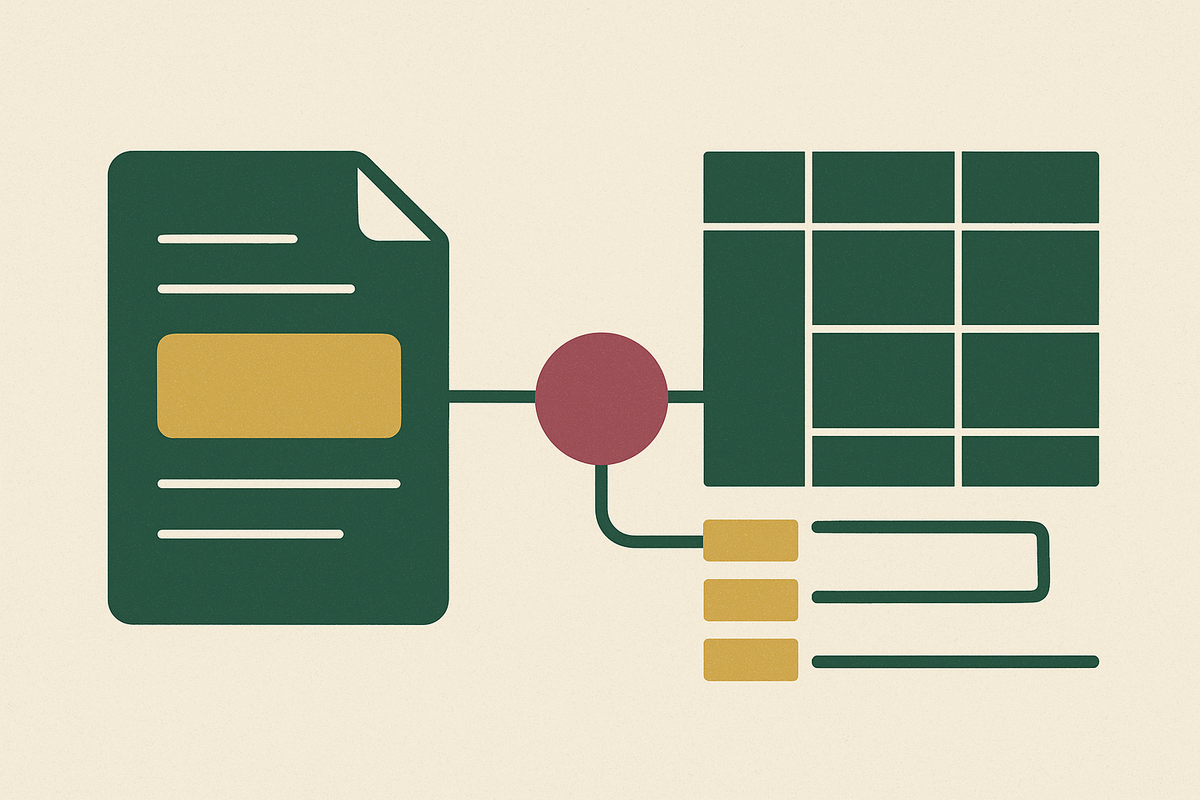
Confidence Score Standards in Document Extraction APIs
Confidence scores only matter if they match real-world accuracy rates in production.

An engineer builds a straight-through processing pipeline and sets an auto-approve threshold at 0.90 confidence. Every field that scores above that line moves downstream, and no human ever looks at it. The assumption built into that threshold is that a 0.90 score means the value is correct roughly nine times out of ten. If the model's scores are not calibrated to that standard, the number means almost nothing: the field could be correct at that confidence level only six times out of ten, or four, and the pipeline has no way of knowing it until something downstream breaks. A score of 0.90 is only meaningful if the field value is correct at that rate in production, not merely at that rate on whatever benchmark set the vendor used to tune it.
That distinction, between a benchmark correctness rate and a production correctness rate, is where calibration either holds or collapses. Box Extract's own confidence score documentation states the target: scores are "calibrated to approximate real-world correctness probabilities. That phrasing matters because it names the standard against which every extraction API's confidence output should be judged, and it is a standard, not a default behavior that comes for free with any model that outputs a number between 0 and 1.
Automated routing, human-review queues, and agent pipelines all treat a confidence score as a probability signal, and they act on that signal without re-verifying it. An uncalibrated score that overstates certainty causes the system to auto-approve fields that should have been flagged for review. A score that understates certainty does the opposite: it floods human reviewers with work they didn't need to do, burning the labor the automation was supposed to save. The gap between what a score claims and what it delivers is what the field calls calibration mismatch: a model can report high confidence on a field and be correct meaningfully less often than that score implies at that threshold. Once that mismatch exists, threshold-based automation generates silent errors at a rate nobody is measuring.
Where Confidence Scores Come From and the Production Gap
Confidence scores arrive at their final number through different mechanisms depending on the API, and each mechanism breaks down in its own characteristic way once it hits real documents.
One documented approach sends the same extraction request multiple times, varying the prompt, the temperature setting, or the subset of fields requested, then aggregates the resulting answers by frequency. If a field returns the same value across every pass, it earns a high confidence score; if it returns different values across passes, it earns a low one. Box Extract documents this method directly: multiple responses are aggregated based on the frequency of distinct values returned per field, and confidence is estimated from that frequency. The method has a specific failure mode: consistency is not the same thing as correctness. If a model produces the same wrong answer across every one of its sampled responses, the frequency-based score reads as high confidence, and the value is still wrong. The score measures how much the model agrees with itself, not how well it matches the ground truth.
A separate, stricter approach uses conformal selective gating, where a field is accepted only if its calibrated probability clears a threshold set on a held-out calibration set. This gives the operator a mathematically provable bound on the error rate within the auto-approved tier, in place of a heuristic cutoff chosen by feel.
The parsing layer sits beneath either mechanism, and its quality bounds everything built on top of it. A confidence score attached to a field pulled from garbled OCR output reflects the model's certainty about a corrupted input, not the correctness of the final value. No scoring method downstream of a bad parse can recover information the parse never captured. For agent workloads, this matters acutely: the extraction API sits between the raw document and the model reasoning over it, and if the confidence signal coming out of that layer is unreliable, the agent has no basis for knowing when to trust what it was just handed. Before adopting any confidence score, an engineer needs an answer to two questions: what mechanism produced this number, and has it been calibrated against a held-out set that resembles the documents it will actually run against in production?
What calibration requires, and how it is validated
Calibration is a property of a model evaluated against a specific population of documents, and that distinction has direct consequences for how much weight a vendor's reported numbers deserve. A vendor's calibration figures are only meaningful to the extent that the vendor's calibration set resembles the documents an engineer actually plans to run through the API. A model calibrated on clean invoices says nothing reliable about its behavior on handwritten intake forms.
In practice, calibration gets validated by plotting confidence scores against observed accuracy on a held-out set and checking whether the two track each other. A well-calibrated system produces a reliability diagram where the confidence curve and the accuracy curve align closely across the score range. A miscalibrated system shows systematic overconfidence or underconfidence concentrated in particular score bands, and those bands are exactly where automated routing decisions go wrong.
Threshold setting has to happen on the documents an engineer actually works with, not on the vendor's internal set. Box Extract's documentation says so directly: "We recommend validating confidence score thresholds against your specific document types and accuracy requirements." Microsoft's Foundry Tools guidance makes a related point from the other direction: when confidence scores come in lower than expected on new document formats, it recommends labeled sample documents to improve analyzer results. Both point to the same conclusion: calibration is an ongoing process tied to the documents in front of the system, not a setting configured once and left alone.
Field-level and document-level calibration are not interchangeable, and conflating them hides real risk. A single document-level confidence score can look well-calibrated on average while individual field scores inside that same document are badly off, because the average smooths over the fields that are actually wrong. Compliance workflows and agent pipelines both need per-field calibration, because the decision being made is almost always about one specific value, not a whole document's aggregate reliability. Foundry Tools reflects this by letting confidence scoring be enabled on all fields through the estimateFieldSourceAndConfidence property, or narrowed to specific fields through the field-level estimateSourceAndConfidence property, which makes per-field granularity a configuration an engineer has to choose, not something the system hands over by default.
Schema complexity degrades calibration on its own, independent of how clean the source document is. Research published in 2026, ExtractBench (arXiv 2602.12247), found that frontier models produce no valid output at all when they hit a large financial reporting schema. That failure is invisible to any benchmark built around small schemas, and it means schema breadth has to be treated as its own calibration variable, tested directly rather than assumed to scale smoothly from a narrow test case.
How calibrated scores should drive routing: thresholds, field risk, and the human-review boundary
A calibrated confidence score earns its value only once it's wired into routing logic that acts on it correctly. The score is the signal that decides whether a field value moves downstream automatically, lands in front of a human reviewer, or gets rejected.
Two separate routing decisions get made in most extraction pipelines, and they should never share a single threshold. Classification confidence confirms whether the system identified the right document type. Extraction confidence answers whether a specific field value, once pulled, is correct. Conflating the two produces a particular kind of error: a wrongly classified document can still produce fields that read as high-confidence, routing a document that should never have entered the pipeline as if it were correctly handled, while a correctly classified document with one genuinely uncertain field gets kicked to review in its entirety. Extraction APIs built for agent workloads tend to separate these explicitly, with a Classify endpoint handling document routing before extraction runs, and per-field confidence scores separately governing what the agent acts on after extraction completes.
Thresholds also need to be weighted by field risk, applied unevenly across a schema according to the cost of a wrong value. A currency total or a regulated identifier carries a higher downstream cost if it's wrong than a free-text vendor name does, so it warrants a stricter auto-approve threshold even within the same document. Microsoft's Foundry Tools documentation lays out the three routing outcomes this logic should produce: auto-approve high-confidence extractions for straight-through processing, route low-confidence results to human review, and reject or flag extractions that fall below a minimum threshold for manual intervention.
Human review only works efficiently if grounding accompanies the score. Source citations that tie each extracted field back to its page location and bounding box let a reviewer see where a value came from, giving the reviewer a quick way to verify it. Compliance workflows depend on exactly this kind of traceability, since every field has to link back to its source so an auditor can reconstruct months later how a value was produced. For agent pipelines, the confidence score functions as the agent's self-check before it acts: an agent reasoning over a loan packet or a clinical record needs discrete values paired with a reliability signal it can evaluate before taking action, and raw text with no score attached gives it nothing to pause on.
Some vendors argue that removing the human from the loop entirely is itself a compliance feature, pointing to privacy risk in regulated environments as the reason. The concern about privacy risk is legitimate, but it doesn't make the calibration problem go away: a model that auto-approves everything without a human gate is unmonitored. A well-calibrated score shrinks the review queue to the fields that genuinely need a second look, keeping the gate in place.
What benchmarks can and cannot tell you about a confidence score's real-world reliability
Standard extraction benchmarks measure accuracy against curated documents, and that's a different thing from what calibration actually requires, which is a known relationship between a score and observed accuracy on the documents a given pipeline actually processes. However strong a vendor's benchmark numbers are, they cannot substitute for testing on a labeled set drawn from an engineer's own pipeline.
The schema-complexity failure described earlier gives this a concrete shape. Production pipelines run into dense forms, large arrays, and complex tables constantly, so the benchmark result that actually predicts production performance is one measured on documents that resemble that mix, not one measured on clean single-page PDFs that look nothing like what the pipeline will actually see.
Benchmarks published by an extraction platform on its own documents carry a built-in limitation: they're not independent evaluations, because the vendor controls both the model and the test set. If practitioners run finalist APIs against the same labeled documents pulled from their own pipelines, they get a more honest signal, measuring field accuracy, grounding quality, and the volume of low-confidence outputs that genuinely require review.
One failure mode that most accuracy benchmarks don't penalize at all is silently dropped rows in large-array extraction. A system that drops some rows from a long table can still report high field accuracy on the rows it did extract, while handing back an output that's corrupted by omission. Benchmarks that only score the fields a system chose to return, without scoring completeness against what the document actually contains, miss this failure, and it is the kind of failure that appears in production but never appears in a vendor's reported numbers.
A sound evaluation protocol follows from this directly. Run the candidate API against a labeled set of documents pulled from the actual pipeline it will serve. You should measure per-field accuracy against ground truth rather than trust the API's own self-reported confidence. You should plot confidence against observed correctness to check whether the two actually track each other across the score range. Measure how large the review queue becomes at each candidate threshold, since that number shows whether the automation is actually saving labor or simply moving it somewhere else.
Criteria for Adopting an Extraction API with Confidence Scores
The right test for any extraction API is not whether it produces a confidence score at all, since nearly every API on the market does that now. The real test is whether that score is calibrated, grounded, available at the field level, and genuinely actionable inside the routing logic being built around it.
Start with the output contract: does the API return a confidence score and a source citation (page, bounding box, source text span) for each individual field, or does it hand back a single document-level score with no way to trace it to anything specific? Foundry Tools requires explicit configuration to turn on per-field confidence and grounding. Confirming the feature exists in the product is not enough; it has to be confirmed as switched on for the fields that matter. Agent-oriented APIs should treat schema-defined JSON with per-field confidence and source citations as the baseline output contract, not as a premium add-on layered on top of a plainer response.
Calibration transparency matters as much as the output format. A vendor should be able to say how its scores are produced and what calibration set they were validated against. If a vendor reports accuracy numbers only against its own benchmark documents and doesn't describe the methodology behind those numbers, it is offering marketing material, not a reliability guarantee an engineer can build a routing threshold on.
Schema breadth needs direct testing. An API should be run against schemas that match the actual field count a production pipeline requires, and if those documents call for dozens of fields, the test needs to happen at that scale, because a model that performs cleanly on a narrow schema can collapse once the field count grows, as the ExtractBench findings on large financial reporting schemas demonstrate.
Check exception handling directly: when a field's confidence falls below threshold, does the API return a structured low-confidence response that still carries grounding information, or does it simply omit the field? Silent omission is the extraction equivalent of a dropped row: a caller receiving no value for a field cannot tell whether that field was genuinely absent from the document or whether the extraction attempt failed.
For regulated documents, the compliance boundary has to be confirmed explicitly: where the processing happens, what the retention policy is, and whether SOC 2 Type II, HIPAA BAA, and GDPR certification are in place as a baseline. Wherever data cannot leave the organization's own environment, self-hosted or bring-your-own-cloud deployment becomes necessary, and compliance workflows also need every field to trace back to its source so an audit can reconstruct how a value was produced.
Total pipeline cost is the last and most commonly underweighted factor. The cheapest per-page rate can turn expensive fast once evaluation tooling, schema mapping, human-review infrastructure, and grounding get added on top of an API that leaves all of that for the engineering team to build. If an API bundles evaluation sets, versioned workflows, and a human-review interface, it can cut the total engineering surface area considerably, even when its quoted unit price looks higher on a spec sheet next to a cheaper competitor.
Sources
- Top 5 Document Extraction APIs
- Valid Per-Field Selective Risk Control for Document Extraction: Three Failure Modes, a Validity Ladder, and When Conditioning Pays
- Beyond Logprobs: A Multi-Signal Confidence Engine for LLM-Based Document Field Extraction
- Knowing When Document AI Is Wrong: Multi-Signal Confidence Calibration for Business Document Field Extraction
- Enhanced machine learning model accuracy through post-hoc confidence score calibration