Document Parsing System Architecture for AI Agent Pipelines
Fixing parsing errors early prevents silent failures downstream in agent systems.
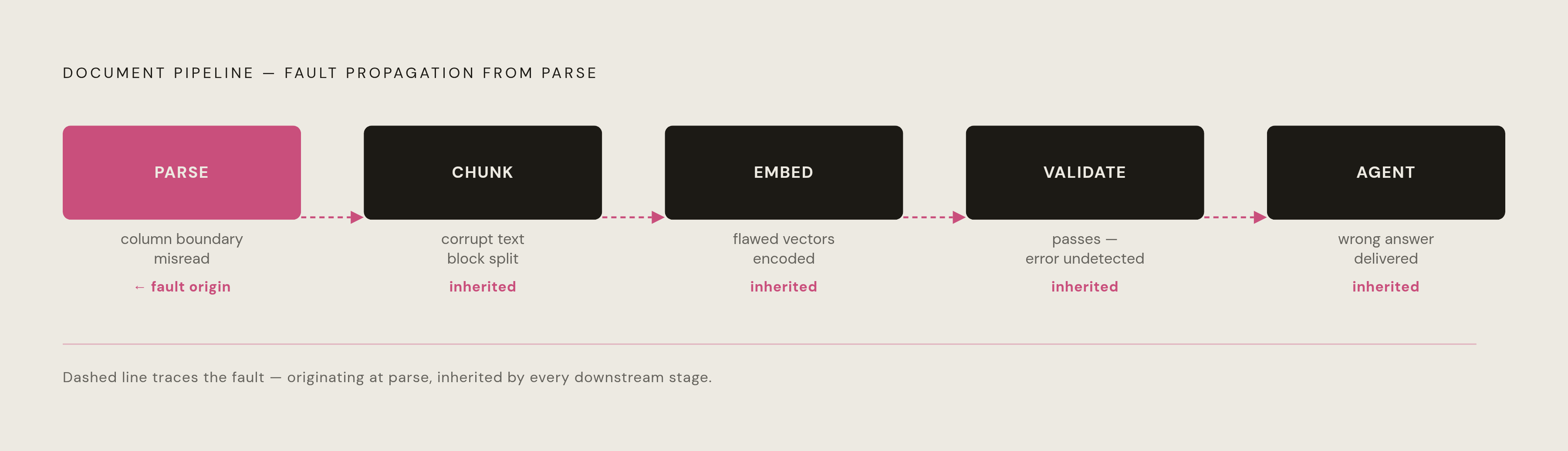
The gap between having a document and having something an AI agent can act on is where most production pipelines quietly fail. A parsing error on page one doesn't stay on page one: it moves through chunking, through embedding, through validation, and lands in front of an agent as a confident, wrong answer. Tables get garbled into flat text, multi-column layouts get linearized into nonsense sentences, scanned pages come back empty. None of that is a volume problem. It's a structural one, and the teams that keep treating it as a tool-shopping exercise (buy a better OCR engine, swap in a newer model) are the ones debugging the same invoice-total error six months from now.
What a production document pipeline looks like: five interdependent stages
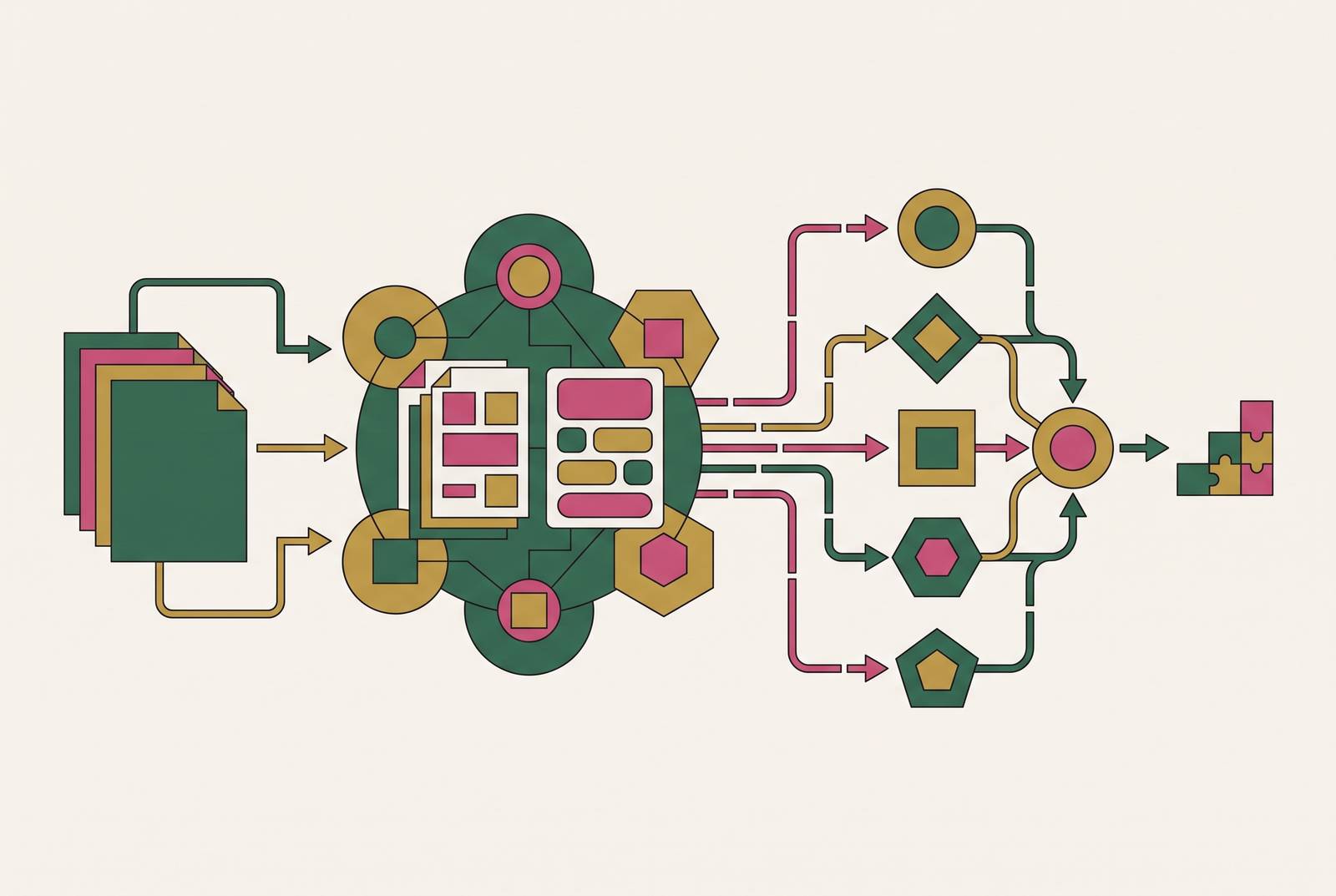
Five stages make up a working pipeline: parsing, chunking, embedding, validation, and agent handoff. Calling them "sequential" undersells how tightly they're coupled. A parsing failure doesn't just weaken extraction, it corrupts it. A weak validation layer doesn't just miss a few errors, it lets bad data walk straight through to the agent, and from there into whatever system the agent touches next.
Skipping any one of these stages, or treating it as optional, means the gap won't announce itself at build time. The gap appears at runtime, in a form that's maddeningly hard to trace back to its source. By the time someone notices the invoice total is wrong, the actual fault, a misread column boundary three stages upstream, sits buried under two layers of transformation.
This is a different problem than the one traditional intelligent document processing was built to solve. Template-based IDP classifies a document against a fixed layout and outputs fields against that template, and that works fine when every document looks the same. It breaks the moment a pipeline needs to reason across pages, cross-reference multiple source documents, validate against business rules, and leave an audit trail a compliance team can actually follow. Agent-facing pipelines need that reasoning capacity built in from the start. Bolting it on after the fact doesn't work, and most teams that try find that out the expensive way.
Cost gets missed early, too, and it cuts in both directions. Real-time throughput for a workload that could batch overnight burns money for no reason. A slow batch process wired into a workflow an agent needs answered in seconds breaks the thing it was supposed to support. If the choice is wrong in either direction, the pipeline runs exactly as designed while failing the business anyway.
Parsing: where layout awareness separates working pipelines from broken ones
Parsing is where most of the damage originates, and multi-page context loss is a common and costly source of it. An extractor that treats each page as its own island will resolve a field reference on page 2, then go completely blind to it by page 5, even though the two describe the same entity. A contract that defines "Lessee" once, on page one, and refers to it by that term for the next forty pages, will confuse an extractor that isn't carrying that definition forward. That's most contracts, not an edge case.
Format fragmentation compounds it. A single ingestion pipeline handling PDFs, Word documents, and scanned images at once is handling three genuinely different kinds of input, with different text layers, different encodings, different display artifacts depending on how the file was generated or scanned. Classic OCR, built to recognize characters, has no concept of any of that.
The real dividing line between a modern parsing layer and OCR from a decade ago is layout awareness: the ability to detect that column A and column B on a page are two separate streams of text, not one continuous, run-on sentence formed by reading straight across the page. Get that wrong on a two-column research paper or a financial statement with side-by-side tables, and every downstream stage inherits a text block that reads like it was shredded and taped back together at random. No amount of clever chunking or embedding fixes that later. The damage is already load-bearing by then.
Why the wrong chunking boundary ruins retrieval before it starts
Once a document is parsed cleanly, it still has to be broken into pieces an embedding model can work with, and the boundary chosen for that break decides retrieval quality before a single query ever runs.
Hierarchical chunking preserves the document's own structure: sections, subsections, clauses, nested as chunk levels that mirror how the document was actually organized. That's the right call for a multi-page contract, where a clause's meaning depends partly on which section it sits under, and cutting that relationship changes what the clause means to a retrieval system.
Semantic chunking groups text by topic or meaning instead of by fixed length or formal structure, and it fits heterogeneous documents better: ones where section length swings unpredictably and a rigid, structure-based split would cut straight through the middle of an idea. Neither approach wins by default. Pick hierarchical chunking for a pile of loosely structured emails, or semantic chunking for a rigidly formatted legal filing, and the failure just comes from the opposite direction.
Getting the boundary wrong, in either approach, causes damage that becomes visible later, at retrieval time, when an agent queries the index and gets back a partial thought instead of a complete one. The query still returns something. It's just missing the second half of the sentence that would have made it useful, and there's no error message for that, only a worse answer delivered with the same confidence as a good one.
None of this gets decided in isolation from the embedding model, either. Its context window and the indexing strategy sitting on top of it determine which chunks actually surface when an agent asks a question. Chunking and embedding are one decision, not two: a chunking strategy tuned for one embedding model can quietly underperform on another, and nobody notices until retrieval quality drops for reasons that look unrelated to either piece.
Five tool-calling patterns that determine how agents interact with document APIs
Once a document is parsed and indexed, an agent still needs a way to call the tools that pull structured data out of it, and the pattern chosen shapes both cost and reliability.
Parallel fan-out lets multiple extraction calls run concurrently, cutting wall-clock time when a document has many independent sections to process at once. The speed comes with a catch: results have to be merged back into a single, document-scoped context, or the agent ends up holding fragments that contradict each other across segment boundaries.
A router pattern has the agent classify the document type first, then dispatch a type-specific extraction schema. This is what lets a single agent handle a mixed queue, W-2s, pay stubs, bank statements, instead of standing up a separate pipeline for each document type.
Retry-with-fallback lives or dies on classifying the failure correctly before deciding what to do about it. A transient error, a timeout, a rate limit, earns exponential backoff with jitter and another attempt. A structural error or a low-confidence extraction earns none of that: it should skip the retry loop entirely and go straight to a human reviewer. Retrying a bad parse just produces the same bad parse again, slightly slower, and teams that retry everything by default end up paying twice for one failure.
Human-in-the-loop routing sends low-confidence fields to a review queue before they reach any downstream system, and that logic belongs in the orchestration layer, sitting above the extraction tool, not buried inside the tool itself. Buried in the tool, it only applies to whichever tool happens to call it. Sitting in orchestration, it applies the same way no matter which extraction path produced the result. That distinction alone decides whether a review policy actually holds across an entire pipeline or just protects one corner of it.
Validation architecture: the three checkpoints that stop errors from compounding
Confidence scores are the first checkpoint: numerical values, typically running from 0 to 1, quantifying how certain the system is about a given extracted field. A high score clears the field for automated processing. A lower score routes it to a person before it goes anywhere else.
Fields that skip this checkpoint don't cause a crash. They cause something quieter and more dangerous: silent data corruption, visible weeks later inside a business system with no trace back to the parser that produced the bad value. That's worse than a visible failure, because nobody knows to go looking for it until the damage has already spread downstream.
The second checkpoint is business-rule validation, and it catches what confidence scores structurally cannot. A field can be extracted with high confidence and still be wrong in context. Total must equal the sum of the line items. Invoice number must not duplicate one already on file. These are semantic checks that live at the agent level, evaluating extracted data against the rules of the business process it feeds into. The parser has no visibility into that context, and asking it to catch these errors means asking the wrong layer to do a job it was never built for.
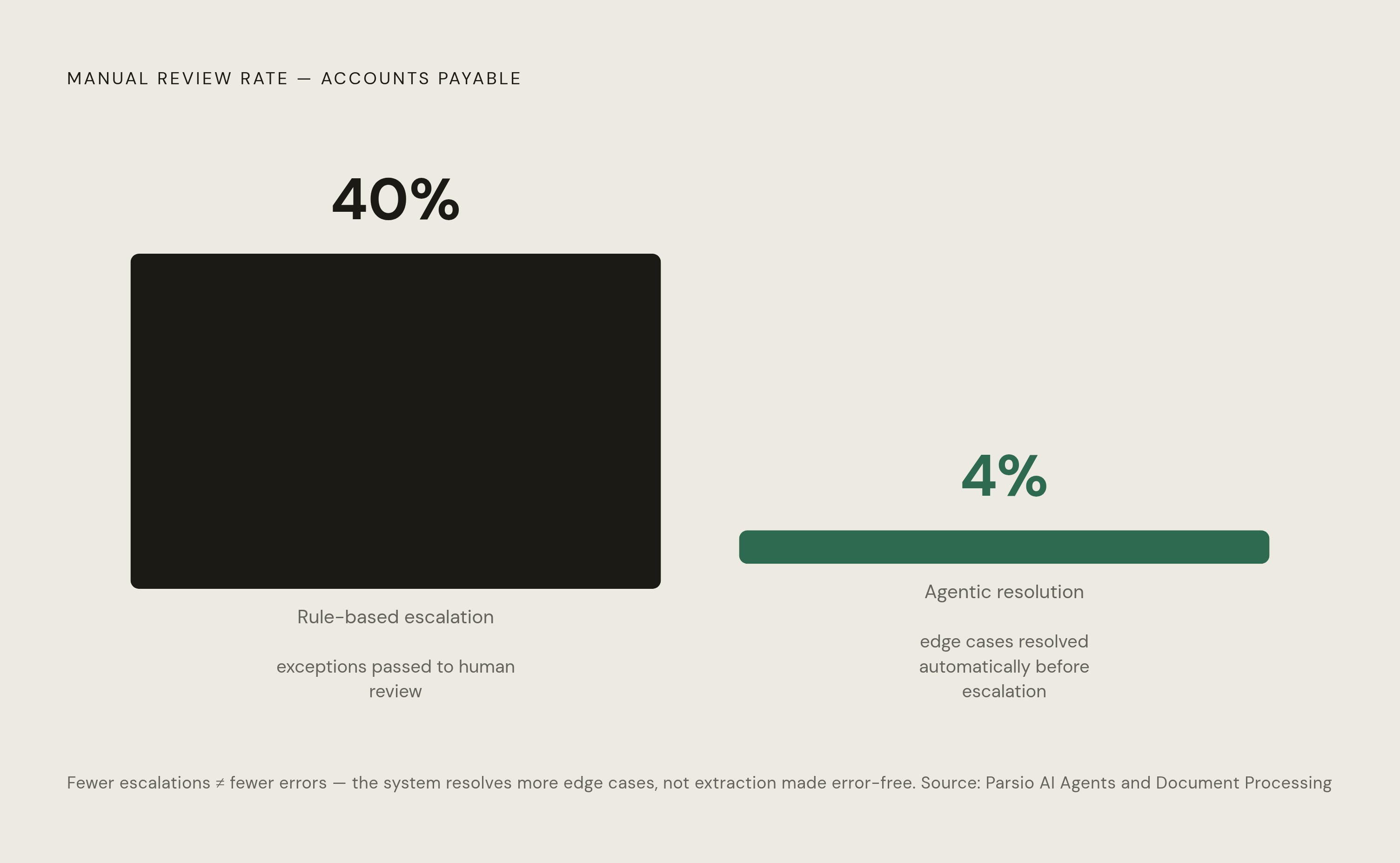
The third checkpoint is the escalation path itself, and its effectiveness is visible directly in the numbers. According to the Parsio AI Agents and Document Processing blog, one accounts payable team dropped its manual review rate from 40% to 4% after moving to an agentic approach. Reading that as proof extraction became flawless misses the actual mechanism. It happened because the system got better at resolving edge cases on its own, before they ever needed a human. Fewer escalations, not fewer mistakes, is the real achievement here, and conflating the two is how teams end up disappointed by a system that's working exactly as intended.
Agent handoff: what "structured output" requires for agents to act reliably
"Structured output" gets used loosely, but a handoff an agent can actually act on reliably requires a few specific things, and most pipelines are missing at least one of them.
Typed schemas need field-level confidence scores embedded directly in the response JSON, so the agent reads reliability off the object itself instead of guessing at it after the fact. Cross-page entity references need resolution before the handoff happens, so the agent reasons over one coherent representation of the document rather than a stack of page-isolated fragments it has to stitch together on its own. Field identity can't carry residual ambiguity, either: an agent should never have to infer whether "amount" refers to a line-item total or the invoice total as a whole. That kind of ambiguity is trivial to a person skimming the page and lethal to an agent acting on it, because the agent acts confidently on the wrong number rather than pausing to ask.
Where the downstream goal is to trigger an action, update a record, match a purchase order, approve a payment, agentic architecture handles that chain of steps more reliably than a brittle integration script wired together for one specific case. Scripts break the moment the input deviates even slightly from what they were written for. An agent working from a clean, typed handoff has room to reason about the deviation instead of failing on it.
Where hybrid routing outperforms a purely agentic pipeline
Running everything through an agentic pipeline out of enthusiasm for agents is a mistake. Most documents don't need an agent reasoning over them, they need a fast, cheap, deterministic path, and the architecture that actually holds up in production is hybrid: predictable volume goes down the cheap route, and the agentic path stays reserved for the minority that carries real variance.
Four situations justify the extra cost of that agentic path. High document variety is one: documents arriving from many different senders with no stable, shared template. Validation-heavy workflows are another, accounts payable, insurance claims, compliance review, where extraction has to be cross-checked against business rules before anyone can trust it. A persistently elevated manual review rate signals that simpler extraction methods aren't resolving enough edge cases on their own. And workflows where extraction has to trigger a downstream action in another system benefit from an agent's capacity to reason through that chain rather than snap at the first unexpected input.
The counter-case matters just as much, and it isn't a small one. A stable, high-volume document type from a known source, the same invoice format from the same supplier every month, runs faster, cheaper, and more predictably on a template-based or pre-trained parser. There's no variance to handle there, so the extra reasoning capacity an agent brings earns nothing. It's overhead sitting on top of a problem that doesn't exist, and paying for it anyway is the mistake teams make when they treat "agentic" as a default setting instead of a decision.
Exception handling on the agentic side has gotten more sophisticated, too. Traditional systems escalated to a human the moment confidence dropped below a fixed threshold, no exceptions, full stop. Agentic systems try harder first: checking whether the same value appears elsewhere in the document, comparing it against a known pattern, before giving up and routing to a person. That's a different failure mode entirely, one that resolves more cases automatically without lowering the bar for what counts as acceptable confidence.
How benchmarks reveal what accuracy claims on production documents mean
Accuracy claims on production documents are only as good as the benchmark behind them, and most vendor claims lean on benchmarks that measure something narrower than what they're implying. A number without its test conditions attached tells you almost nothing.
OmniDocBench, accepted at CVPR 2025, covers 1,651 PDF pages across 10 document types and 5 layout types, with 28 block-level annotations. It scores text with Normalized Edit Distance, tables with Tree-Edit-Distance-based Similarity, and formulas with CDM. It was updated to version 1.7 in April 2026, adding Multi-Granularity Adaptive Matching specifically to cut matching bias in how results get scored. Even so, a February 2026 post from within the field, bluntly titled "OmniDocBench is Saturated, What's Next for OCR Benchmarks?", flagged that top-performing models are now converging near the benchmark's ceiling. That's a sign the benchmark is running out of room to tell a genuinely better system apart from one simply tuned to its quirks.
olmOCR-bench takes a different approach entirely, built around breadth of input diversity rather than depth on a single document type. Its 1,403 PDF files span seven category splits: ArXiv math, old scans of math content, tables, old scans generally, headers and footers, multi-column layouts, and long stretches of tiny text. Where OmniDocBench pushes for precision across a fixed set of document types, olmOCR-bench tests whether a system holds up across genuinely different failure conditions.
What both benchmarks share is the lesson that actually matters: a headline accuracy number means very little without knowing which documents, which layouts, and which failure modes it was measured against. A parser that scores well on clean, single-column PDFs and falls apart on a two-column scanned form is being measured on a test that doesn't resemble the documents it will actually meet in production. Mistaking that score for a guarantee is where most procurement decisions on this go wrong.