Data Retention and Sovereignty Standards in Document AI APIs
APIs that process documents trigger data transfers, not just storage compliance obligations.

Document AI compliance is routinely treated as a data-at-rest problem, a matter of where files sit once they land in a database or object store. That framing misses the actual event that creates legal exposure: every API call that sends a document for parsing, extraction, or classification is an active international data transfer, not a storage event. This distinction carries real weight under GDPR Chapter V, because its restrictions on cross-border transfers attach to processing, not just to storage. When a claim form or a loan application passes through a hosted inference endpoint, it triggers transfer obligations the moment the document leaves the enterprise's control, no matter where the resulting output eventually gets stored.
Document pipelines rarely involve a single processing event, which compounds the exposure. A typical workflow can chain OCR, parsing, extraction, embedding, and classification together, and each stage is its own distinct processing event, each capable of touching PII, PHI, or financial records in plaintext as it passes through. An enterprise that audits only its final storage layer has accounted for one link in a chain that might have five or six, each a separate point at which sensitive data crosses a boundary it cannot easily see.
Whether each of those transfers is compliant depends on the architecture of the API itself, not a policy document or a vendor's marketing page. A privacy policy can promise anything; what matters is whether the system that actually moves the document from the enterprise's environment into an inference endpoint was built to satisfy the transfer, residency, and retention obligations that apply to it. That is the problem this piece works through: not whether a vendor says the right things, but whether the underlying architecture can prove them.
The three legal concepts teams conflate
Much of the confusion around document AI compliance traces back to three legal concepts that get treated as interchangeable when they are not. Data residency, data localization, and data sovereignty describe three different things, and choosing a European data center satisfies, at most, one of them.
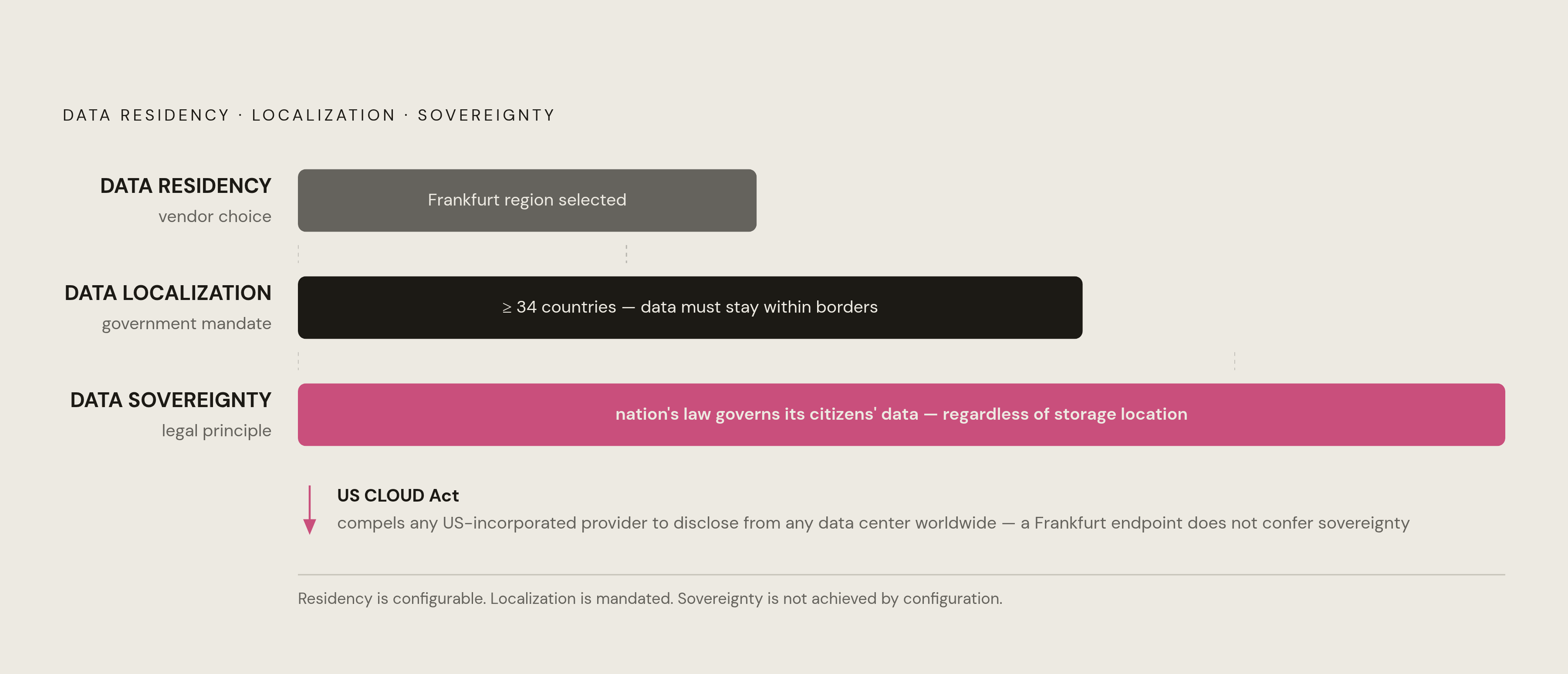
Data residency is simply a vendor configuration choice: where data is physically stored and processed. Selecting a Frankfurt region endpoint is a residency decision, nothing more. Data localization works on a different level entirely: it is a government mandate requiring that specific categories of data stay within national borders. At least 34 countries have enacted or strengthened data localization requirements that restrict where AI processing can occur, with Russia and China enforcing some of the strictest regimes. India's DPDPA does not itself impose a general data localization requirement, but India maintains sector-specific localization rules through the RBI and other regulators, and several EU member states layer their own sector-specific rules on top of GDPR.
Data sovereignty is the concept most teams get wrong, and it is the legal principle that a nation's laws govern data collected within its borders or about its citizens, regardless of where that data is physically stored. An American cloud provider's European data center does not give you data sovereignty under EU law. If the provider is US-incorporated, the US CLOUD Act allows US authorities to compel disclosure of data stored anywhere in the world, including EU data centers. An engineering team picks a Frankfurt region, concludes the data "stays in Germany," and ships to production believing sovereignty has been achieved. It isn't: CLOUD Act exposure survives that decision because a provider's legal domicile determines sovereignty, not the geography of the data center it operates. That exposure has to be assessed for every cloud provider touching an AI workload, since a US legal domicile means US authorities can compel disclosure from any of that provider's data centers, EU ones included. This is the fact that makes self-hosted and BYOC architectures necessary rather than optional, a point the rest of this piece builds toward.
The regulatory frameworks that directly constrain document AI API architecture in 2026
Each major compliance framework imposes a distinct type of architectural requirement, and a document AI provider that cannot satisfy all of them at once is not usable across regulated industries, full stop on the industry, not on the provider's other merits.
GDPR Chapter V treats any document that holds EU personal data and passes through inference as a restricted international transfer. Standard Contractual Clauses remain an available mechanism, but they require supplementary measures, and the legal basis for each transfer has to be documented. Articles 44 through 49 restrict transfers of personal data outside the EU unless the destination country has an adequacy decision, SCCs are properly in place, or a specific derogation applies. The EDPB's report on large language models found they rarely meet the GDPR standard for true anonymization, so data sent to a third-party model may not be recoverable when a data subject access request comes in. The architectural implication follows directly: a document AI API has to be able to produce, on demand, the specific legal basis under which any given EU-origin document was transferred for processing.
The EU AI Act works differently. For high-risk AI systems, data governance obligations attach to the enterprise deploying the system, not to the model vendor supplying it. Article 10 requires providers of high-risk AI systems to implement data governance practices covering training data collection, bias examination, and documentation of data gaps, and that obligation cannot be delegated to an LLM vendor by contract alone. High-risk categories under Annex III include AI used in credit scoring, employment decisions, and access to essential services, while AI embedded in medical devices is classified as high-risk through a separate route under Annex I and Article 6(1), covering AI that functions as a safety component of, or is itself, an EU-regulated product requiring third-party conformity assessment. Those categories overlap directly with document AI workflows in finance, healthcare, and HR. The architectural implication: the deploying enterprise, not the vendor, needs documentation infrastructure built into the pipeline from the start.
HIPAA applies data minimization and de-identification requirements to any agent or pipeline that accesses protected health information. A business associate agreement is required from every vendor that touches PHI, and minimum necessary access has to be enforced at the API level itself, not just in a policy document sitting beside it. The architectural implication is an access control layer granular enough to enforce "minimum necessary" at the level of individual API calls.
SOC 2 requires documented controls across five Trust Services Criteria: security, which is mandatory, and availability, processing integrity, confidentiality, and privacy, which are optional depending on scope. For document AI APIs, satisfying SOC 2 means audit logging of data flows, enforced access controls, and a demonstrated incident response process, not a checkbox a vendor fills in on a sales call. The architectural implication is logging infrastructure built to produce evidence, a requirement the final section of this piece treats in full.
Zero data retention as the first architectural requirement to verify
Zero data retention is often treated as a privacy marketing phrase, but it names a specific technical commitment: documents submitted for processing are never written to disk, cached, logged, or used for model training once the inference call completes. For document AI, the risk this commitment addresses is asymmetric compared to most other API traffic. A single document sent for extraction may contain entire pages of PHI, PII, financial records, or proprietary contract terms, so the retention of even one request creates a data subject access problem and a potential breach surface, not a marginal increase in exposure but a qualitatively different one.
Verifying a zero-retention claim means checking that it covers three retention events a vendor's top-line statement will rarely mention on its own. The first is training data ingestion: some providers, particularly at free or consumer API tiers, reserve the right to use API inputs for model improvement unless an enterprise explicitly opts out, and some consumer-tier training data can be retained for several years. At paid and enterprise tiers, training on customer data is generally off by default, and retention is typically bounded to a period covering abuse monitoring rather than indefinite storage, but "generally" and "typically" are not the same as contractually guaranteed, and that gap is what an enterprise compliance review needs to close. The second hidden retention event is content moderation and safety filtering: providers may route content through safety classification systems located in different regions from the primary processing pipeline, even when that primary processing is itself region-locked, which quietly reintroduces a cross-border transfer the enterprise believed it had eliminated. The third is logging and debugging: engineering teams at the vendor may access API logs for routine troubleshooting, and a zero-retention commitment that doesn't explicitly name these intermediate logs leaves a gap large enough to defeat the whole policy.
A credible zero data retention policy has to address all three of these events explicitly, be written into a binding contract rather than left in a privacy policy that can change unilaterally, and be auditable, with the provider able to demonstrate the commitment in a SOC 2 report or an equivalent independent attestation. Anything short of that is a claim an enterprise cannot verify and therefore cannot rely on.
Data residency controls and BYOC deployment closing the gaps zero retention leaves open
A genuine zero data retention policy keeps documents from being stored, but inference can still run on infrastructure that exposes the enterprise to legal liability. Even a provider that never writes a document to disk can still expose an enterprise to CLOUD Act liability and GDPR Chapter V violations if the inference itself runs on US-incorporated infrastructure. The data is processed there whether or not it is ever stored there, and processing is what both frameworks regulate.
Data residency controls for document AI have to cover the location of inference compute, not just the location of output storage. An enterprise needs to know two things about every provider running inference on its documents: the physical data center region, and the legal domicile of the company operating it. The first answers a residency question; only the second answers a sovereignty question.
BYOC, or Bring Your Own Cloud, deployment addresses CLOUD Act exposure directly by running the provider's models inside the enterprise's own cloud account and virtual private cloud. Because the compute environment is controlled by the enterprise rather than the vendor, the vendor never takes custody of the data, so its legal domicile no longer governs it. Self-hosted deployment goes a step further still: model weights, the inference engine, and all intermediate outputs run entirely inside the enterprise's own perimeter, with no external API calls made during inference and network egress blocked at the OS or firewall layer, so prompts and outputs never leave local memory or encrypted local storage.
The tradeoff between the two is practical. Self-hosted deployment delivers the maximum available sovereignty, but it shifts the operational burden of model maintenance, scaling, and ongoing accuracy improvement onto the enterprise itself. BYOC paired with a capable vendor delivers most of the sovereignty benefit while leaving that operational burden with the vendor. Which one an enterprise should choose depends on the sensitivity classification of the documents involved and the internal capacity it has to absorb infrastructure operations. Evaluating either option means checking four things: that model weights and outputs are stored within the required jurisdiction, including the input data; that no subprocessor dependency quietly reintroduces an external data flow during inference; that deletion guarantees are documented for any intermediate artifact the pipeline creates; and that the full data flow, from user input through model output to storage, including any intermediate caching or logging step, is written down. Residency and BYOC close the sovereignty gap that zero retention leaves open, but neither one is sufficient on its own without the contractual and logging controls the next section covers.
The logging and audit trail requirements that compliance frameworks specify
Controlling where inference runs keeps processing within the right legal jurisdiction, but an enterprise also has to be able to prove what happened during processing, and that is a logging requirement, not a deployment requirement. Audit logging for document AI is not the same discipline as application logging. Compliance frameworks call for immutable, structured records that capture what data entered the system, what processing occurred, and what was returned, retained for the sector-defined window the enterprise controls.
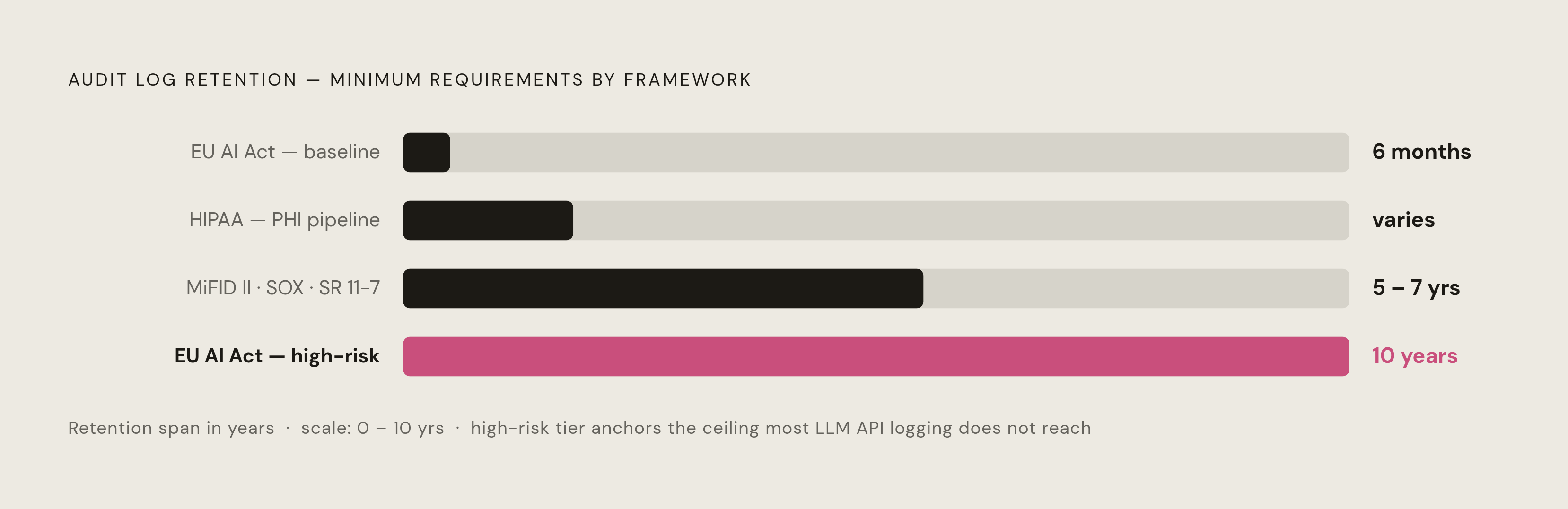
The EU AI Act spells this requirement out for high-risk systems. Logging has to be built into the system architecture itself, automatically capturing events relevant to identifying risks and material modifications, and retained for at least six months, with longer periods applying where other Union or national law demands it. Sector rules on top of that baseline push retention windows much further out. Finance, under MiFID II, SOX, and SR 11-7, requires five to seven years of audit trail for any data feeding regulatory reporting. Healthcare, under HIPAA, requires retention timelines specific to any pipeline accessing PHI. High-risk EU AI Act systems are at the far end of the scale, with logs retained for at least 10 years under the regulation's most demanding tier.
Most off-the-shelf LLM APIs don't give you the logging, lineage tracking, and deletion capabilities a compliance audit expects, because their logging infrastructure was built to support internal debugging, not customer-controlled audit trails. That gap is not a minor configuration shortfall: it means an enterprise relying on such an API may be unable to produce the records a regulator asks for, even if every other architectural control, zero retention, residency, BYOC, is in place. Logging turns the rest of the architecture into something an enterprise can prove, and it is the requirement most likely to be missing from a provider's default offering.