Extraction API Design Patterns for Agentic Document Workflows
Four design patterns prevent quiet failures in AI document workflows.

Extraction failures in agentic pipelines and extraction failures in batch jobs are not the same category of problem, even though both start with a document and a wrong field. Agentic document workflows need four specific design patterns to work in production: schema-guided output, per-field confidence scoring, deliberate handling of large arrays, multifile coherence, and retry loops built to route failures to the right place. None of these are optional refinements. Each one closes a failure mode that the others cannot catch on their own, and a pipeline missing any of them will eventually produce a confident, wrong answer that nobody notices until it costs something.
Extraction failures: agentic pipelines vs. batch jobs
A batch job that mis-extracts a field tends to announce itself. A malformed date throws an exception, a missing total trips a validation rule, and a human picks up a ticket before the bad value goes anywhere. The failure is loud because the job was built to stop and wait for someone to look at it.
An agent built on the same bad extraction doesn't stop. It reasons over the field as though it were true, decides a next step based on it, calls a tool, and sometimes passes the value along to another document in the same workflow. The shift from template-based intelligent document processing to LLM reasoning loops changes what failure looks like: a template pipeline fails loudly when a document deviates from the template it expects, while an agent pipeline fails quietly, producing a plausible-sounding downstream action built on a number or a name that was never there. Each additional reasoning step the agent takes on top of that value multiplies the blast radius of the original error, because nothing in the loop was designed to ask whether the input it started from was correct.
ExtractBench, published in July 2026, sorts the failures driving this into three categories: long-list completeness, where rows get truncated, duplicated, or merged; needle-in-haystack retrieval, where the right target gets missed or the wrong occurrence gets pulled; and dense-document extraction, where fields get over-extracted or mislabeled. None of these are OCR failures. A document processing step can read every character on the page correctly and still hand the agent a truncated array or a mislabeled field. OCR accuracy by itself tells a team almost nothing about whether an agent built on top of that output will behave reliably. ParseBench, also from 2026, states the shift directly: the bar for a parsing and extraction system has moved from being good enough to read to being reliable enough to act on. The rest of this piece is about what it takes to clear that second bar.
Schema-guided output as the foundation for every other pattern
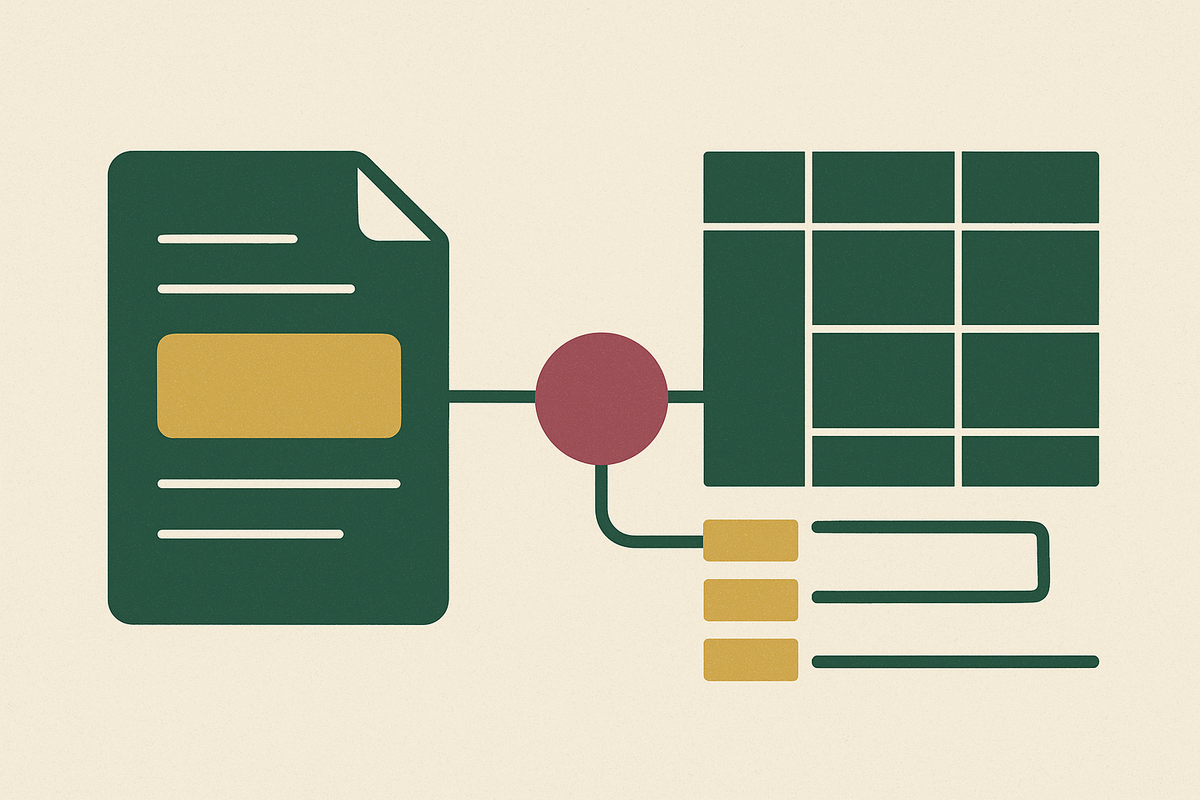
Schema-guided extraction means giving the extraction API a user-defined JSON schema and requiring the output to conform to it: every field the schema names gets populated or marked null, and nothing arrives that the schema didn't ask for. ExtractBench defines the extraction task in exactly these terms. Given a document and a user-defined schema, the system has to return schema-valid JSON with correct values, every record of each repeated structure present, missing fields marked null instead of invented, and source evidence attached to each value. That definition does double duty: it specifies what correct output looks like, and it specifies what a system is not allowed to do when it doesn't know an answer, which is guess.
A single invoice schema has to cover invoices from every vendor an agent might encounter, regardless of how each vendor lays out its own paperwork. The schema is shared across the whole document type rather than tuned to one template, which is the property that makes it useful to an agent operating on documents it hasn't seen before.
Without that contract, an agent is left working with raw block primitives or undifferentiated text, and it has to build its own mapping from that output to whatever data model its reasoning depends on. That mapping work doesn't disappear when there's no schema. It moves into the reasoning layer, where it happens invisibly, can't be tested the way a schema validator can be tested, and fails in ways nobody can trace back to a cause.
Schema versioning follows directly from this. When a schema changes, extraction behavior has to change in a traceable way across every document it touches, not drift document by document until nobody can say which version of the schema produced which output. And everything described in the sections that follow, confidence thresholds, retry routing, multifile coherence, depends on having a stable set of named fields to operate on. None of those patterns are possible without the schema in place first. The schema isn't one feature among several; it's the interface contract between the document and everything the agent does with it afterward.
Uses for per-field confidence scores in an agent reasoning loop
A schema tells an agent what shape the output takes. It says nothing about whether any individual value in that output can be trusted, and that's the gap confidence scoring closes. Per-field confidence scores, paired with citations back to the source document, give an agent a way to check extraction quality before it acts on a value, which turns what would otherwise be a binary pass or fail into a threshold a team can tune field by field.
Consider a loan amount pulled from a scanned application and a closing date pulled from the same form. If the loan amount comes back with high confidence and the closing date comes back low, a well-built agent proceeds on the loan amount immediately and routes the closing date to a retry step or a human review queue, without holding up the rest of the workflow waiting on a field that was never in question. The document processing API guide frames citations and traceability (bounding boxes, source text, confidence signals, evaluation sets, review queues) as the mechanism that decides whether a team can audit an output and correct it when it's wrong. Without a confidence signal, an agent has no way to tell a value it extracted reliably from one it hallucinated or truncated, because both appear as identical strings sitting in the same JSON field.
ExtractBench scores grounding at two separate levels, word-level bounding box and page-level, because visual grounding and traceability make agent-powered extraction usable at production scale. Confidence has to live at the field level rather than the document level, because a single document routinely contains high-confidence header fields sitting next to low-confidence table rows, and a document-wide aggregate score hides exactly the rows an agent shouldn't be acting on. ParseBench's 2026 results point to one of the clearest versions of this problem: a misaligned table header can produce a wrong value sitting in a field that looks, at the document level, like it populated correctly. Field-level confidence is the only way to catch that kind of error before it reaches the agent's next decision.
Why large-array extraction requires explicit design, not incidental handling
Confidence scoring catches uncertainty in a field that got extracted. It does nothing for a row that never got extracted at all, and that's a different and worse class of failure. Silent row truncation in long arrays is a failure mode that standard extraction passes, and the demo documents teams use to evaluate extraction APIs, tend to conceal, because demo documents are usually short enough that truncation never has a chance to occur. In an agent workflow the result is worse than a visible error: the agent receives a JSON array that looks complete, parses without complaint, and is quietly missing rows the agent has no way to detect, because a missing row doesn't arrive as a low-confidence entry. It simply isn't there.
The design response has to treat array completeness as part of the contract rather than a tuning parameter to adjust after the fact. The schema itself needs to specify that a repeated structure is exhaustive, and the confidence layer needs a way to flag when a completion rate for that structure looks suspect, the same way a field-level confidence score flags a questionable value. An agent working through financial line items, clinical trial records, logistics shipment rows, or lease schedules depends on the full list being there. A truncated array in any of those contexts doesn't just produce a smaller number. It produces a miscalculation or a compliance gap, and because the array looked complete going in, the agent's downstream reasoning amplifies the gap.
Multifile coherence and the extraction contract for loan packets, claim files, and clinical records
Everything up to this point assumes a single document. Real agent workloads rarely offer that convenience. The data an agent needs usually sits scattered across a bundle of related files, and extracting each file in that bundle separately forces the agent to resolve the connections between files on its own, reconciling a name on one form against a name on another. That is precisely the kind of fragile glue code a well-designed extraction API exists to eliminate, not hand back to the team building on top of it.
A loan package with pay stubs and bank statements, or a claim file containing the policy, the incident report, and supporting receipts, has to be extracted in a single pass so that fields referencing each other resolve into one coherent result. Without that, the agent is left acting on fragments it has to reassemble itself. Multifile coherence is not the same operation as running separate single-file extractions in parallel and concatenating the outputs afterward. True coherence means context gets shared across the entire file set, so a borrower's name on a pay stub gets checked against the same name on a bank statement and on the loan application itself, inside the extraction step. An extraction API with native multifile support takes the whole file set in as one run and treats it as one related object; an API without that support processes one document per call and hands back block graphs that a team then has to map and stitch together by hand.
Mortgage origination is a clear case: pay stubs, bank statements, and the application need to resolve into one borrower profile, and an income mismatch across those documents is a risk signal the agent needs to see, not a merge conflict it has to untangle. Insurance claims work the same way: policy terms, the incident report, and supporting receipts have to be read as one set, because coverage eligibility depends on relationships between fields that live in different files. Clinical records carry the same requirement with an added constraint: intake forms, lab results, and prior-authorization documents feeding into an electronic health record pipeline have to resolve into a single patient record, with HIPAA-compliant handling at every step along the way.
A multifile extraction design still needs a plan for the moment one file in the bundle doesn't come through cleanly, a receipt that's too degraded to read, a statement page that's missing. That failure has to be handled without discarding the coherence already established across the rest of the bundle, which is the job the retry layer takes on.
Designing graceful retry loops that don't amplify the failures they are meant to catch
The most direct response to a low-confidence field is to resubmit the whole document and run the extraction again, and it's also the worst one available. A document-level retry wastes cost, adds latency the rest of the workflow has to wait on, and if the original problem was a document-quality issue, a bad scan or a smudged field, resubmitting the same document a second time simply reproduces the same error. A retry loop built well routes at the field level.
The pattern looks like this in an agent pipeline: extraction runs once, a confidence check follows it, any field that falls below threshold routes to a targeted re-extraction running in a higher-cost, more capable mode, and any field still below threshold after that retry routes to a human review queue, while the rest of the document's fields, the ones that came back confident the first time, proceed through the workflow without waiting on the slow path. The document processing API guide describes the mode architecture that makes this possible: an API that exposes explicit processing modes, per-request configuration, confidence thresholds, and routing controls lets a team escalate selectively instead of defaulting every document to the most expensive mode available.
Extraction modes commonly come in a few tiers, light, performance, and agentic, each with its own cost and latency profile, and the retry pattern is what makes those tiers work together rather than forcing a team to pick one tier and run every document through it regardless of difficulty. The top-five extraction API comparison from September 2026 frames these three modes as a way to tune cost, latency, and accuracy to the workflow at hand, and the retry loop makes the modes composable instead of mutually exclusive, escalating only the fields that need the more expensive treatment.
A retry also needs to come back in exactly the same schema-valid shape as the original call, with the same confidence scores and citations attached, so that nothing downstream has to branch its logic depending on whether a given field came from the first pass or the second. And none of this is debuggable without visibility into which fields triggered a retry, at what threshold, and with what outcome. The document processing API guide lists the developer-experience signals that separate a pipeline a team can actually debug from one that degrades quietly as document quality shifts in production: async jobs, webhooks, idempotency, clear error messages, versioned configurations, observability, test environments, and evaluation tooling. A retry loop missing those signals can still function, but nobody running it will know when it stops working.
How parsing quality upstream determines extraction accuracy downstream
Extraction and parsing are two different operations, and conflating them is how teams end up unable to tell why an agent pipeline produces bad output. Parsing converts the raw file, a scanned PDF, a photographed form, a native document, into clean, structured, LLM-ready content: text in reading order, tables preserved as rows and columns, layout retained well enough that a field's position on the page still means something. Extraction is the step after that: pulling specific, schema-defined fields out of the parsed content and returning them as JSON with confidence scores and citations attached.
An extraction accuracy number measured on documents that already parsed cleanly says nothing about what happens when the parsing step itself struggles, on a dense form, a long table, a handwritten field. If parsing drops a row or garbles a table's column alignment, the extraction step that follows is working from corrupted input, and no amount of schema design, confidence scoring, or retry logic can recover a value that parsing never handed over correctly. That's why evaluating the two steps together produces a misleading picture of where a pipeline's real risk sits. A team needs to know separately how well a system parses a document and how well it extracts fields from a document that parsed correctly, because a failure in the first step will look, from the outside, identical to a failure in the second, while the fix for each is completely different. Judged apart, the two numbers tell a team where to spend its engineering effort.