Document AI for BFSI Production Pipelines
Regulators demand accountability at every step of document processing, not just faster data capture.

In banking, financial services, and insurance, character recognition is no longer the bottleneck when you process documents at production scale. The limiting factor now sits further out, across the whole chain from ingestion to the moment an agent acts on what was extracted. The defining shift underway in 2026 is toward what might be called governed intelligence: automation wired into observability, controls, explainability, and traceability, built for a sector where regulators expect an answer for every decision, not just a faster way to capture data. Legacy OCR and template-bound IDP were built to solve a narrower problem than the one banks actually face. They were designed to turn clean, stable forms into text, and that design assumption shows its age the moment a document departs from the template it was trained on.
The pressure to move past that narrower problem is not aesthetic, it's financial. Manual document handling inflates costs as a meaningful share of total operational spend at most banks and insurers, and the workflows most exposed to that cost, KYC onboarding, loan processing, AML compliance, trade finance, and fraud detection, happen to be the same workflows carrying the highest volume and the highest cost when something goes wrong. A missed field in an AML filing or a trade finance packet is a compliance event. That asymmetry is why the industry has stopped treating document automation as a tooling upgrade and started treating it as an infrastructure problem: one that spans ingestion, parsing, extraction, verification, reasoning, and action, with every layer accountable to the layer above it.
What a production-grade BFSI document pipeline covers
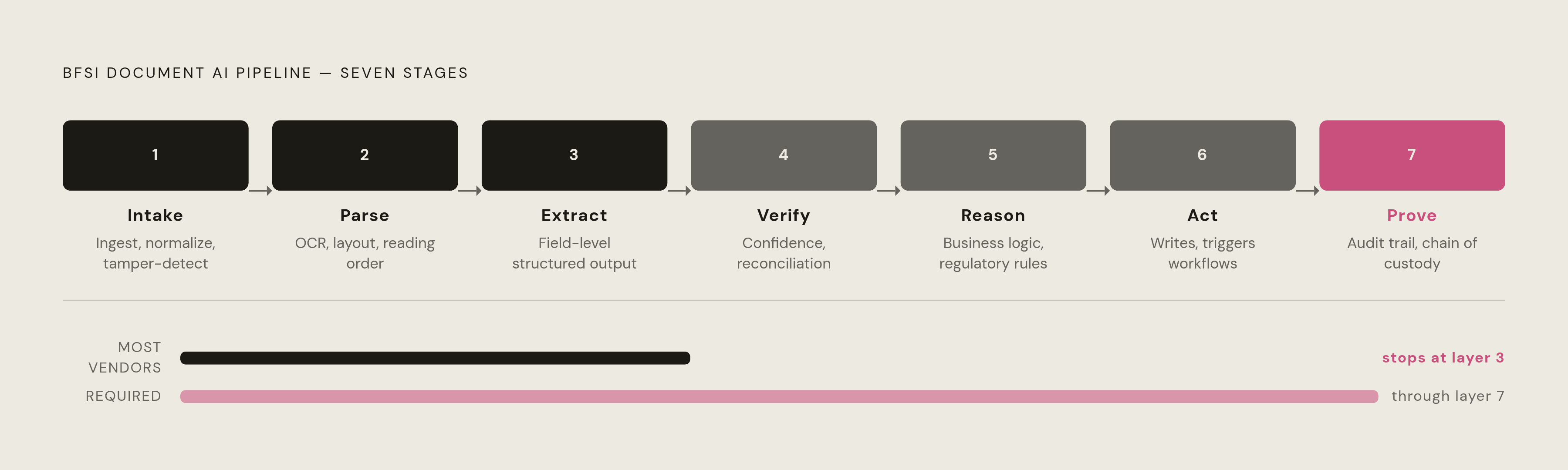
The mature architecture for BFSI document AI is a layered stack, and most of what gets sold as a complete platform actually covers only the first few layers of it. A full pipeline runs through at least seven stages [1][2]. Intake handles ingestion, format normalization, and tampering detection. Parse covers OCR, layout reconstruction, and reading-order recovery. Extract turns parsed content into field-level structured output. Verify applies confidence scoring and reconciles data across related documents. Reason applies business logic and evaluates documents against regulatory rules. Act writes results into downstream systems and triggers workflows. Prove maintains the audit trail and chain of custody that regulators will eventually ask to see.
Even the first of these layers carries more complexity than it looks like from outside. Intake has to normalize input arriving from email, mobile uploads, and legacy portals that were never designed to talk to each other, clean up image quality on scans that range from crisp to barely legible, identify what kind of document just arrived, and check it for signs of digital tampering, all before a single character gets parsed. None of this argues that the older, rule-based approach is obsolete. For document types that are stable, high in volume, and arrive from known senders, a deterministic pipeline is still faster to run, cheaper to operate, and easier to audit than a generative one. The hybrid approach uses deterministic processing where the document type allows it, generative and agentic processing where it doesn't, and a stack that can tell the difference.
Why parsing accuracy on complex financial documents matters
Parsing is not a standalone accuracy metric that can be improved in isolation. Every layer that follows inherits whatever the parse got wrong, and those errors compound as a document moves through extraction, verification, and reasoning rather than correcting themselves along the way. A 1099 barely changes from one filing season to the next, and that stability is exactly the condition under which OCR performs at its best. The picture shifts hard the moment the document stops being stable: semi-structured financial documents, handwritten addenda, and faxed amendments produce a disproportionate share of total errors even when clean structured forms still make up most of the volume a bank processes.
LLM-enhanced IDP closes part of that gap, and it posts meaningfully higher accuracy than traditional OCR specifically on semi-structured documents, because the improvement traces back to semantic understanding of document structure and context rather than to better character recognition alone. LLMs carry their own failure mode distinct from anything OCR produces. They're strong at pulling text content off a page but sometimes struggle to preserve the document's actual structure, and open-weight vision-language models in particular carry a real hallucination risk, inventing content that looks plausible but was never on the page. For agent and retrieval workflows downstream, running text extracts fairly reliably, but information embedded in charts, diagrams, and tables gets lost at a much higher rate, and the same extraction can fail on multi-column layouts and scanned pages regardless of format. If an agent gets correctly recognized characters in the wrong reading order, it will reason its way to a wrong conclusion using data that was, technically, extracted correctly, because the parse has to reconstruct the document's layout and logic, not just its text.
Splitting and classification before extraction: the step most pipelines get wrong
Before structured extraction can start on a packet containing several distinct documents, a mortgage file, a KYC bundle, a trade finance submission, the pipeline has to work out where one document ends and the next begins, and what type each one is. Get that step wrong and the error poisons every extraction that follows, because a field extracted from the wrong document is worse than a field left blank. Splitting performance turns out to depend less on which underlying model does the work and more on the system harness built around it: how document boundaries get detected, how a classifier assigns document type, and what confidence threshold triggers a flag for an ambiguous split. The same frontier model will perform very differently depending on how you frame and constrain that splitting task, so you have to put the engineering burden on the harness, not on model selection alone.
This is one of the few places where a benchmark actually tests the problem banks face rather than a cleaner version of it. Extend's PoliTax Split benchmark tests splitting accuracy against real compound tax documents, long presidential tax filings with boundaries subtle enough to trip up a naive classifier, not against clean, single-document inputs that flatter whatever system you test. A splitter that performs well on single documents and poorly on compound ones will look strong in a vendor demo and fail in the first week of production use.
Structured extraction at scale: where silent failures become compliance events
Getting individual fields right is necessary, but it isn't sufficient, and the extraction failure that most accuracy benchmarks miss entirely is the silent one: a row quietly dropped from a large array, a trade confirmation that never made it into the output, an income line omitted from a tax return, all while the result still looks like a clean, complete extraction on the surface. A document-level confidence score cannot catch this kind of error, because a document can contain dozens of correctly extracted fields alongside a single critical mistake, and the aggregate score will still read as high. Field-level confidence scoring closes that blind spot: every extracted value needs its own confidence score, a plain-language explanation of how it was derived, and a source attribution that points back to its exact location in the original document.
Many BFSI workflows require extraction logic that reasons across more than one document at a time as a baseline requirement. Extend's LongArray-Extract benchmark targets precisely this gap, surfacing row-dropping and related failures in large-array extraction through recall-oriented scoring, where a failed run counts as zero rather than as a partial success. On the question of how you should build extraction pipelines in the first place, FinanceBench, a benchmark built around financial filings and PDFs for question-answering tasks that resemble real production conditions, shows that long-context approaches outperform vector-store retrieval on this class of document. That finding has a direct bearing on how a BFSI extraction pipeline should be architected, favoring approaches that keep more of a document in context rather than chunking it for retrieval.
The multi-agent architecture that turns extraction into action
Getting from structured output to agent action requires an orchestration layer that holds state, sequences tasks in the right order, handles failures gracefully, and routes exceptions to the right place, and this is where most production deployments hit their first real problems after launch. A canonical architecture for this layer pairs a Planner Agent, responsible for breaking a task down and sequencing it, with Domain-Specific Agents that handle compliance validation, document parsing, and risk scoring individually. An Orchestrator coordinates across those agents, maintaining state and resolving conflicts between them, while a Human Oversight Layer catches flagged and high-risk decisions before they go further. That modularity is what makes the architecture scalable without sacrificing precision on any individual task.
Agentic IDP differs from classic IDP in kind rather than in degree. An agent comparing a Bill of Lading against a Letter of Credit doesn't stop at extracting two sets of dates [1][2]. It checks whether those shipping dates actually satisfy the credit terms, querying external systems when it needs to, and does not need reprogramming every time a new document variant shows up. The Stanford 2026 AI Index puts a number on how far that engineering still has to go: AI agents fail roughly one in three attempts on structured benchmarks. Retry logic, graceful degradation, and a clear path to human escalation have to be built with the same care as the primary workflow, because a one-in-three failure rate on structured tasks guarantees the exception path will get exercised constantly in production. Extend's approach to this stack combines proprietary trained models with frontier AI models calibrated to the specific use case, which speaks directly to the hallucination-versus-accuracy tradeoff raised earlier: specialized vision models built for complex layouts deliver the semantic understanding that lifts accuracy on semi-structured documents, without the over-correction and hallucination risk that open-weight vision-language models can introduce.
Where BFSI document AI has production traction today
KYC onboarding, loan origination, and AML compliance deliver the clearest production value from agentic document pipelines in BFSI today, because these workflows combine the highest document volume with the highest cost of getting something wrong. The actual bottleneck in KYC was never character recognition, it's cross-document identity verification, matching a name or address across multiple source documents that were never designed to agree with each other. Large banks spend tens to hundreds of millions of dollars annually on KYC compliance alone, so this single workflow is the largest automation opportunity in retail banking.
Loan origination carries a similar structure. Document-related delays account for a large share of total mortgage cycle time, and IDP has been shown to compress close cycles dramatically while it cuts per-loan document processing costs. AML compliance adds a governance dimension on top of the efficiency one: IDP produces a defensible, auditable trail where every extraction gets logged, which has turned IDP-based compliance software into a regulatory expectation rather than a competitive edge, while also cutting down the false positives that otherwise eat up analyst time chasing risk cases that were never genuine.
One named example illustrates what this looks like at scale. A Spanish bank automated the vast majority of its loan applications at 99 percent precision, and separately, its AI agents processed millions of loan pages with minimal human intervention to validate income statements, tax returns, and identity documents. Accounts Payable and Corporate Finance lead in enterprise-wide deployment, Retail Banking follows close behind on the strength of KYC and loan origination use cases, and Investment Management lags furthest, still concentrated on trade confirmations, prospectuses, and SEC filings, the document class where complexity runs highest and tolerance for error runs lowest.
Testing vendor accuracy claims on BFSI documents, not general benchmarks
A vendor's score on a general-purpose benchmark says very little about how that same system will perform on a real mortgage packet or an AML filing. General benchmarks tend to draw on clean, well-structured documents because you can label and score them more easily, and that's precisely the condition that flatters almost every parsing and extraction system on the market. The moment a document stops looking like that, a scanned trade finance submission with handwritten annotations, a multi-document loan file with ambiguous boundaries between its parts, a holdings table dozens of rows long, the gap between benchmark performance and production performance is widest and most visible in production.
That is the case for testing accuracy claims against the kind of documents a buyer will actually run through the system: compound tax filings with subtle splitting boundaries, large-array extractions where a single dropped row changes a filing's meaning, cross-document verification tasks where two records have to agree before a decision gets made [1][2]. Extend positions itself as infrastructure built to span that full stack, from parsing and extraction through confidence scoring and workflow orchestration, because leaving those connective layers to single-point tools creates gaps that a bank only discovers once it tries to put the system into production. If you engineer document AI for BFSI at that level, you build for governed intelligence from the start, rather than adding compliance and observability onto a tool that was never designed to carry them.