Throughput Architecture Tradeoffs in Document Parsing APIs for Daily PDF Processing at Scale
Balancing speed, cost, and accuracy requires routing, not a single parsing model.
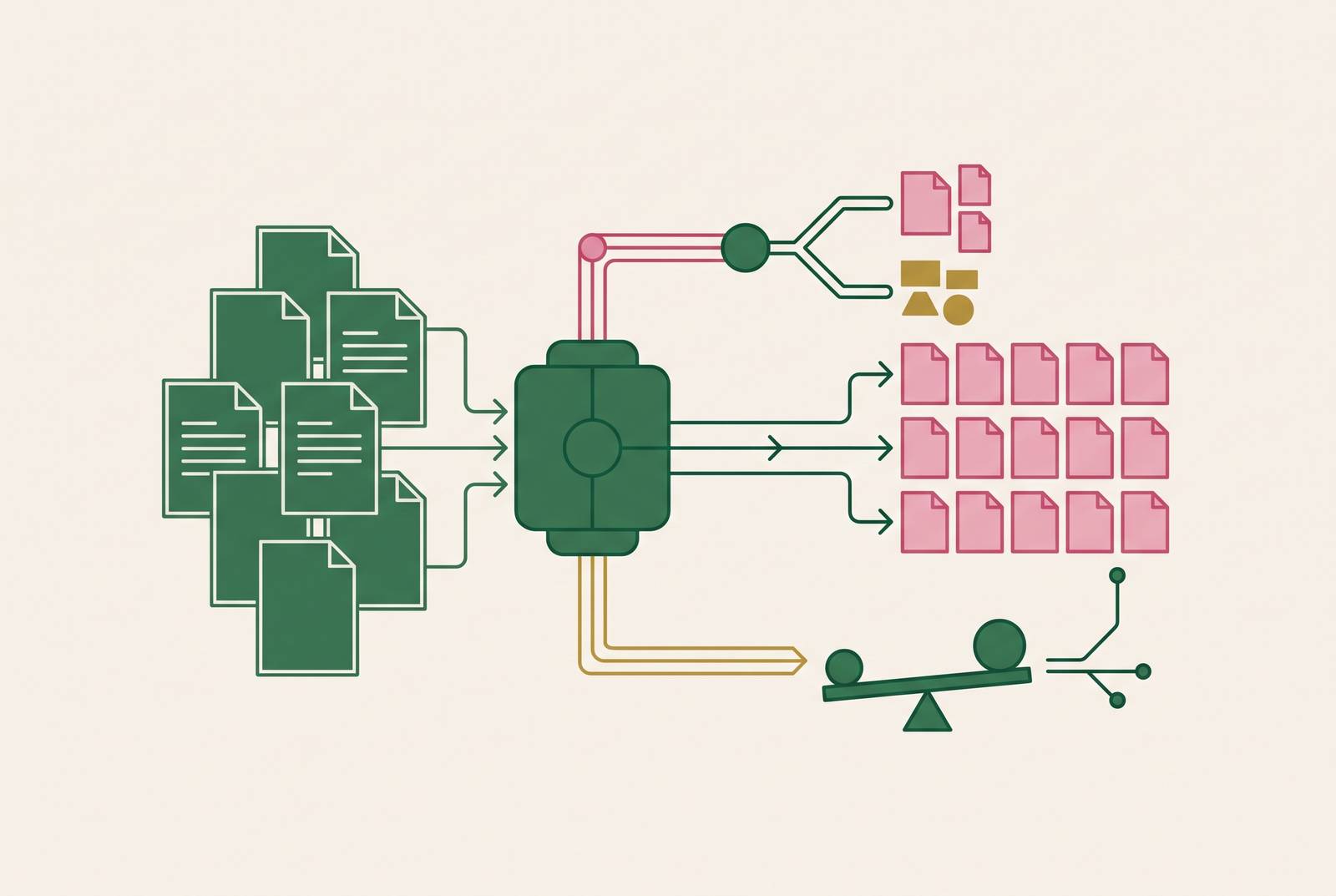
Scaling daily PDF processing requires an architecture that balances accuracy, throughput, and cost. For medical documents that must not send protected health information to third-party servers, self-hosted deployment is a relevant selection criterion, but the supplied evidence does not establish a named API as HIPAA-compliant. Deployment, data retention, regional processing, and audit requirements belong in the same decision as parsing quality, concurrency, confidence routing, and orchestration.
Why scaling PDF throughput is a three-way tradeoff, not a single optimization
An engineer optimizes for throughput, the batch completes, and a downstream approval engine acts on incomplete data before the missing field becomes visible. The parser may have dropped a row, detached a value from its label, or assigned confidence that allowed an incorrect result to bypass review, potentially without returning an error. Across an agent chain, those defects can propagate through extraction and routing before reaching the system that makes a decision.
This is a systems-design problem. Fast, low-cost layout parsers work well on known formats, while heavier multimodal approaches can handle harder documents but cost more in compute and take longer per document. Neither position dominates every production document mix. A pipeline that processes predictable digital forms has a different tradeoff from one that processes difficult scans and tables that vary. The downstream consequences of an error also change how much speed or cost reduction is acceptable.
The architecture determines how deliberately that tradeoff is managed. Model choice affects the work required to reconstruct a document, concurrency determines how that work progresses across a batch, and routing determines which documents receive expensive processing. Orchestration then governs whether uncertain or failed results are exposed before downstream use. These layers cannot be judged in isolation because a gain in one can create pressure elsewhere, including a review queue that grows faster than automated processing clears documents. Daily volume therefore has to be assessed against the document mix, the latency budget, and the cost of incorrect output.
What the parsing model class actually determines about throughput and accuracy
Classic text-layer extraction tools, including PyMuPDF, pdfplumber, and Camelot, perform well on clean, digitally native PDFs with predictable layouts. Their speed and low processing cost make that document class attractive. However, scanned pages, multi-column layouts, and tables spanning page boundaries expose the fragility of assumptions about spatial structure. The lowest-cost path saves money only as long as those assumptions hold.
Coordinate-dependent extraction makes the risk concrete without requiring an unusual document. A vendor invoice arrives with column positions shifted two pixels from the expected bounding box, and the field drops before reaching the approval engine. No error is surfaced. The file has been processed, but the value needed for the next decision has disappeared. Open source parsers leave the engineering team responsible for adapting to such variability, while production APIs can absorb that work at the model layer. The organizational cost becomes visible when new layouts break extraction rules and the review queue outgrows the team’s ability to patch templates.
Specialized extraction APIs and multimodal vision-language models have different tradeoffs further along this spectrum. Neural and vision-language approaches can process entire pages in a single forward pass, preserving spatial relationships and document structure rather than relying on brittle multi-stage OCR processing. That capability requires more compute and reduces per-second throughput. Tables are still hard for all model classes because merged cells, repeated headers, cross-page rows, and borderless layouts take more than word recognition to handle.
Parsing reconstructs the full document into ordered text and layout, while extraction returns selected values against a schema. They are not interchangeable measures of accuracy. A fast parser can recognize words correctly but interleave columns or damage table structure, so the downstream extraction step returns the wrong fields.
How concurrency model and async job design shape real daily throughput
Once the parsing model is chosen, daily throughput depends on whether the job architecture can keep it productive without losing control of failures. Per-document latency no longer describes the whole constraint. The API must also define how many files can be submitted concurrently, whether submission blocks until completion, and how individual outcomes become available. An asynchronous request separates submission from completion. That separation only helps operationally if the job contract makes the intervening states visible.
Per-file state is needed because each file in a batch can fail on its own. If one unreadable document invalidates the whole job, recovery requires resubmitting files that already succeeded. Idempotent resubmission addresses a different risk by allowing retries without duplicate processing. Completion reporting also needs a defined interface, whether through webhooks or exposed polling states, so downstream systems do not have to infer that work has finished. Machine-readable rate-limit responses give the orchestration layer information it can use to back off and retry intelligently.
Even after a large submission is accepted, it can spend time in a queue, finish only in part, or take costly work to recover. Daily throughput depends on queue time, processing time, per-file completion rate, and how the system recovers from failures. These distinguish accepted work from usable output. A concurrency comparison that ignores them can favor an API whose submission limit looks generous but whose batch contract leaves the engineering team responsible for reliability.
Concurrency also changes the cost of the selected parsing mode. Sending every document through the highest-accuracy mode at maximum concurrency maximizes throughput within that mode while also maximizing its processing cost. It does not establish that every document needs the expensive path. To control that expense without slowing routine work, the architecture needs a way to reserve heavier processing for documents that justify it. Confidence routing provides that control.
Confidence routing as the mechanism that connects accuracy, cost, and throughput
Routine documents can take a fast, lower-cost path, while documents with uncertain results go through heavier processing or review. Without explicit modes and routing controls, teams accept one opaque quality-cost tradeoff across the entire document mix. That uniform policy makes straightforward files pay for capabilities they may not require. A configurable policy instead lets the pipeline concentrate effort where errors are more likely or more consequential.
The score driving that policy must have a clear scope. OCR quality, model certainty, element-level confidence, and confidence in a single extracted field each describe a different thing. Vendor scores are therefore not directly comparable. For the signal to be useful, it also needs source grounding through per-field bounding boxes, page references, and cited source text. Those references let a reviewer locate the evidence for a value rather than search the whole document, making review a practical part of the processing path.
Confidence is a routing signal. High-risk fields still need format checks, cross-field rules, and business validation before they can skip human review. Even a score that passes an average calibration check may do a poor job of telling correct outputs from incorrect ones. Calibration asks whether stated confidence matches the actual success rate, while discrimination asks whether the scores tell successes from failures. Both need to be measured on their own because a score can be accurate for the outputs as a whole but lead to poor decisions on single documents.
The failure can cascade beyond the parsing step. Miscalibrated confidence produces incorrect routing, incorrect extraction then reaches a decision system, and no reviewer sees the defect before action. APIs with explicit processing modes, per-request configuration, confidence thresholds, and control over which documents reach heavier processing are preferable. Those controls make runtime choices possible, but they do not establish the right settings. Thresholds are only as useful as the evaluation pipeline that calibrates them against the documents and decisions they will govern.
Why evaluations must be run on your documents, not on public benchmarks alone
Public benchmarks provide necessary directional evidence about model capability, but they cannot substitute for the production document mix. Skewed scans, rotated headers, mixed handprint and type, fax compression artifacts, and new invoice layouts introduce conditions that static test sets may not replicate. Benchmarks are therefore a starting point for shortlisting, rather than the final basis for selecting a parser or setting routing thresholds. Benchmarks are more useful when the evaluation task is closer to the work the pipeline has to do.
Benchmark methodology also affects what a ranking means. Different versions can test different capabilities, and score gains can follow changes to data engineering or the evaluation suite even when the model is unchanged. Suites also vary in how heavily they weight enterprise documents against academic or general corpora. A score needs its methodological context to be useful. Comparing results without that context can turn a precise-looking number into an imprecise architectural decision.
Field accuracy and array completeness need measurement apart from layout accuracy because a parser can reconstruct the page while dropping rows from a large array. Reading order and table structure also need separate scores. A parser can recognize every word and still mix up columns or lose the link between cells and their headers. For tables, merged cells, repeated headers, footnotes, and cross-page continuations deserve direct testing because general OCR and field-accuracy claims do not predict their handling.
The evaluation must then follow the output into its real task. Document Q&A answer correctness, RAG retrieval quality, and extraction schema completeness show whether reconstructed content supports its intended use. Grounding quality shows whether a source location points to the exact region that supports the output or just to the right page. Review volume reveals the operational cost of thresholds. Measuring that volume at different routing settings shows whether a policy preserves accuracy at an affordable processing and review burden. Once those choices have a sound empirical basis, the policy depends on orchestration to survive daily batch operation.
Job orchestration decisions that determine whether the pipeline holds at daily volume
A fast path for high-confidence documents and a heavier path for uncertain ones can only deliver their intended benefits if failures remain isolated and orchestration exposes exceptions before downstream use. Silent drops defeat that design immediately. A failed file that produces neither output nor a visible failure leaves a gap that completion totals alone may conceal. Per-file status makes the distinction between completed, failed, and unresolved work operationally important.
Failure recovery must also avoid turning one bad document into repeated work for the whole corpus. Undifferentiated batch failure forces successful documents back through processing, while missing idempotency can make retries create duplicates. Review routing introduces another capacity constraint. Thresholds that send too much work to human reviewers can erase the throughput gain from automation. Outputs released to an ERP, data warehouse, or decision system before confidence routing and business validation create a different exposure, because the error cannot be recalled once acted on.
Developer tooling determines how much of this behavior the engineering team must build and maintain. Typed SDKs, a CLI, MCP server support, agent skill templates, idempotent resubmission, per-file status, webhook signing, and evaluation tooling broaden the comparison beyond the first successful request. Acceptance volume is not the deciding criterion. The stronger platform combines asynchronous per-file processing, reliable structured output, failure isolation, review routing, and controls over latency, accuracy, and cost. Those capabilities support daily operation rather than merely demonstrating that a document can be parsed.
Zero data retention, self-hosted deployment, regional processing options, and audit trails for routed decisions affect whether a pipeline can operate in a regulated setting at all. Healthcare, financial services, and logistics have distinct requirements. For engineers, the practical objective is an architecture that makes the accuracy-throughput-cost tradeoff visible and controllable at every layer. Understanding how parsing, concurrency, routing, and orchestration change those dimensions permits deliberate choices before a missing field, overflowing review queue, or irreversible downstream action reveals the compromise in production.