Human-in-the-Loop Design for Document AI Error Recovery
Routing errors early through calibrated confidence signals prevents downstream cascade failures.
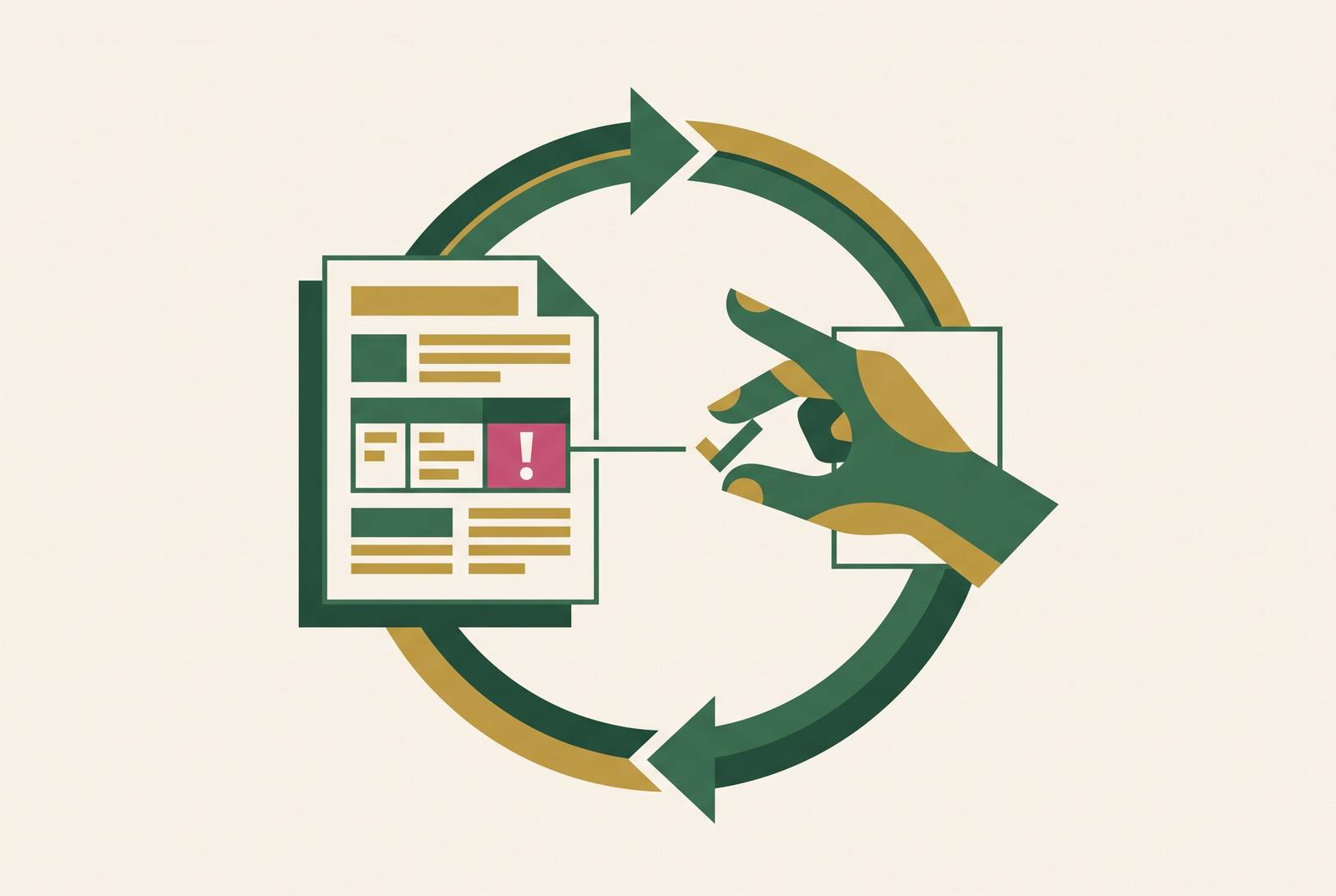
Human-in-the-loop design for document AI error recovery is a pipeline engineering problem. Systems that work well use calibrated confidence signals to send errors to the right reviewers before those errors build on one another. That takes clear routing thresholds, review effort that matches error cost, structured corrections, and benchmarks that test whether the whole process can be used to make production decisions.
Why treating HITL as a final review step creates a structural problem
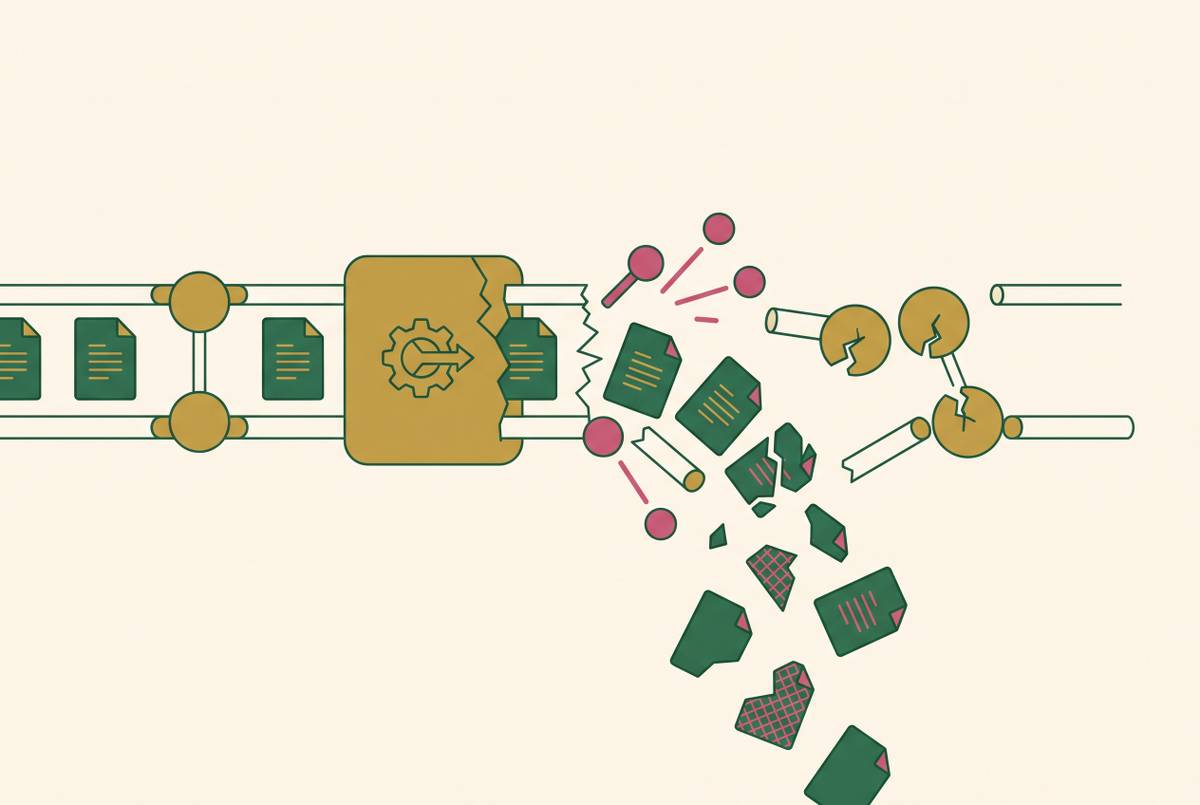
A document pipeline can look sound in testing and break down when real documents arrive. The engineering team then adds a review queue at the end, where people correct outputs that automation could not handle reliably. This catches errors, but catches them too late. By then, a parsing mistake may have passed through extraction, validation, formatting, and agent reasoning, moving the recovery cost downstream and leaving its source unaddressed.
ParseBench (2026) describes the underlying change in requirements as a shift from “good enough to read” to “reliable enough to act on.” A small parsing error becomes a decision error when an agent acts on the result. A parser can transcribe every character accurately while placing the text in the wrong row, column, or field region. Downstream extraction then receives clean text in the wrong semantic context, producing an output that looks more trustworthy than it is.
A composite accuracy score obscures that distinction because it reduces character and structural performance to one number. Reviewers at the end of the pipeline have the same blind spot. They can replace a wrong field value, but the output alone does not show whether OCR, layout detection, or extraction logic caused the mistake. Without that distinction, the correction supplies no useful signal to the stage responsible for the failure. The necessary response is instrumentation that exposes uncertainty and failure sources within the pipeline.
What calibrated confidence signals actually tell the pipeline — and what they hide
Confidence scores provide a basis for routing only when they correspond to observed correctness. A high-confidence prediction must be correct at the rate its score claims on production documents. That correspondence is calibration, and it can drift. As document populations change, a model may continue reporting high confidence even though its outputs are wrong more often. Thresholds that appeared dependable at launch can therefore become unreliable without any obvious change in the scores themselves.
Even a maintained confidence signal has limits. ParseBench separates evaluation into five dimensions, which are tables, charts, content faithfulness, semantic formatting, and visual grounding. Those dimensions show different failures that matter to agents, each of which is a separate part of parsing quality. A score useful for one kind of extraction does not establish reliability across all of them. Calibration must therefore be assessed against the work the score is meant to authorize, rather than treated as a general assurance about the model.
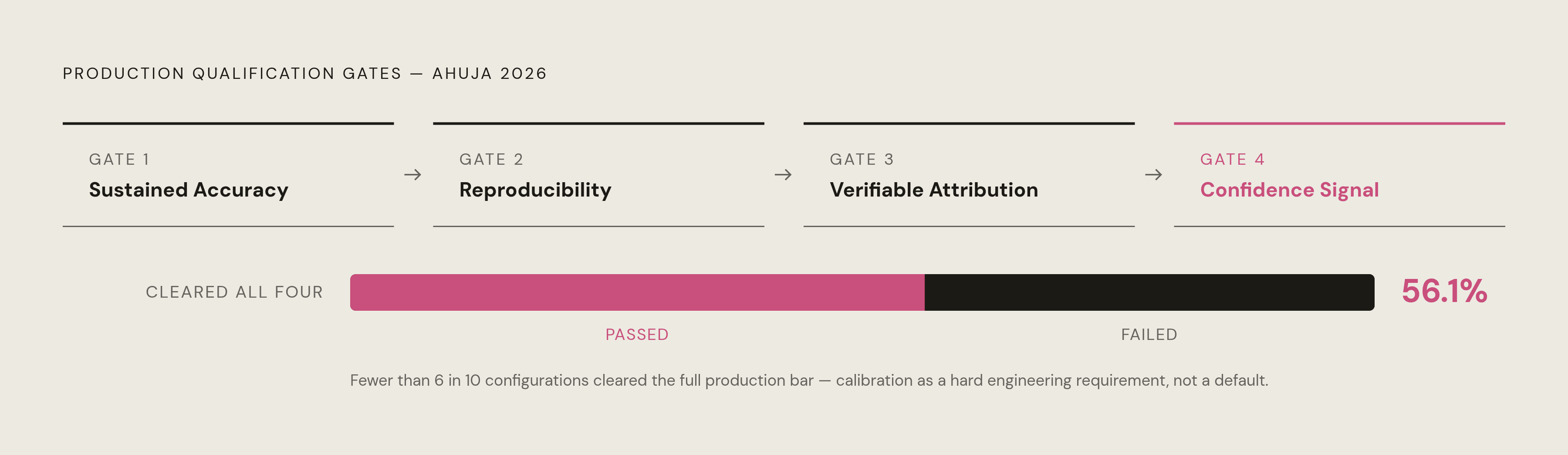
Ahuja’s July 2026 paper found a survival rate of just 56.1% across configurations when moving from a demonstration bar to a production bar. The latter required sustained accuracy, reproducibility, verifiable attribution, and an informative confidence signal. Confidence itself was part of the test. This is the strongest objection to using model scores as ready-made routing controls. When properly maintained, however, calibrated signals can distinguish a high-certainty extraction on a consistently formatted document from an ambiguous extraction on a poor-quality scan, giving HITL routing a defensible foundation.
How tiered confidence thresholds turn routing from ad hoc to deterministic
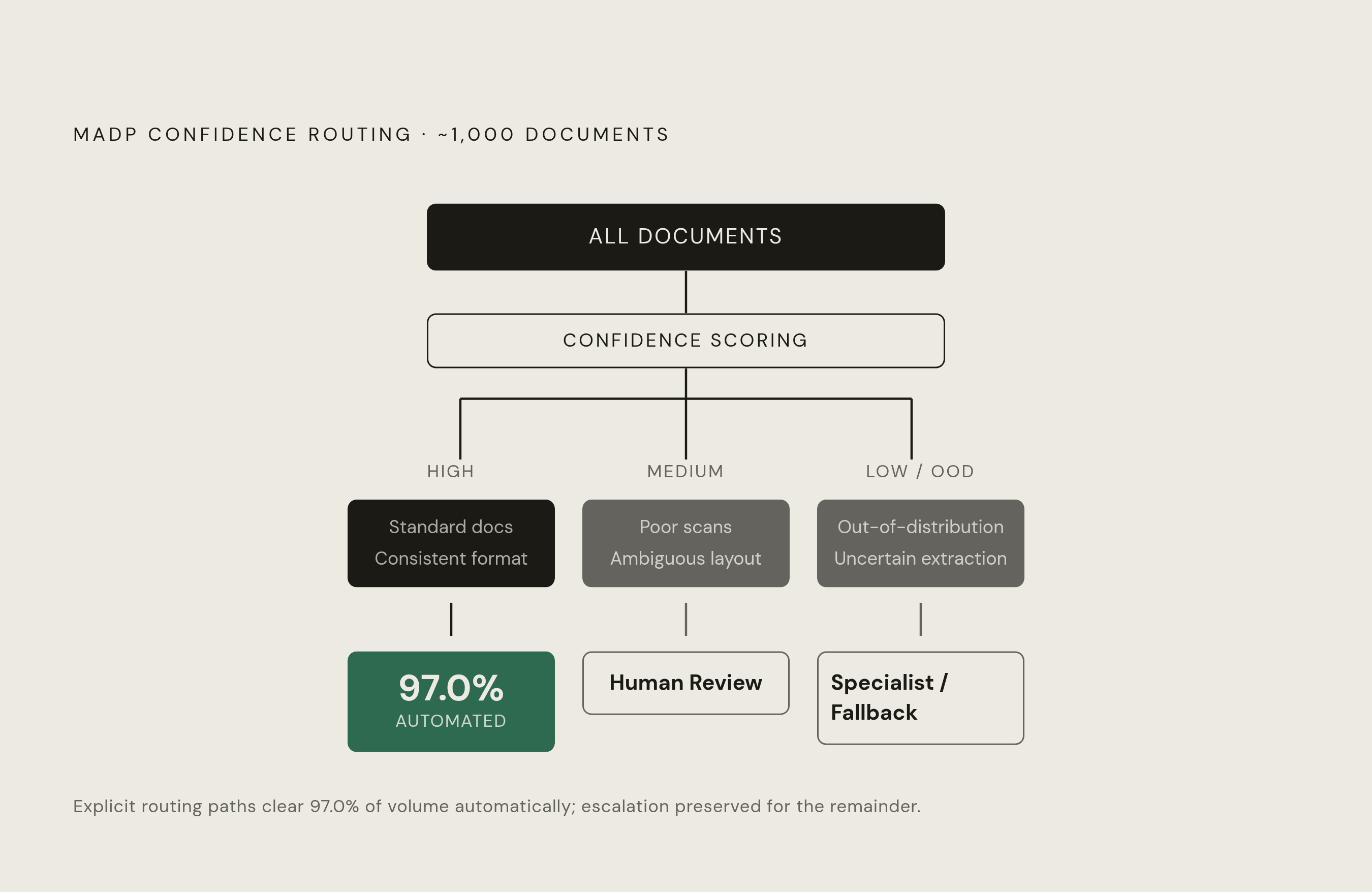
Confidence-gated routing converts that foundation into explicit decisions about what proceeds automatically and what requires intervention. Standard documents with consistent formatting go into the high-confidence band when their calibrated scores match actual accuracy. The medium-confidence band directs uncertain extractions, poor-quality scans, and ambiguous layouts to human review. Low-confidence or out-of-distribution documents go to specialists or explicit fallback logic.
Gosmar and Zenezini’s 2026 MADP framework provides a production example of this integrated approach. It combines five specialized agents, namely Classificator, Splitter, Parser, Extraction, and Validator, with HITL inside the pipeline. Gosmar et al.’s 2026 analysis reported a 97.0% full-pipeline automation rate when the system was used on nearly a thousand real-world documents, with only a small share needing non-AI fallback. Automation and human review can each have their own clearly defined paths.
Those paths remain dependable only while their thresholds remain calibrated. New suppliers, document variants, and changes in scan quality require the confidence bands to be revisited as the input population shifts. Explicit gates make routing auditable, but do not prevent drift by themselves. Some document characteristics also warrant escalation beyond the score. Hurried handwriting on real-world forms produces meaningfully higher error rates than print even for the strongest models, making handwritten fields a candidate for automatic escalation regardless of stated confidence.
Where reviewer effort should concentrate — and what happens when it doesn't
A single queue for every uncertain result erases the distinction between a case that needs domain judgment and one that needs a second look. That distinction determines who should review the output. When routine corrections and high-risk exceptions compete for the same attention, volume can dilute scrutiny of the cases with the greatest downstream cost. Routing design must therefore specify more than when automation stops. It must also establish which kind of human judgment is needed next.
Error cost provides the allocation rule because mistakes are not equally expensive to discover after downstream processing. High-risk claims routed to specialist reviewers before leaving the system compress days-in-accounts-receivable, the metric that determines cash flow, while clean claims process automatically. For a team designing such routing, the lesson is to reserve domain specialists for high-stakes fields and use general reviewers for corrections that do not require the same expertise.
Routed review nevertheless covers only the outputs that the system recognizes as uncertain. Auto-accepted results need a separate check. Senior reviewers who check a small share of auto-approved decisions in each batch can find systematic errors that confidence gates have missed. This audit sampling complements escalation rather than duplicating it, because the two paths inspect different populations. Catching a recurring error there is structurally cheaper than allowing it to spread through production and trigger a rework cycle.
Why feedback from reviewers must be structured at capture time, not cleaned up later
After months of HITL operation, a team may still be unable to answer where its model keeps failing if corrections were stored only as plain edits. The corrected values show the desired answers, but not the reasons for intervention. An OCR character error, a layout detection error, and an extraction logic error require different responses, yet all three can end with the reviewer entering the same replacement value. Saving only that value collapses the distinctions needed for improvement.
The correction schema must preserve those distinctions at capture time. Each reviewer decision needs a correction category, a decision type such as approval, rejection, or edit, the original AI output, the field in question, and the document characteristics. These records let ML teams separate systematic failure patterns from isolated noise. ParseBench’s dimensions provide a useful taxonomy for that work. A correction to a merged-cell table value conveys a different signal from an edit restoring dropped semantic formatting, even if both leave the final document looking correct.
MADP’s Prompt Fine Tuning with Feedback Inheritance approach shows how structured human corrections can help a system adapt without retraining the models it uses. Gosmar et al.’s deployment recorded 98.5% document-level accuracy under HITL supervision, using error patterns to update prompts and extraction rules at the agent level. Compliance provides a second reason for preserving the record, because a corrected answer alone cannot explain the reviewer’s decision. Capturing the original output and the nature of the intervention supports an account of what changed rather than requiring that account to be reconstructed later.
How benchmark design determines whether a pipeline can be trusted in production
The reliability of calibration, routing, and feedback depends on how they are evaluated. A benchmark that uses clean documents and composite accuracy cannot show whether thresholds will hold on the inputs a system gets in production. It also cannot show which document categories will dominate review demand or where correction patterns will cluster. Evaluation must expose the failure modes that the pipeline is designed to detect and recover from.
ParseBench uses human-verified enterprise document pages spanning insurance, finance, and government, and finds that no method is consistently strong across all five of its dimensions. That fragmented capability landscape limits what an overall score can establish. Strength in one dimension can coexist with weakness in another. A production evaluation therefore needs to preserve the distinctions relevant to routing. Otherwise, the benchmark can reward a parser without revealing the specific work its reviewers will inherit.
Infinity-Parser2’s technical report illustrates the same limitation at the model level. Infinity-Parser2-Pro reached the highest reported scores on olmOCR-Bench and ParseBench as of its July 2026 publication, yet its cross-domain results show that leading parsing scores do not translate uniformly to layout analysis, chart parsing, or document VQA. A leading result still has a scope. It does not establish that every document task will perform at the same level.
Vendor-built benchmarks add another evaluation risk when the party selling a tool also constructs the test used to promote it. Marketing and measurement then become difficult to separate. As headline accuracy converges, production-relevant differentiation depends on tests that include the worst inputs, expose uncertainty, and measure integration cleanly. For HITL, those tests must check how well the system shows failures and helps it recover, as well as how accurate it is on clean documents.
What a fully instrumented HITL pipeline looks like end to end
An engineering team should begin by instrumenting parsing to emit separate layout accuracy and extraction accuracy signals. This preserves the distinction between readable text and correct field assignment before downstream processing obscures it. Calibration should then use the documents the system gets in production, with recalibration scheduled as document types change. Training-time performance is not the operating reference. The signals must describe the documents the system is actually being asked to process.
The next step is to define and version the routing thresholds as an auditable configuration artifact. High-confidence outputs proceed automatically, medium-confidence outputs receive human review, and low-confidence or out-of-distribution documents escalate to specialists or fallback logic. Reviewer allocation should follow error cost, with domain specialists handling high-stakes fields, general reviewers handling formatting corrections, and senior reviewers sampling auto-approved outputs for systematic failures.
At the point of review, the system should capture the decision type, correction category, original AI output, affected field, and document characteristics in a structured record. Capture cannot wait until after the correction. Teams should use those records to update prompts and extraction rules without a full retraining cycle, following the feedback inheritance pattern shown by MADP.
Finally, the complete pipeline should be validated against benchmarks that test difficult documents, separate failure modes, and penalize silent drops. Calibration, thresholds, reviewer allocation, and feedback capture are interdependent, so removing one weakens the usefulness of the others. Ahuja’s production bar supplies the closing test. A configuration that succeeds in a demonstration is not yet a production system unless its accuracy holds, its behavior is reproducible, its attribution is verifiable, and its confidence signal is informative enough to govern action.