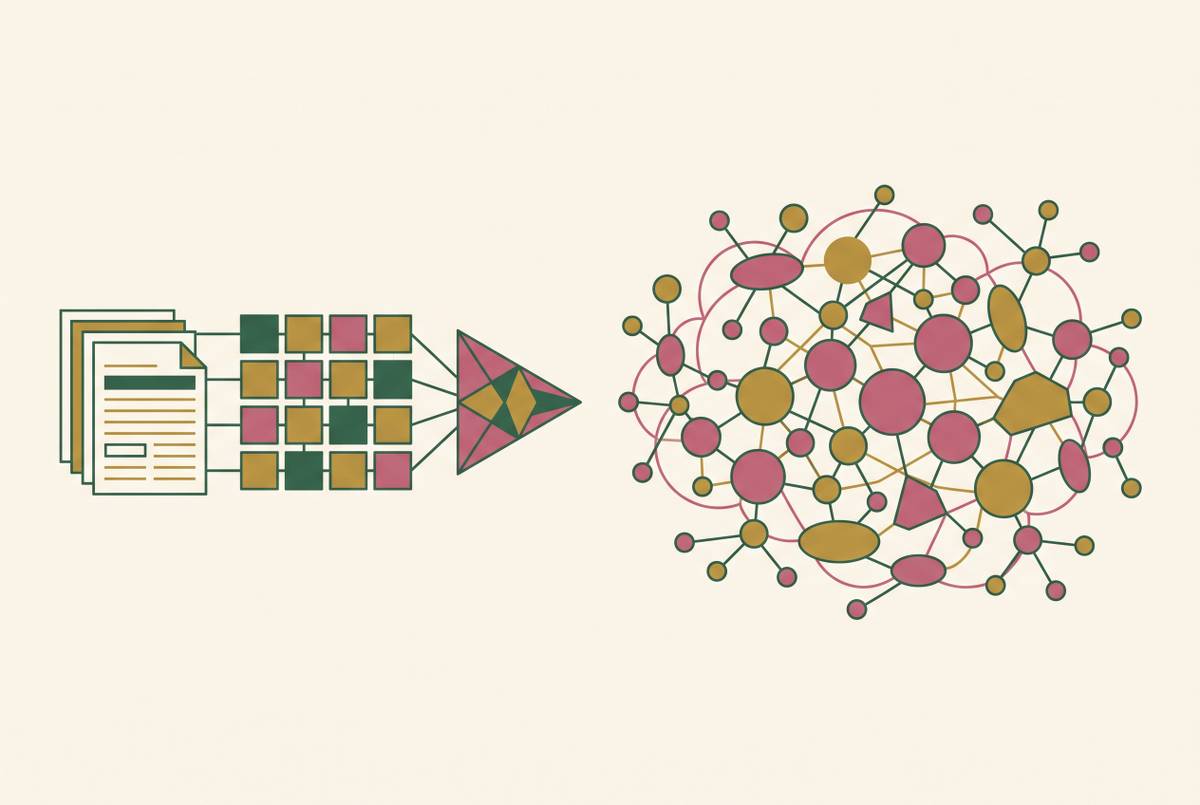
How Document Parsing APIs Fail Complex Table Structures and Which Evaluation Criteria Actually Predict Production Accuracy
High OCR scores can mask field mapping and structural failures that destroy table usability.

Document parsing APIs fail complex tables when they recognize the text but lose the relationships that give it meaning. Production accuracy therefore requires separate tests for character recognition, field mapping, and structural preservation, followed by confidence calibration. A high OCR score alone cannot establish whether a parser is ready for a table-heavy pipeline.
Why table extraction fails in ways that character accuracy cannot detect
A parser reports 99% character accuracy, but errors pile up in the downstream validation queue. Some PDF parsing tools report that level of character accuracy, yet a correctly transcribed value can still land in the wrong column or lose its row identity. The text survives, but its meaning changes. In a table, recognizing a cell is not the same as extracting a usable record.
Zhang et al.'s document parsing survey distinguishes parsing from traditional OCR because transcription alone does not preserve structural relationships and semantic organization. That distinction divides accuracy into three layers, which are character recognition, field mapping, and structural preservation. The first concerns the text, the second its semantic assignment, and the third the relationships among document elements. Each can fail independently of the others. Teams that select a parser from a leaderboard without separating these layers can encounter failures on document types the test set never covered, with no framework for locating the breakdown.
What each of the three accuracy layers measures and where tables stress each one
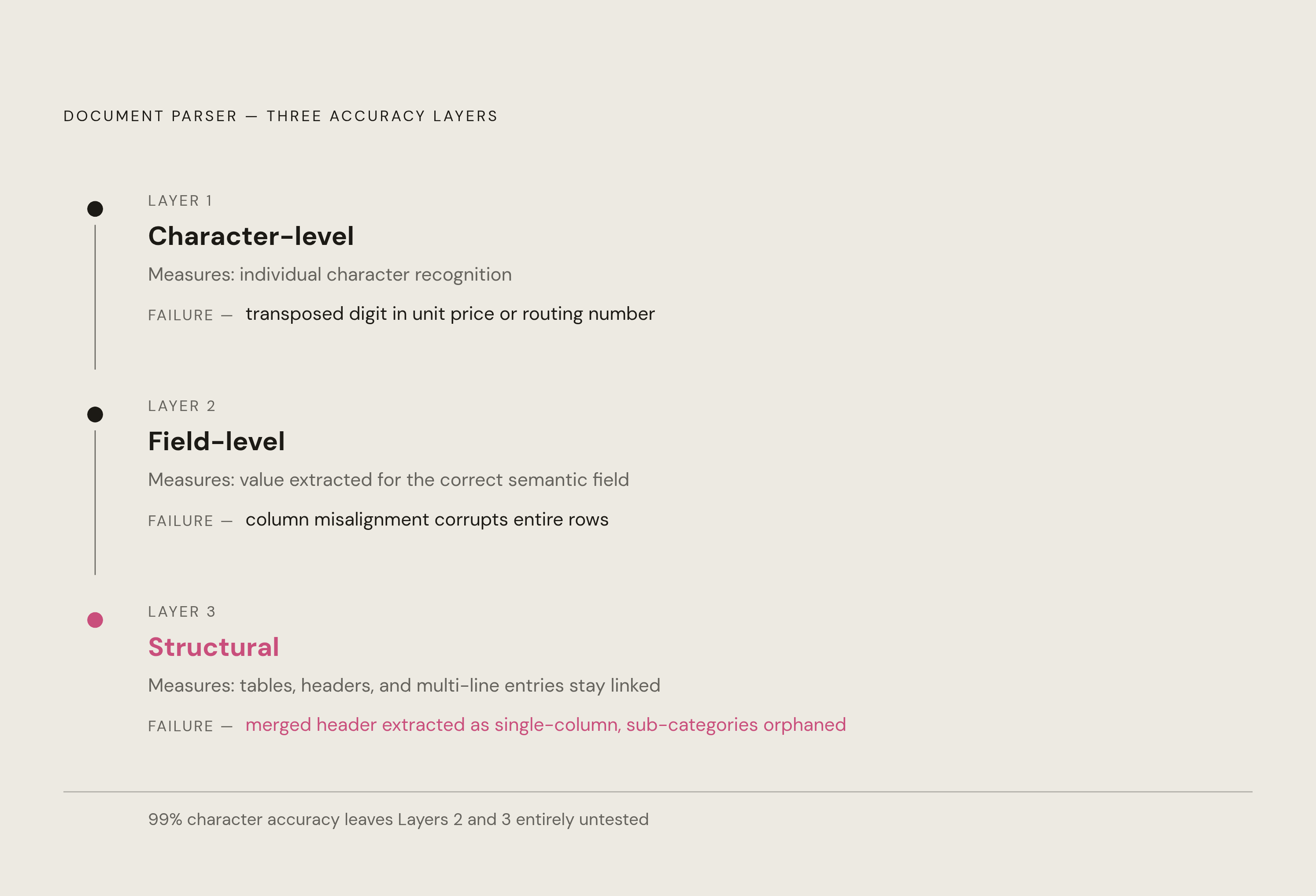
Character-level accuracy measures whether individual characters were recognized correctly. A transposed digit is its table-specific warning sign. In a unit price, routing number, or lab value, that error can break downstream validation even when the surrounding text is correct. OCR quality is most directly visible in character-level accuracy. Yet a high score across the document can obscure an error in the numeric cell that a downstream process actually needs.
Field-level accuracy measures whether the right value was extracted for the right semantic field. Column misalignment is the dominant table failure here. When column boundaries are detected incorrectly, text from one column is assigned to an adjacent column, potentially corrupting entire rows. Every character may still match the source. The failure lies in the assignment, so checking transcription cannot establish whether the extracted fields are correct.
Structural accuracy measures whether tables, headers, columns, and multi-line entries stay linked in the right ways. Merged cells expose this failure particularly clearly. A header spanning several columns may be extracted as though it belongs to only one, disconnecting sub-categories from their parent category. Other failures alter the table's boundaries or internal roles, including full-width totals rows parsed as separate single-cell tables and embedded sub-headers treated as data. Right-aligned numeric columns can also shift position when font output varies across PDF generators, breaking the arrangement that connects values to their context.
Why coordinate-dependent parsers are architecturally unable to handle layout variability
Coordinate-dependent extraction uses spatial position to classify text regions. Changes in layout can therefore break extraction before the parser starts to rebuild the table. The constraint is the reliance on coordinates as stable evidence of a region's role. A layout change can invalidate that assumption. Where field identity depends on a fixed position, tuning for one format does not establish reliability on another.
Camelot's stream flavor needs tolerance tuning for each template. Layout variation can silently produce an incorrect extraction that still looks like a valid grid and raises no exception. PyMuPDF and pdfminer perform well on text-layer PDFs with predictable, single-column structure, while multi-column layouts require manual reading-order logic in both. Scans and tables spanning page boundaries expose further limitations, making the degradation a design constraint.
Silent failure changes how this constraint must be evaluated. A dropped row can pass with no exception, warning, or confidence signal, while downstream validation may flag a malformed character value. Open-source tools are still a good fit for clean, text-layer PDFs with fixed templates, especially when volume is low or data residency rules out external APIs. That scope is narrower than variable production documents. Once the workflow has to deal with scan quality, changing layouts, or cross-page tables, coordinate dependence adds risks to production as well as maintenance costs.
How standard benchmarks measure the wrong layer and what they miss about tables
Benchmarks that focus on characters in clean or semi-clean documents can give high scores to parsers that fail at field mapping and structural preservation. OmniDocBench is a leading academic standard covering plain text, mathematical formulas, tables, and structured layouts across books, slides, financial reports, academic papers, and newspapers. Its composite uses Normalized Edit Distance for text, Tree Edit Distance Similarity for tables, and CDM for formulas. Structure is therefore part of its evaluation.
The TEDS methodology paper defines how to compare the structure of HTML tables represented as trees. TEDS also integrates normalized edit distance as the cell-content substitution cost, allowing it to evaluate structure and content together. That is more informative than character accuracy alone. Yet even a useful table metric can get lost in a composite ranking that combines scores from different tasks. Comparing only that aggregate leaves the table-specific differences unresolved.
OmniDocBench is restricted to five language types and largely clean or semi-clean scans, although it includes handwritten notes as a document type. OmniDocBench's omission of fax artifacts and the multilingual logistics documents found in production limits transfer to operational workloads. Production documents can contain skew, rotated headers, mixed handprint and type, and compression artifacts, so the relevant question is whether the benchmark's difficulty resembles the pipeline's inputs.
AlphaEval's agent evaluation research frames the broader mismatch between benchmark tasks and production requirements. Business descriptions contain implicit constraints, inputs are heterogeneous multimodal documents, information is fragmented across sources, and domain experts judge success. No existing benchmark fully captures those conditions. Academic scores remain useful evidence of capability, but they cannot substitute for testing table relationships and schema assignments on the documents a system will process.
Which evaluation criteria map to each layer and actually predict production table accuracy
For engineers selecting a pipeline, the decision rule is to measure each layer separately so its failures remain visible. Character error rate, or CER, is the starting point for Layer 1. It detects transcription errors in table text, including the numeric mistakes that break validation. Zero CER does not establish extraction correctness. A system can reproduce every character while assigning values to the wrong fields or flattening a nested header.
Layer 2 requires field-level precision and recall against the expected schema. Precision measures how often extracted values are correct, while recall measures how often expected fields are found. A silently dropped field must count as a recall failure in the evaluation. The comparison also has to preserve semantic identity, because finding a value somewhere in the output is not enough if it belongs to another field.
Layer 3 needs a test that compares structure in tables as complex as those used in production. TEDS is the most rigorous structural metric in this framework because it captures merged cells, nested headers, and cell-content similarity together. Its input documents remain decisive. A strong score on clean scans does not establish that cross-page tables or embedded sub-headers will survive extraction, so those cases belong in the structural test.
A new template required for every encountered format signals coordinate dependence, even if each configured template performs well in isolation. That requirement changes the interpretation of the score. Similarly, opaque confidence scoring with no tunable thresholds gives no usable basis for choosing how much uncertainty the downstream workflow will accept.
Why confidence calibration is the layer that makes the other two actionable in production
The three accuracy layers describe how well a parser performs, but they do not establish whether its confidence signals are trustworthy. Calibration supplies that operational connection. A parser that reports high confidence while being correct far less often than it claims cannot reliably separate outputs suitable for automation from those needing review. Routing based on thresholds then relies on a signal that can mislead. Without calibration, manual checking is needed to compensate for uncertainty that the parser does not report faithfully.
Field-level confidence makes selective escalation practical for document extraction. It allows individual fields to pass downstream or enter a review queue, rather than forcing a decision about the document as a whole. Granularity changes the cost of uncertainty. A single low-confidence cell in a 500-row array does not warrant rejecting the entire document, but a document-level score cannot by itself identify that cell. The confidence signal must operate at the level where the extraction decision is made.
Tunable thresholds are equally important because the cost of a false positive differs from the cost of a false negative across domains. A fixed threshold forces the team to accept the vendor's default operating point. Calibration makes that choice interpretable. It does not replace character, field, or structural testing, and a calibrated parser may still be insufficiently accurate for the task. Instead, it completes a four-part evaluation by showing whether the system can reliably signal when its outputs need human judgment.
How to run a pre-commitment evaluation that covers all three layers on your own documents
The practical next step is a structured evaluation on the intended document corpus before selecting a pipeline. Build the corpus from easy cases to hard ones, starting with clean born-digital invoices as a baseline, then adding multi-column layouts with merged headers, cross-page tables, and scans with artifacts. Include adversarial cases as well. These should include fields that are truly absent and should return null, values that repeat but have different meanings, and mid-table sub-headers that the parser could mistake for data rows.
Measure CER on a character-rich subset with serial numbers, dates, and numeric fields, so the test shows transcription errors without mixing them up with assignment errors. Then compare extracted fields against a ground-truth schema for the document types in the corpus. Count silent drops as recall failures. Evaluate precision separately so that a parser is not rewarded for returning many values when those values occupy the wrong semantic fields.
Next, inspect merged-cell preservation, cross-page header continuity, and sub-header handling as structural outcomes. Use TEDS where HTML table ground truth can be generated. Keep these results separate from transcription and field scores. The purpose is to reveal whether a parser reads a table accurately but reconstructs it incorrectly, rather than allowing strength in one layer to compensate numerically for failure in another.
Finally, test calibration by sorting outputs by the confidence the parser reports and checking how often it is right in each confidence band against the confidence it claims. Verify that confidence is available per field and that thresholds are adjustable. Treat a single aggregate accuracy number without document-type breakdowns, a new template requirement for every format, or confidence without field-level granularity and tunable thresholds as red flags. The commitment decision should rest on demonstrated performance across the corpus, including table failures, and usable uncertainty signals.