Specialist Document AI vs. General-Purpose LLM APIs
Spatial reasoning problems favor specialist document AI over scaled general models.
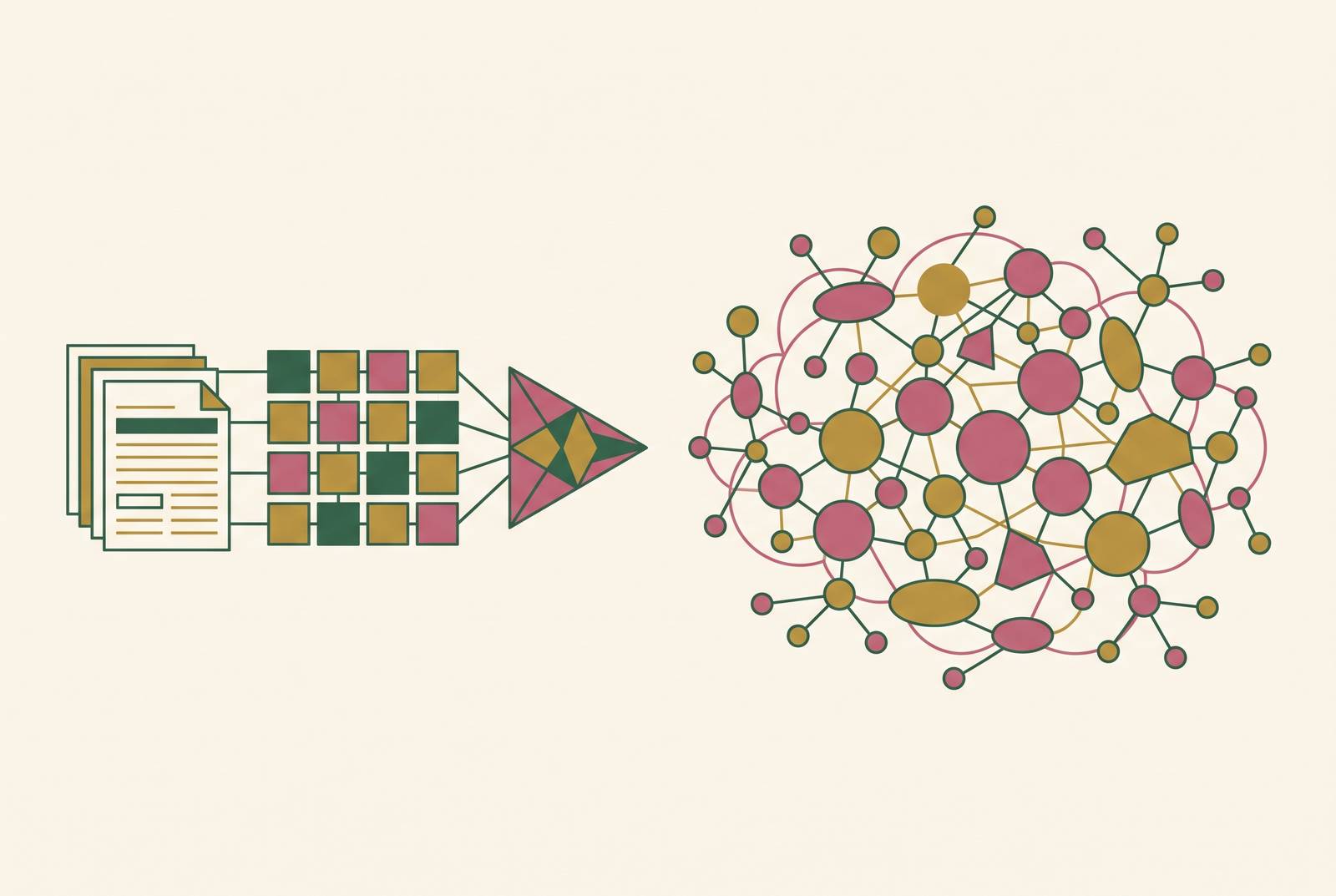
So does specialist AI beat general-purpose models? There is no one answer. That result alone should give pause to anyone who assumes narrow, domain-tuned systems automatically win on professional tasks: on semantic question-answering, general-purpose scaling has caught up to, and passed, purpose-built clinical tools.
The two tasks, semantic question-answering and structured document parsing, look alike from the outside, but you need entirely different capabilities to do them. When it comes to document parsing, the strengths that let general-purpose models win on clinical queries do not help. Layout reconstruction, reading order, table structure, and field extraction are spatial reasoning problems, and general-purpose LLMs have not been trained to solve them, so the gap between specialists and generalists on parsing tasks has widened rather than closed. The rest of this piece stays on that second fault line: document parsing and extraction, where the right answer to "specialist or general-purpose" is specialist, and where the reasons why matter for anyone building a production pipeline.
What document parsing actually requires that general-purpose LLMs were not trained to do
Document parsing is a spatial problem before it is a language problem, and that single fact explains why throwing a bigger model at it has not closed the gap. Traditional OCR handles clean printed text well but degrades sharply once it meets complex layouts, handwriting, or dense tables, and it gives back no signal about how much to trust any given output, so every line still needs a human to check it. That absence of a confidence signal is not a minor gap.
That single-pass design is the real shift from the old pipeline architecture, where OCR, layout detection, and parsing ran as three separate stages, each one blind to what the others saw, and each one capable of losing spatial relationships that the next stage never recovered; the critical advance is unified layout intelligence, in which vision-language models trained on document data handle the full pipeline in a single pass, preserving the spatial relationships that sequential pipelines lose.
Table extraction makes the problem concrete. You need to detect rows, columns, and merged cells all at once, but general-purpose models approach that token by token rather than spatially. A model reading text left to right has no native way to know that a number three inches below a column header belongs to that column, particularly when a merged cell or a nested sub-table breaks the grid. General-purpose LLMs have been trained overwhelmingly on text that came from documents, not on the rendering and layout problems that produced that text in the first place. They have learned to read the output of good parsing. They have not learned to do the parsing.
The OmniDocBench Leaderboard and the Performance Gap in Practice
The clearest evidence for this split sits in the numbers. As of OmniDocBench v1.7, the top three performers on the leaderboard, TeleOCR, OvisOCR2, and Baidu's PaddleOCR-VL-1.6, are all compact open-source specialists, and they lead ahead of frontier general-purpose vision-language models that carry orders of magnitude more parameters. Scale alone does not win this task. A five-point difference per document sounds survivable until it is multiplied across a month of invoices, claims, or loan files, at which point it becomes a predictable volume of silent errors.
The fact that the leading specialists are open source also matters for anyone evaluating them. It means the performance advantage is not locked behind a single vendor's claims, and any team can reproduce the comparison independently rather than taking a sales deck's word for it. General-purpose AI benchmarks broadly have saturated at this point. That is why vertical evaluations like OmniDocBench now carry real weight in procurement decisions: they test the specific spatial reasoning that generic leaderboards never isolate.
None of this settles the matter on its own. A benchmark is a curated set of documents, evaluated once, under conditions a vendor or research team controls. Production documents are messier, they arrive less consistently, and they get processed thousands of times a day rather than once for a leaderboard entry. But does the benchmark gap hold up once a pipeline leaves the lab?
Why benchmark scores understate the gap once documents reach production
Production conditions make the specialist advantage larger, not smaller. The clean, well-scanned, well-formatted documents that populate most benchmarks are exactly the conditions under which general-purpose models look their best. Layout variation, compounding hallucinations, and the absence of any confidence signal all raise the error rate once real documents start moving through a pipeline, and each one amplifies the errors that follow it.
Hallucination risk is not constant across use cases. Stanford's RegLab found general-purpose models hallucinating on the large majority of legal queries tested, so you can see how sharply hallucination rates climb in high-stakes document domains even while the same models post strong aggregate scores on general benchmarks. A model that hallucinates occasionally on open-ended trivia questions can hallucinate constantly on the specific, high-stakes language of a contract or a court filing, and a benchmark score averaged across easy and hard cases will never show you which bucket your documents fall into.
The deeper mechanism is what Microsoft Research's VeriTrail work identified as compounding error: in a multi-step document workflow, a hallucination introduced at one step gets treated as established fact by every step that follows it. By the time the pipeline produces its final output, one contaminated field early in the process has generated several more fields of confident, plausible-sounding, entirely wrong information downstream. No single-step benchmark can catch this, because single-step benchmarks test one extraction in isolation. Production document workflows are rarely one step. They are chains, and VeriTrail's finding means the chain itself is the vulnerability, independent of how accurate any one link looks when tested alone.
Confidence calibration sits at the center of why this compounding goes undetected. In 2024, models expressed the same confident tone whether they were right or wrong, giving a downstream system no way to tell a solid extraction from a fabricated one by looking at the model's own language. By 2026, top models have improved on this front, and their expressed confidence has become a more useful signal. But that calibration was built and tested on clean benchmark conditions, and it does not transfer cleanly once the documents get messy, scanned at odd angles, partially redacted, or formatted in ways the training data never covered. Enterprise agentic AI systems already show a real gap between what they score in a lab demonstration and what they deliver in production, with results dropping substantially when the same system is measured run after run rather than judged on a single successful pass. A pipeline's accuracy on day one tells you less than its accuracy across the thousandth run.
Confidence Scoring, Routing, and the Accuracy Calculus
The way out of this problem is a system that knows when to doubt itself. If a document pipeline scores its own extractions field by field and routes anything below a set confidence threshold to a human reviewer, you turn accuracy from a fixed, binary outcome into something you can tune directly.
A paper accepted at the RobustifAI Workshop at IJCAI-ECAI, held in August 2026, laid out a multi-signal confidence approach for LLM-based document field extraction, built on the premise that production deployments need to know when to trust a given extraction. A calibrated confidence score lets a team route only the low-confidence predictions to human review, so it cuts down on costly downstream errors while it keeps as much of the pipeline automated as the data allows. This works because the score aggregates several signals into both a per-field confidence number and an overall grounding rate, rather than asking the model to grade its own homework, a method that falls apart quickly on documents that differ from what the model was trained on.
Traditional OCR offers nothing like this. Every output carries the same implicit confidence whether it is right or wrong, so adding a real confidence layer on top of a general-purpose pipeline is a structural change in how the whole system handles the fact that it will sometimes be wrong. Threshold-based routing, where confident extractions move straight through and uncertain ones stop for a human, is what makes very high accuracy achievable on genuinely complex documents, because the system is built to recognize the limits of its own certainty rather than asserting the same confidence on every field it touches.
Extend's document processing platform is built around this exact architecture: its extraction APIs include confidence scoring that enables this kind of routing, and the company publishes its own open-source benchmarks, RealDoc-Bench, LongArray-Extract, and PoliTax Split, specifically to catch the silent failures, dropped rows, missed fields, that a plain accuracy score tends to hide. Catching those failures before they reach a downstream system, rather than discovering them after a human or an agent has already acted on bad data, is a design decision a pipeline has to make from the start.
The compliance requirements that make field-level auditability non-negotiable in regulated industries
Accuracy is only one axis a regulated team has to answer for. Regulated industries cannot treat a field-level audit trail as a nice-to-have, and general-purpose LLM APIs do not natively produce the provenance records that SOX, HIPAA, and PCI DSS require.
The specific retention windows differ by mandate, and the differences matter for how a system has to be built, not just how it has to be operated. SOX-relevant systems need seven years of audit workpapers and financial audit records, but they typically hold operational and system logs for just one year. HIPAA requires six years of retention. PCI DSS v4.0 requires 12 months of logs, with the most recent 3 months immediately accessible. None of these are requirements a team can retrofit onto a finished pipeline after the fact. They have to be designed in from the first line of the architecture.
General-purpose APIs typically hand back extracted text or structured output with no field-level provenance attached: no record of which model version produced a given field, at what confidence, pulled from which page. That output can be entirely accurate and still be forensically incomplete, because an auditor cannot reconstruct how it was produced. The same structural gap that Nature Medicine's study pointed to in clinical AI appears here by analogy: FDA clearance documents only that a regulatory process was completed. Compliance certification and fitness for purpose are not the same thing, and enterprise document workflows make that same substitution when they treat a vendor's certification as proof that its output can survive an audit. If you are a regulated team handling protected health information, financial records, or PCI-scoped card data, self-hosted or bring-your-own-cloud deployment is the baseline requirement for data that cannot transit third-party infrastructure at all.
The layered architecture that production teams are converging on
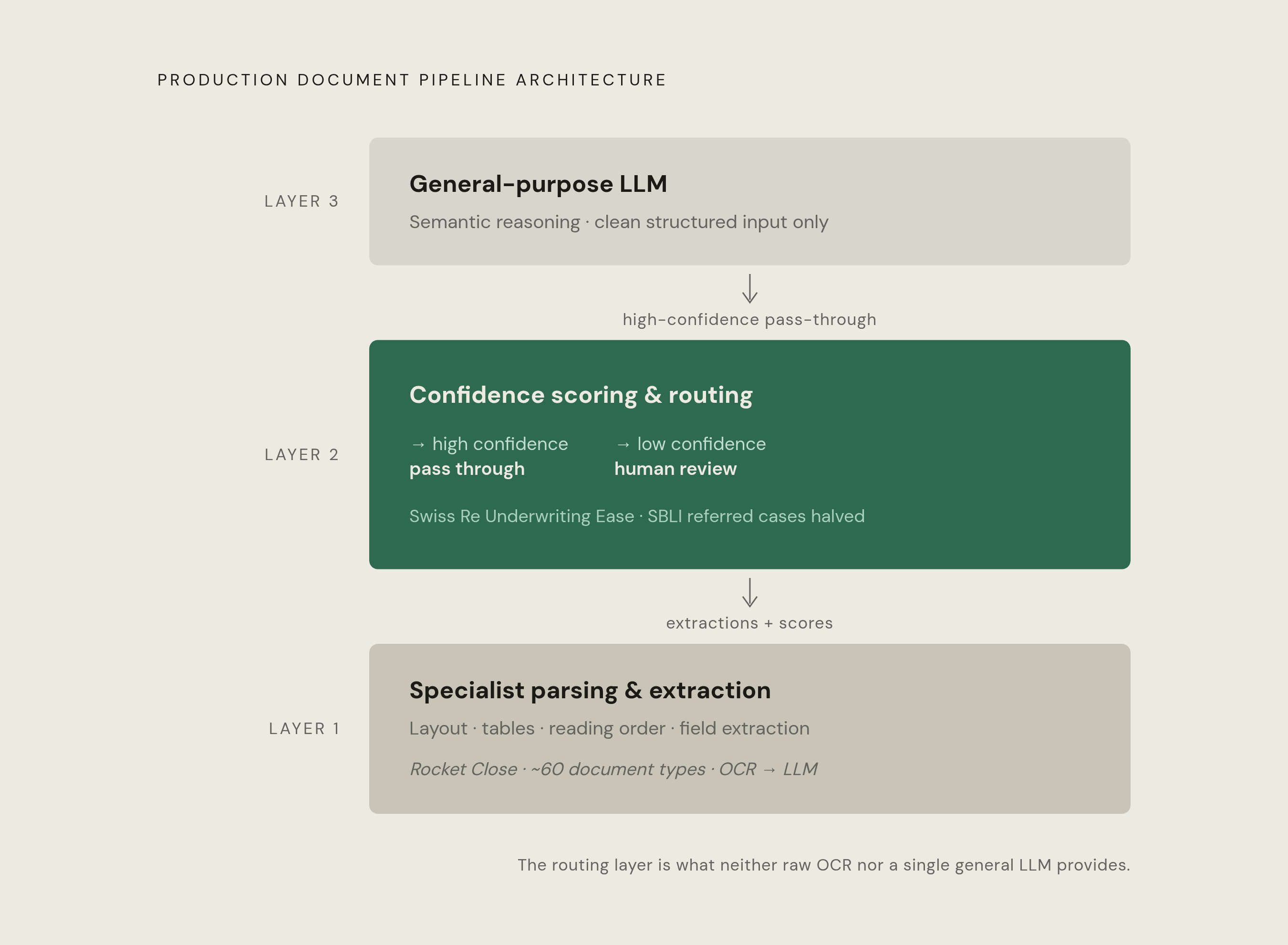
The answer production teams have converged on is a layered pipeline: specialist parsing and extraction at the foundation, general-purpose LLMs handling semantic reasoning above that layer, and a confidence-scoring and routing layer in between, with the quality of the whole depending on the quality of that first layer.
The strongest case against specialist document AI is maintenance. Models trained on specific form types can break when a layout changes, while a general-purpose model can often adapt just by adjusting the prompt, and that concern is real rather than a strawman. But a general-purpose model's average score on a broad leaderboard says very little about how it will perform on a specific task like contract review, mortgage document processing, or transaction monitoring, and the ongoing cost of prompt-engineering a general-purpose model into reliable parsing tends to run higher over time than the cost of running a purpose-built extraction layer underneath it.
Companies already running document pipelines at real scale bear this out. Rocket Close, affiliated with Rocket Companies, processes mortgage documents through a two-stage pipeline, OCR followed by an LLM, rather than handing the job to a single general-purpose model, and it handles roughly 60 distinct document types at high throughput, with Rocket Companies disclosing substantial efficiency gains and millions of documents classified in its Q4/FY2024 SEC filing. Swiss Re built its Underwriting Ease platform the same way, combining OCR, NLP, and LLMs to speed up manual underwriting on referred cases, and SBLI has reported that the platform cut processing time on those referred cases in half.
So neither of those hands the whole job to a single general-purpose API. Both are layered systems, where a specialist extraction layer does the spatial work a general-purpose model was never trained to do, and a reasoning layer sits above it to handle judgment calls once the structured data is already clean. For a team evaluating document processing infrastructure at scale, whether for mortgage files, insurance claims, or any high-volume structured extraction workload, that layered pattern is what the production evidence supports.