Document AI Vendor Landscape for Enterprise Pipelines
Most vendors stop at extraction, leaving the layers that determine production reliability unbuilt.
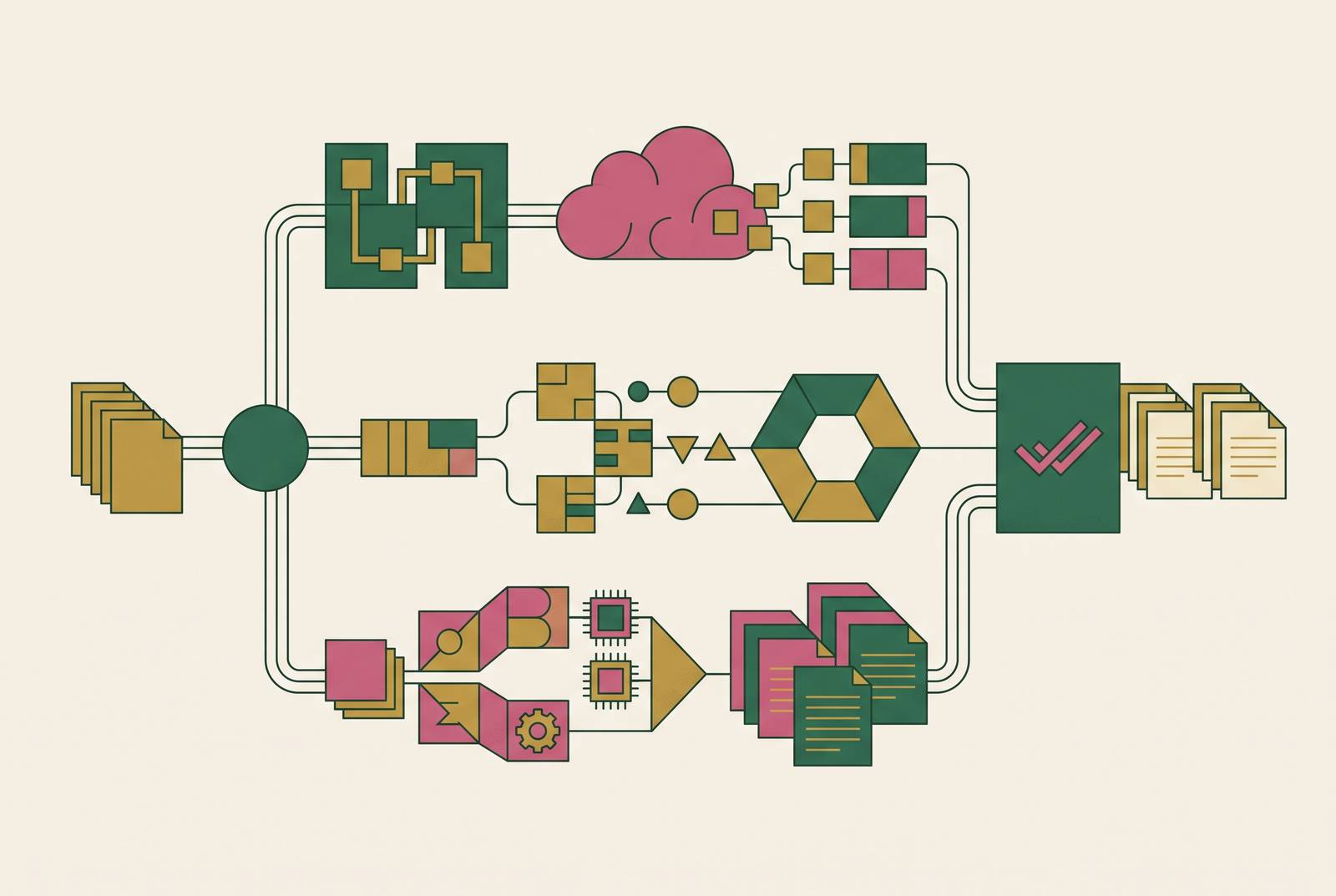
Choosing a Document AI vendor on demo accuracy alone is the wrong frame, because the layers that fail in production, verification, confidence routing, orchestration, rarely appear in a vendor demo at all. A well-rehearsed extraction pass on a clean sample document says almost nothing about how a system behaves on the fifteenth variant of a form it has never seen, routed through exception handling nobody tested. The pressure behind this shift is structural: the AIIM Market Momentum Index IDP Survey 2025 found that 78% of enterprises are now operational with AI in document processing and extraction, and the demand has moved from "make it fast" to "make it reliable". Pilots run against clean, controlled document sets routinely overstate accuracy by a wide margin compared to what Allata's production deployments record once real-world document variance enters the picture. The rest of this piece lays out the full pipeline a Document AI vendor needs to cover, layer by layer, so a buyer can tell whether a system demos well or holds up at volume.
The seven-layer pipeline that vendors rarely ship in full
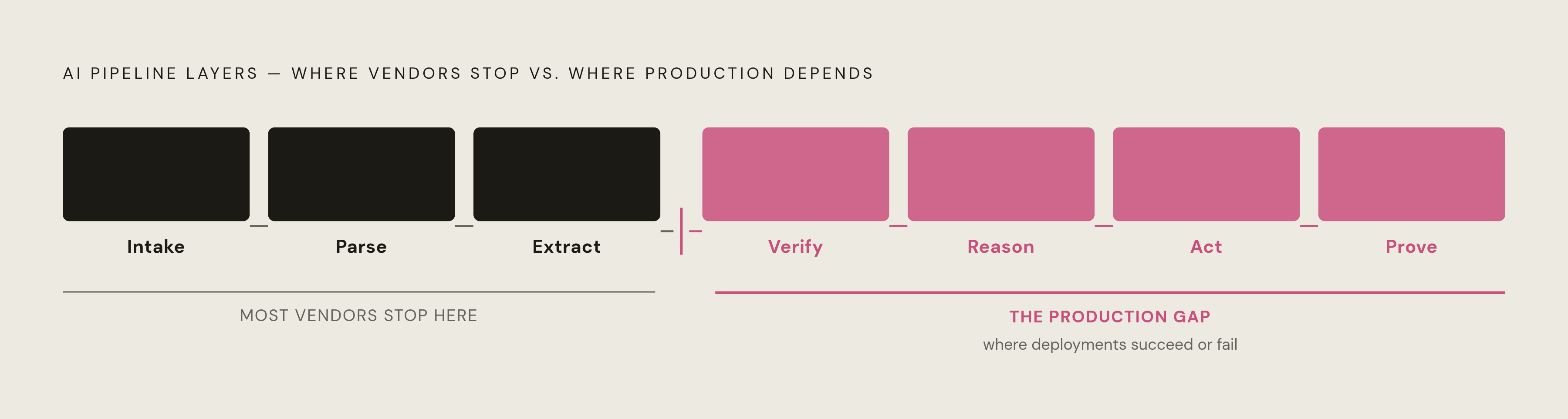
The architecture now taking shape across the industry has seven layers: Intake, Parse, Extract, Verify, Reason, Act, and Prove. Most vendors build the first three, Intake, Parse, Extract, and market the result as a complete platform, leaving the layers that actually decide whether a deployment survives contact with production volume unaddressed.
Intake covers document ingestion, format normalization, and the step that gets skipped most often: splitting a multi-document packet into its separate document types before any extraction logic runs. Parse converts raw bytes into a structured representation, and it keeps layout, tables, and spatial relationships intact instead of collapsing a page into an undifferentiated stream of text. Extract pulls field-level data against a defined schema, including relationships that span multiple pages or multiple documents in the same packet. Verify scores confidence, routes outputs against a threshold, and escalates uncertain cases to a human reviewer, and whether automation can run unattended depends entirely on this layer. Reason performs multi-step analysis grounded in the actual document rather than in whatever a model happens to recall from training. Act writes results back into the systems that depend on them, an ERP, a CRM, a data warehouse, or an agent's tool call. Prove generates the audit trail and attribution record that compliance and review teams need, so they can trust the output.
A buyer evaluating vendors should ask, for each layer, who owns it: the vendor, an integration partner, or the buyer's own engineering team. That question does more to predict production outcomes than any accuracy figure quoted from a sales deck.
Intake failures and their effects on downstream layers
Intake is the least glamorous layer in the stack, and it's also where the most expensive and least-scrutinized vendor differences live. A mortgage file averages 15 to 25 distinct document types bundled into one submission; a claims packet arrives as a form stapled to receipts and correspondence. A 90-page inbound file processed as a single document means every extraction result, every classification, and every verification check layered on top of it is wrong from the start, because that single document split created the wrong structural premise for all of it.
Platforms built to handle this pair specialized vision models with dedicated parsing and reconciliation pipelines designed around document boundaries, because this is where raw frontier models tend to lose context and fail. Extend takes this approach, using vision models paired with purpose-built reconciliation logic to turn document splitting from a source of silent failure into a managed, predictable step in the pipeline. A splitter has to hold context across chunk boundaries reliably enough that a mortgage file's twenty-plus document types each get separated and routed correctly, not approximately correctly, because getting this wrong misroutes documents before any extraction logic runs.
Even if a system gets splitting right, it accomplishes nothing when the layer above it, parsing, throws away the layout information that gives the split documents their meaning.
What parsing quality determines downstream
Parse quality decides whether a downstream AI system receives structured, usable data or a stream of text that someone on the operations team has to clean up by hand, and the gap between those two outcomes is wider than most vendor evaluations capture. Databricks' OfficeQA Pro benchmark found that frontier agents score poorly on average at enterprise grounded reasoning when given direct access to raw document corpora; feeding those same agents a structured representation from Databricks' ai_parse_document instead produced a 16.1% average relative gain in performance. Parse quality moves agent output quality by a measurable amount, which is reason enough to treat parsing as a serious evaluation criterion rather than a commodity step vendors can be assumed to handle equally well.
Character recognition and document understanding are not the same task. Reading characters off a page and stopping there flattens a document into a stream of text, discarding the table structure, headers, and spatial layout that give the data its meaning. A system that preserves tables as tables and headers as headers, with reading order and spatial relationships intact, hands a downstream agent something it can actually reason over.
The parser market spans a wide range of cost and capability. Mistral OCR 4 and Datalab Parser sit at the lower-cost end, Claude Fable 5 occupies the premium tier, and open-weight self-hosted options including MinerU2.5-Pro, Infinity-Parser2-Pro, PaddleOCR-VL, and Surya OCR 2 compete seriously for teams with the infrastructure to run them; a benchmark published at usefulai.com documents this landscape. MinerU2.5-Pro, built by OpenDataLab and confirmed as a leading open-weight option in current benchmarks, is documented in arXiv:2604.04771 (2026) as a data-centric document parsing system, under the paper title "Pushing the Limits of Data-Centric Document Parsing at Scale". The structured document representations that platforms like Extend produce, preserving tables, spatial relationships, and reading order as a core part of the pipeline rather than an add-on, are what let agent reasoning and extraction accuracy improve downstream, and that compounding effect is the real argument for treating parse quality as a first-order evaluation criterion.
Benchmark proliferation and the difficulty of cross-vendor parse comparison
Comparing parsers across vendors runs into a problem before accuracy even enters the conversation: too many overlapping, non-identical academic benchmarks exist. OmniDocBench, ParseBench, olmOCR-Bench, and ExtractBench (arXiv:2602.12247, 2026) each test somewhat different things, which lets a vendor cite whichever benchmark happens to flatter its own numbers and makes a clean apples-to-apples comparison difficult without a shared test set.
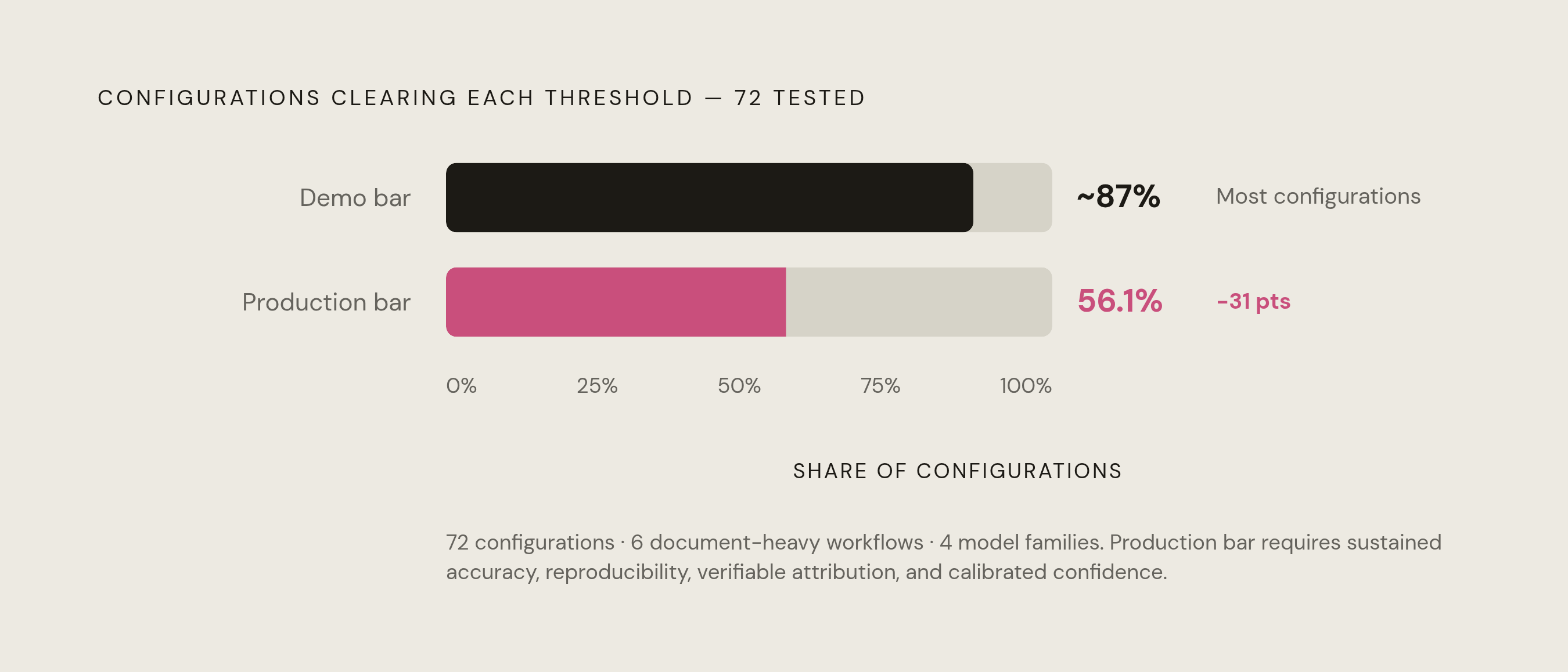
Clearing a benchmark and surviving production are different achievements. A system can produce one correct run for a demo without sustaining the accuracy, reproducibility, verifiable attribution, and calibrated confidence signal that production demands over months of real traffic. A study of regulated financial services document workflows covered 72 configurations across six document-heavy workflows and four model families, and found that most configurations cleared the demonstration bar, but only about half cleared the production bar. That survival rate is why you should insist on production-equivalent test conditions before you sign a contract, instead of accepting a showcase demo as evidence of anything.
A credible vendor evaluation rests on published performance against recognized public benchmarks, not on an internal accuracy claim a vendor cannot show its work for. You should ask whether a vendor has published its methodology alongside any headline number. Extend publishes open-source benchmarks, RealDoc-Bench, LongArray-Extract, and PoliTax Split, built specifically so its accuracy claims can be checked against real-world documents rather than a curated test set designed to flatter the result.
Confidence scoring is the layer that determines whether automation can run at all
A model that reports high confidence while being correct far less often than it claims makes threshold-based automation unworkable, because the routing logic separating straight-through processing from human review depends entirely on that confidence signal being trustworthy. Without calibration, none of the gains made at the parse and extract layers can be operationalized safely, because nobody can tell which outputs to trust without checking all of them by hand.
The practical cost appears in exception handling: if the fallback for every uncertain case is a human inbox, the process has not been automated, only the easy cases have been. Completeness is a separate failure mode from calibration, since a system can answer confidently and correctly every time while still leaving out a large share of what it should have answered. The July 2026 study across six document-heavy workflows found that only 56.1% of configurations cleared the production bar requiring sustained accuracy, reproducibility, verifiable attribution, and a calibrated confidence signal. A system can be right every time it answers and still leave out a large share of what it should have answered in the first place, and that gap matters more for a live deployment than the headline accuracy number a vendor leads with.
Calibrated confidence is what makes a routing policy possible in practice: high-confidence outputs proceed automatically, medium-confidence cases route to a reviewer with the fields already pre-filled, and low-confidence cases escalate as a structured exception record rather than a vague flag. Without that routing, every output needs manual verification regardless of how accurate the underlying extraction was. Extend's confidence scoring pairs calibrated model outputs with a multi-pass review agent that checks extractions before they reach production, an architecture that resembles what Meibel describes as managing output scoring across multiple dimensions before release, and it points toward where more sophisticated evaluation stacks are headed.
Extraction failures on large arrays and high-volume document types
Standard extraction benchmarks score field-level correctness only on the fields a system actually returns. They don't penalize a system for rows it silently dropped. A vendor can score well on a published benchmark while failing badly on a real invoice with many line items or a long table split across pages.
Finance is where this failure costs the most: finance and accounting account for 37.2% of Document AI use cases. Businessware Technologies' IDP benchmark found that ensemble approaches combining multiple LLMs raised average invoice extraction accuracy substantially, and the gap they closed sat almost entirely in completeness rather than in per-field accuracy. Engineering drawings present a harder version of the same failure: the same benchmark tested six LLMs on extracting dimensional and tolerance data from real mechanical engineering drawings, where a dropped dimension is a production defect rather than a rounding error in a scoring report. Logistics shows what the gap costs at scale: automating shipping document generation cuts documentation lead time and reduces coordinator workload substantially, but only when extraction completeness is high enough that downstream systems receive full records rather than partial ones.
Extend's LongArray-Extract benchmark was built specifically to penalize silent row dropping, so it treats completeness as something to measure directly rather than something a benchmark assumes. Complete extraction only pays off, though, if the data it produces actually reaches the systems waiting on the other end of the pipeline.
The orchestration and integration layer that most vendors treat as the customer's problem
A platform that handles parsing and extraction well but leaves integration and audit-trail construction to the buyer's engineering team has shifted the hardest and most time-consuming part of the project downstream, which makes the platform worth less than its feature list suggests. Meibel's analysis puts this directly: the first two pipeline stages, ingestion and extraction, are where most platforms compete on features, but the third and fourth stages, confidence scoring and integration depth, are where production systems actually succeed or fail. A platform strong on the first two and weak on the last two can end up costing more in engineering time than it ever saved on extraction accuracy.
Integration depth looks different by industry, but it's never optional. In finance, AP automation needs ERP write-back into systems like SAP, Oracle, NetSuite, or Dynamics 365, plus three-way matching, not extraction output sitting in a staging table. In healthcare, EMR upload automation, HIPAA-compliant audit trails, and CMS form routing are what turn an extracted field into something of clinical value. In logistics, extracted shipping documents need to land in TMS and procurement systems with complete records before any reduction in documentation lead time materializes.
Practitioners working through 2026 architecture decisions have converged on a useful rule: for a stable, high-volume document type arriving from a known sender, a deterministic pipeline runs faster, costs less, and audits more easily than an agent-based approach. The right orchestration choice depends on how variable the documents actually are, not on which approach is newest. Extend ships APIs for workflow orchestration alongside its parsing and extraction layers, with SDKs in Python, TypeScript, Java, and Go, an open-source CLI, a UI kit, agent skill templates, and a Model Context Protocol server for AI coding agents, which keeps the integration layer inside the platform rather than turning it into a separate engineering project.
Enterprise security and compliance requirements that eliminate vendors before the accuracy conversation begins
For enterprises in healthcare, financial services, or any operation spanning multiple jurisdictions, security and compliance certification functions as a hard filter. A vendor that can't clear it gets removed from the shortlist before anyone compares accuracy numbers.
Procurement, security, and legal teams tend to reference the same regulatory anchors by name: the NIST AI RMF, which now includes a GenAI Profile, and ISO 42001, the AI management system standard most enterprise buyers expect a vendor to have addressed. A vendor that can point to alignment with both has already cleared a bar that has nothing to do with how well its parser handles a line-item table. Buyers evaluating Document AI vendors for regulated workloads should treat this as a precondition to check first, not a box to tick after the accuracy conversation has already picked a favorite.