Upstream Model Update Failures in Document AI Pipelines
Silent model updates break document pipelines without triggering alerts.
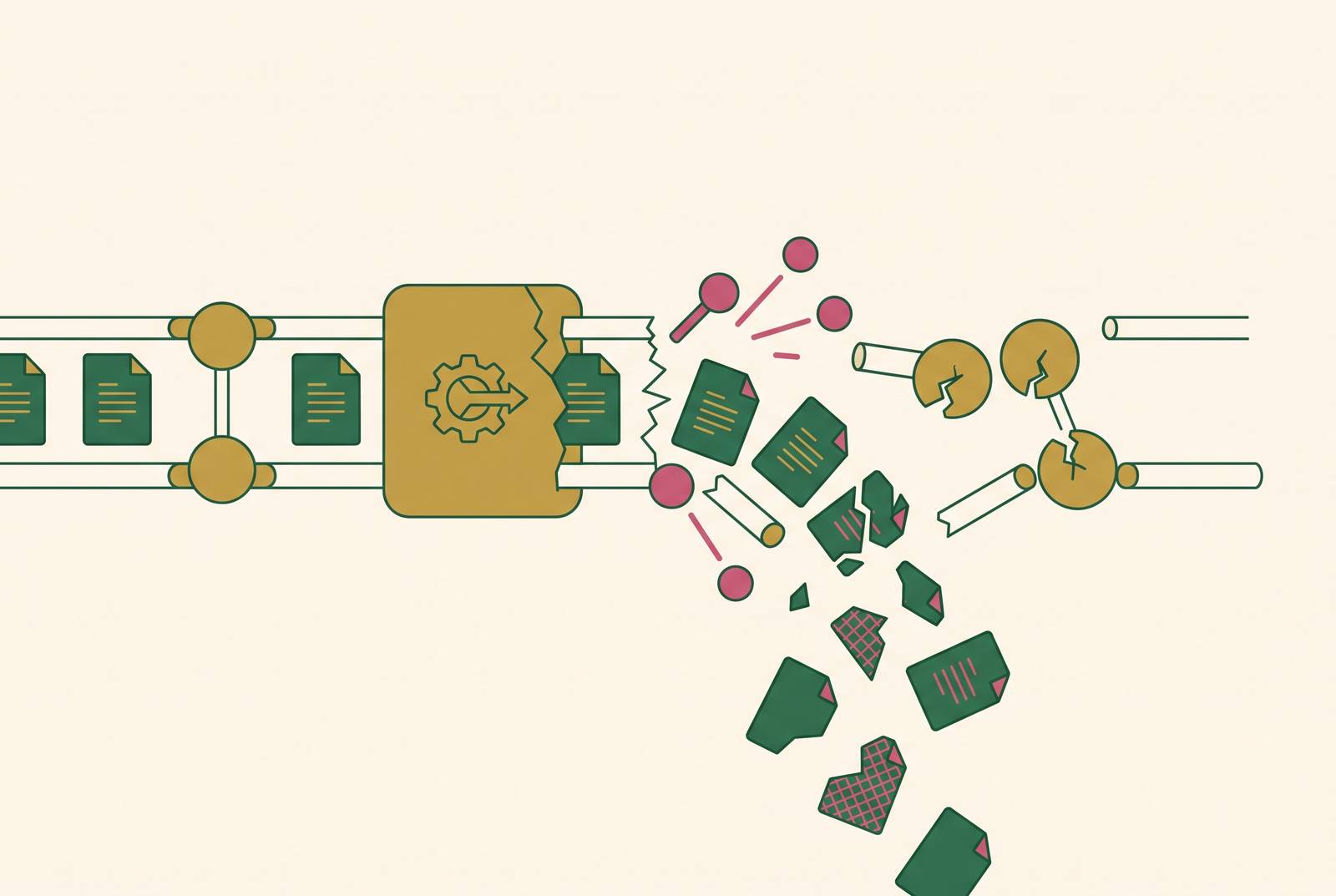
Upstream model changes can break document AI pipelines without interrupting service. Extraction accuracy, output formats, and downstream agent behavior can regress while the pipeline appears healthy. The engineering response is not better prompting or a more capable model, but a system harness that continuously tests behavior, isolates changes, and contains failures before they spread.
Why document AI pipelines fail silently when upstream models change
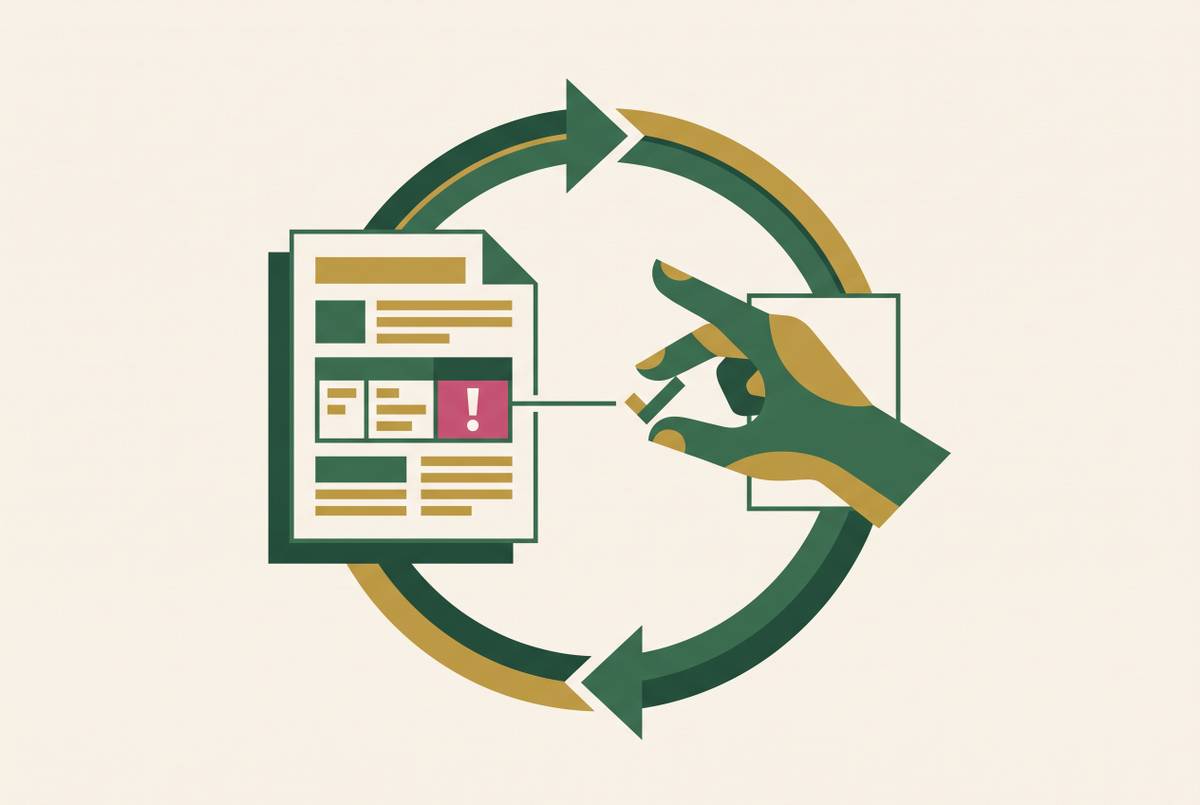
A pipeline owner has changed no code, the API is returning 200 OK, and document extraction has quietly degraded. Previously correct field attributions now assign values from incorrect document locations. Structured output or tool-call ordering may also have changed, disrupting a workflow that previously produced steady results. The pipeline still runs because its connection to the provider works, even though the behavior behind that connection no longer matches what the owner evaluated.
The structural cause is that pipeline owners do not control the model weights or the surrounding serving system. Providers can change behavior through fine-tuning, classifier updates, system prompt revisions, retrieval changes, and routing changes without a version increment or public disclosure. This class of event is called a “silent update.” The model identifier can stay the same even when the behavior changes. For document pipelines, that distinction matters because downstream processing depends on the extraction contract.
Why standard monitoring cannot detect accuracy regression in document extraction
Standard monitoring checks whether a service responds, how long it takes, and whether requests fail. Those checks are still needed, but they cannot tell whether an extracted value belongs to the right field. The API can return HTTP 200, health checks can pass, and the model can keep producing consistently, confidently wrong extractions. Latency spikes and schema validation failures sometimes provide a warning. An accuracy regression, however, can leave both response time and output structure within their expected bounds.
Hard downtime is still worth planning for because 5xx errors and timeouts stop work outright. Yet downtime is usually detectable and actionable through established runbooks. Degraded output is harder because it can move through the pipeline as valid input. In a multi-agent workflow, an extraction error can corrupt downstream stages without a runtime error exposing its origin.
The MAST taxonomy, accepted to the NeurIPS 2025 Datasets and Benchmarks Track, analyzed over a thousand annotated execution traces across seven frameworks. It identified fourteen failure modes, including ignored input and reasoning-action mismatch, that need not produce an exception. These failures show why a successful execution is not proof of a correct result. The provider’s changelog is written for prospective users and rarely discloses behavioral compatibility breaks, leaving deployers without the information needed to judge whether an existing workflow remains sound.
What the disclosure gap looks like in practice and why governance frameworks haven't closed it
Silent Updates: Measuring and Closing the Post-Deployment Disclosure Gap (Abraham & Bucknall, AIES-26) examined nine first-party API providers and seven inference hosts. It found that no provider in the sample published information allowing an external party to verify that the served artifact was the same one described in its documentation. This was not an absence of safety documentation. Providers published model cards, quantitative evaluations, and version-specific reports, but those materials did not show how the model they tested was linked to the one they deployed.
That missing link creates a chain-of-custody problem for governance. Safety evaluations, responsible scaling policies, and post-market monitoring obligations assume that an evaluated model can be linked to the deployed one. Yet most frameworks do not specify when a deployment change requires disclosure or re-evaluation. Documentation can fall short of what operational verification requires even when safety receives sufficient attention.
DeepSeek published V4-Flash as open weights in July 2026, then retired it from its own API on September 10, 2026, in favor of V4.1-Flash. The old deepseek-v4-flash API name stayed in place for a time as an alias routing to V4.1-Flash. Naming continuity was not artifact continuity.
The recommended deployer response to a checkpoint update is shadow evaluation, followed by retraining if the performance delta exceeds a threshold. That response places the verification burden on the team operating the pipeline. It is practical only if that team can evaluate changes at the pace providers make them. Teams without mature evaluation infrastructure cannot turn disclosure into dependable deployment decisions quickly enough.
Why document extraction accuracy is especially fragile when models change
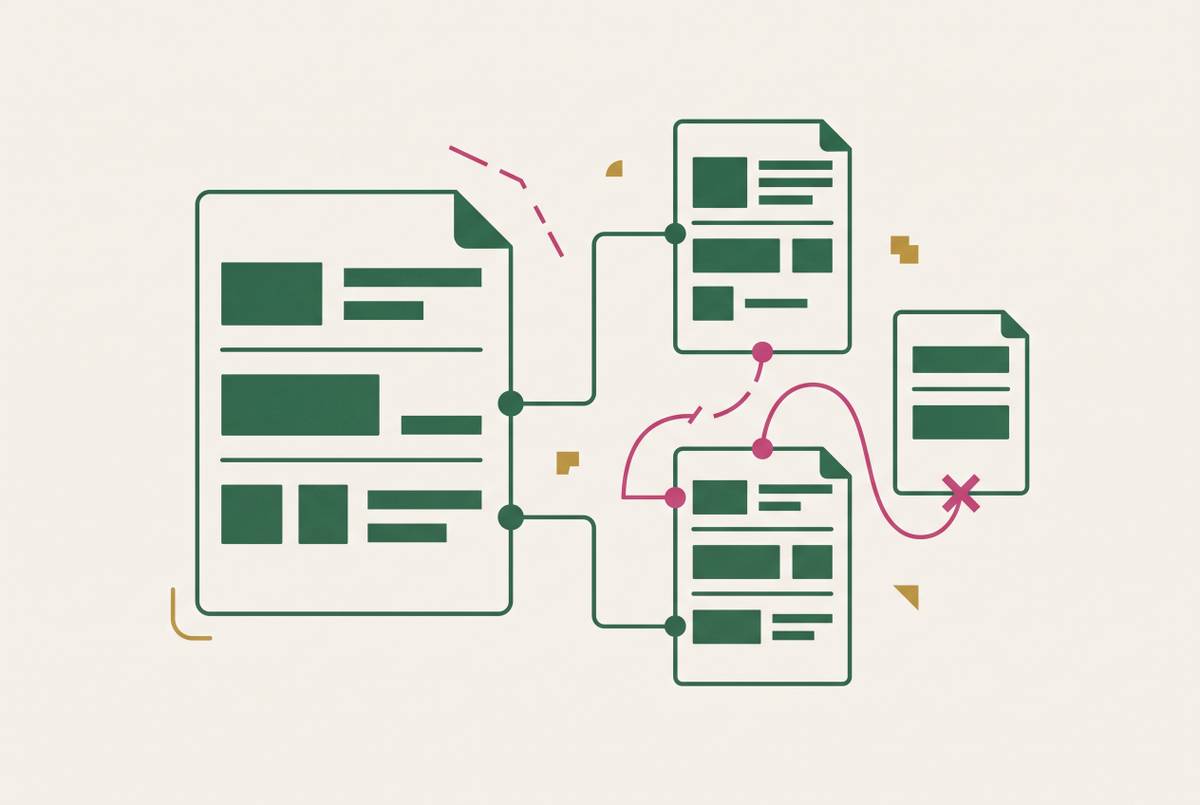
Correct reading order shapes how content is read, while field-level attribution shows which value belongs to which entity or record. Table structure preserves relationships across columns, and large-array completeness preserves every row. An extraction can keep the text readable while breaking any of these relationships. A model update that seems harmless in a general-purpose evaluation can still break a document workflow.
These requirements also interact, which makes isolated measures of accuracy insufficient. Correctly transcribed text is not useful to a downstream agent if the value has been assigned to the wrong field. A well-formed array can still omit rows, and valid structured output can still contain incorrect relationships. Evidence from regulated financial services workflows that handle many documents shows that most configurations fail at least one production requirement even before an upstream update. The production bar includes sustained accuracy, reproducibility, verifiable attribution, and an informative confidence signal.
ParseBench (arXiv:2604.08538, 2026) reinforces this distinction by finding residual content-faithfulness errors even in the strongest system and weak visual grounding in vision-language models. Historical benchmark coverage has also favored well-formatted digitally born documents and a limited set of languages. MDPBench, PureDocBench, and MORE have begun to address multilingual and degraded-document evaluation, but broader coverage does not make a single aggregate score sufficient. Accuracy without a document-type breakdown conceals the local failures that matter to production. A silent update can make a configuration that seems good enough fail in the very places where those weaknesses are hidden.
What a production-grade harness does to detect and isolate upstream model changes
A production-grade harness treats model behavior as an external dependency that it must keep checking. Its first job is to test the full extraction path. For an insurance claims pipeline, a synthetic probe should process a known claim document and compare the structured output against a golden reference. That comparison tests the behavior the business depends on. Tracking latency, schema validation failures, and output format changes helps, but the extracted result still needs to be checked.
Isolation requires version pinning and a model registry that records the complete configuration evaluated for production. For a financial filings workflow, that record must include the model version, prompt version, retrieval config, and harness version. Without that context, a changed result cannot be reliably separated from a changed prompt, retrieval setup, or evaluation procedure. Version pinning remains useful, but the disclosure gap means that a pinned name cannot substitute for behavioral tests. The registry establishes the internal baseline against which an upstream delta can be investigated.
AI Model Lifecycle Guide 2026 distinguishes MAJOR changes to architecture, MINOR changes for retraining runs, and PATCH changes for configuration-only updates, including prompts, retrieval config, and thresholds. These distinctions make the nature of a deployment change explicit. The harness version belongs in the same record because evaluation results depend on the prompt and tooling configuration under which they were produced. For a medical records pipeline, a result obtained under a different extraction configuration is not evidence about the same tested artifact. The registry must preserve that distinction rather than treating the model name as the entire system.
Shadow evaluation then tests a candidate updated model against a fixed golden dataset in parallel with the production model before live traffic is routed to it. For financial filings, promotion must depend on a defined accuracy threshold for the extraction task. This makes the deployment gate a test of the pipeline’s contract. If behavior fails that contract in a time-sensitive insurance claims workflow, fallback routing must be automated. A fallback that requires an engineer to change configuration and redeploy cannot provide the containment the pipeline needs.
How confidence scoring and built-in evals turn the harness into a reliability layer
Deployment gates leave an unavoidable interval between evaluation and use. A model that passed on Monday may have been silently updated by Thursday, so a successful release evaluation cannot establish continuing reliability. Confidence scoring on individual extracted fields provides a production signal at the level where many document failures occur. A drop in confidence for a previously high-confidence field type is evidence of a behavioral shift. A single accuracy claim for the whole pipeline cannot show that change.
Field-level confidence must work with continuous evaluation. A fixed golden dataset runs against production extraction, and drift from the baseline triggers a review cycle before a downstream business process fails. Golden references check results against what is known to be correct, while confidence signals show changes across live document runs. This matters particularly when a regression affects only part of a document or a subset of field types and leaves the rest of the output plausible.
The objection is that confidence scoring adds latency and cost. That cost must be weighed against the cost of using uncertain extraction to make business decisions. ParseBench found that even the strongest system retained a nontrivial content-faithfulness error rate. In revenue cycle, financial compliance, and logistics document processing, extraction errors can lead to incorrect payments, compliance failures, or misrouted shipments. The reliability layer addresses those consequences rather than treating successful generation as the endpoint.
A confidence signal on every extraction is a machine-readable artifact about the behavior actually delivered to the pipeline. Combined with the model registry and evaluation context, it creates an internal chain of custody for production results. It gives the deployer evidence about how the recorded configuration behaved when the external chain is absent, while leaving the identity of the provider’s undisclosed artifact unverified.
What a production document AI architecture looks like when it is built to survive upstream changes
Field-level confidence adds evidence from live runs, and automated fallback routing contains detected failures. Each part answers a different reliability question. Together, they make the pipeline less dependent on the assumption that an upstream model name represents an unchanged system.
Reading order and layout fidelity matter because field attribution can break without any change to the text content. Large-array row completeness matters because dropped rows may cause no error or confidence warning unless row counts are checked against a known reference. Output schema stability matters because changed JSON key names or nesting depth can break downstream agents. These failures belong at the extraction boundary, where they can be detected before structured output becomes another agent’s input.
Benchmark infrastructure must therefore penalize broken table structure, dropped rows, and incorrect field attribution. The expansion of document parsing benchmarks reflects growing recognition that digitization quality and agent-ready extraction are different targets. No single benchmark yet covers all the ways a system can fail in production. Enterprise requirements including SOC 2, HIPAA, GDPR, and PCI add another reason to preserve evaluation context. A silent change in how PHI or PCI data is handled may trigger a compliance obligation that the pipeline owner cannot detect without field-level signals and a model registry.
The engineering standard is consequently a pipeline whose behavior remains verifiable even when the upstream model changes. Better prompting does not provide that verification, and choosing a more capable model does not remove the external dependency. The harness supplies the evidence and controls needed to operate that dependency in production. It is the infrastructure investment that separates production document AI from a collection of stitched-together prompt experiments.