Field Relationship Errors in Multi-Entity Document Extraction
Silent field-relationship errors hide wrong entity assignments that pass basic validation checks.
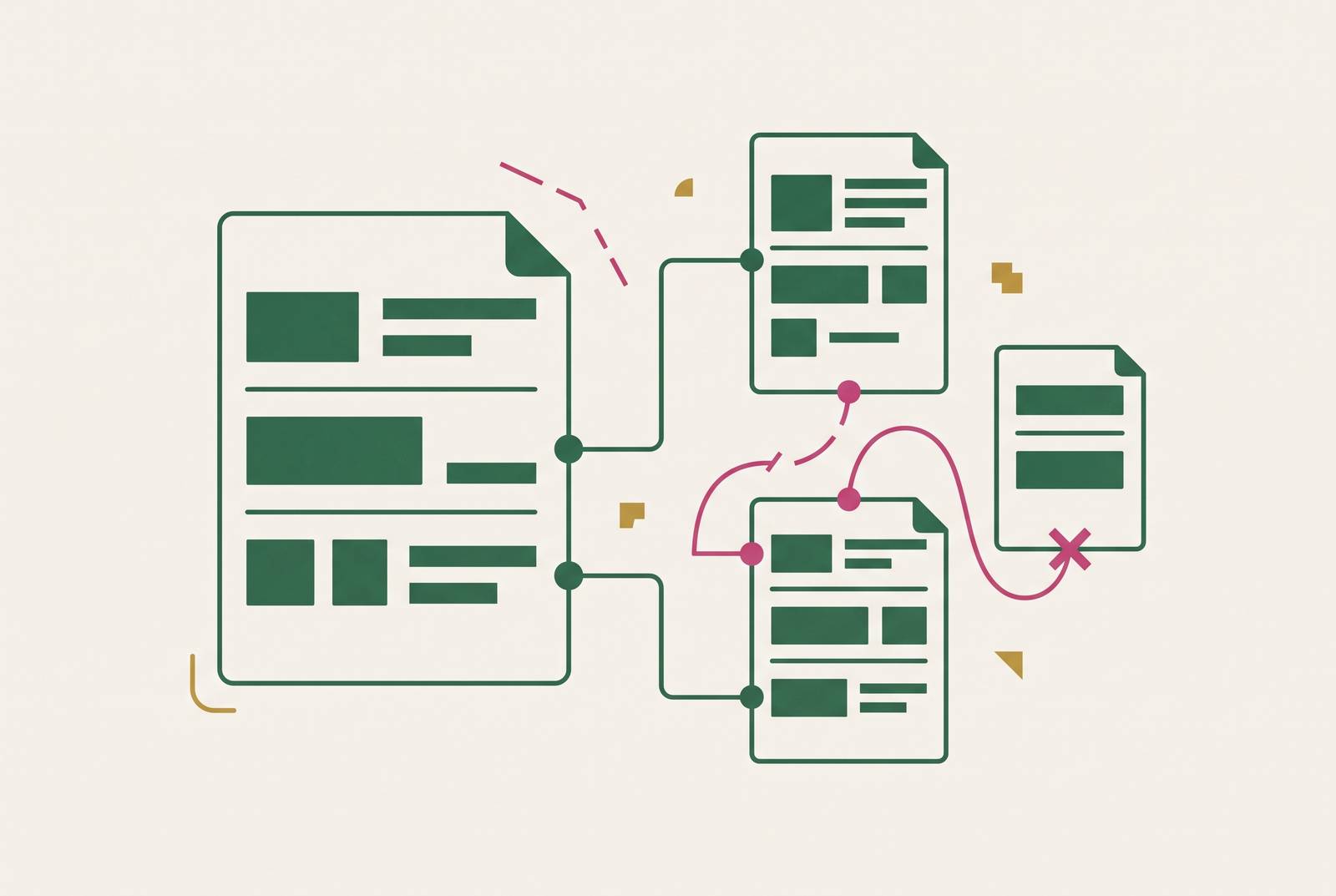
Field relationship errors in multi-entity document extraction put values with the wrong entities, even though the output looks valid. Preventing these silent mis-joins requires more than accurate value recognition. Pipeline architecture, entity-anchored schemas, deterministic validation, and source-grounded evaluation must preserve and test the relationship between each value and the entity it describes.
Why multi-entity extraction fails silently while single-field extraction fails visibly
A blank field shows that information is missing, while a field filled in with confidence can hide a wrong assignment. Single-field extraction failures can surface as empty values or schema parse errors that a pipeline flags immediately. A silent mis-join passes null checks and type checks because the value itself looks right.
Take two suppliers whose flame-retardant ratings are UL94 V-0 and V-2. A consolidated output that reports “compliant to UL94” contains neither an empty field nor an obvious formatting fault, yet it erases the material distinction between the suppliers. The record looks complete precisely where it has lost essential meaning. A better model may reduce such mistakes, but the output shape still gives no signal when one occurs. Without a check against the source, the error remains hidden until a reviewer examines the assignment.
How sequential pipeline architecture turns sub-task errors into compounding mis-joins
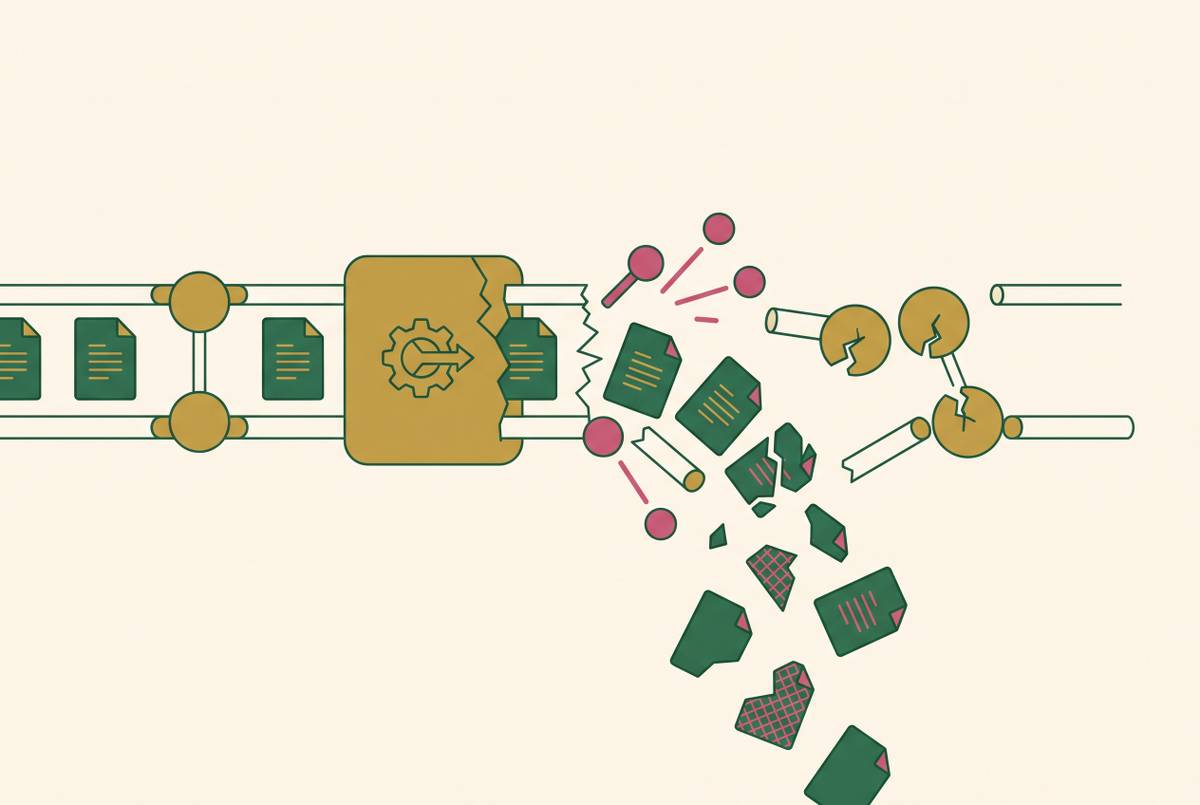
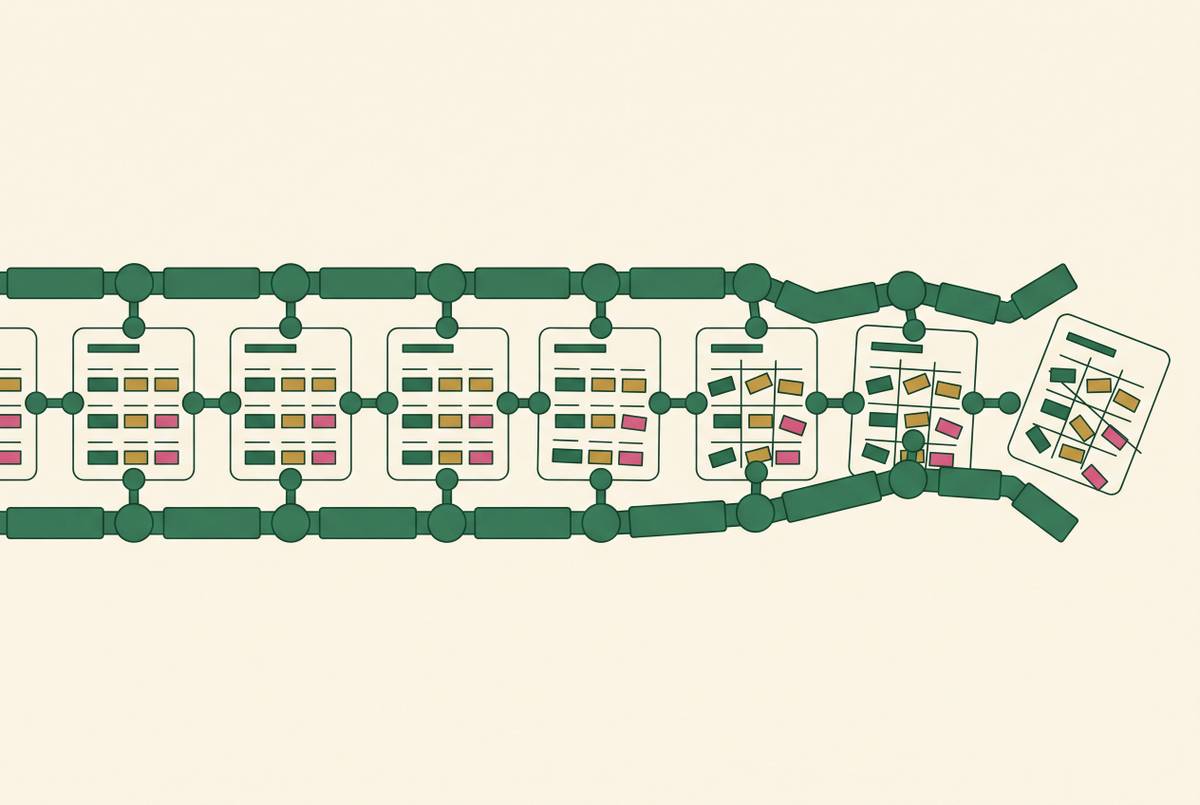
Sequential extraction turns uncertain intermediate decisions into facts that later stages inherit. Mention Extraction first identifies the text that refers to entities, so a missed mention or an incorrect boundary creates a broken anchor. Coreference Resolution then decides which mentions refer to the same real-world entity. If it misses a merge, relations attached to one mention do not carry over to the other. Relation Extraction finally classifies relationships between entity pairs, even when those pairs were malformed upstream.
The 2026 study Document-level joint entity and relation extraction based on multi-task explicit interaction identifies error propagation and limited cross-task information sharing as problems in traditional sequential frameworks. The architectural weakness is the one-way handoff, which gives later evidence no route back to an earlier decision. A Comprehensive Survey of Document-level Relation Extraction (2016-2023) notes that for a large share of relations in document-level datasets, reasoning must draw on more than one sentence. Consequently, a pipeline that loses context between stages misses more than isolated values. It loses the connections needed to assign those values correctly, and downstream classification cannot repair anchors it is required to accept.
The taxonomy of field relationship errors that sequential pipelines produce
Relation transitivity errors occur when the model fails to infer a valid relationship between two entities from their respective relationships with a third. The output omits a relationship that the document supports. A Survey of Document-Level Information Extraction also stresses the need to check when transitivity applies, since some chains do not support an inferred relation. Over-prediction errors run in the opposite direction, adding a relationship for which no ground-truth relation exists. The same survey identifies learned priors in large pre-trained language models as one reason an unsupported assignment can still receive high confidence.
Entity-relation understanding errors occur when the model misreads how entities are related and returns the wrong relationship. The CRE-LLM study finds that these failures account for the largest share of mistakes in its financial relation extraction analysis. It also identifies errors involving multiple relations between the same entity pair as another substantial group, where the output does not correctly represent the full relationship set. Each of these classes needs a different fix, but all can leave the output format intact. Comparison against the ground-truth field-entity mapping exposes what aggregate accuracy and confident presentation can conceal.
Where these errors appear in production documents across industries
Financial and KYC documents create ambiguous anchors through inconsistent terminology, including “revenue,” “income,” and “sales.” Currency unit ambiguity in multilingual documents adds the risk of magnitude misinterpretation. These errors may remain hidden until a downstream calculation produces an implausible result.
Logistics documents pose a different joining problem because, when shipments are split, one order has several bills of lading or proof-of-delivery documents. Duplicate shipment references across unrelated carrier documents can support a confident but incorrect join between records that do not belong together. A customs-adjacent field mis-assigned as plain description text can then remain invisible until a compliance audit.
In healthcare and pharma extraction, binary fields can be extracted reliably, while complex categorical fields are much less reliable, so field classes also matter. The gap varies by task and model, so an aggregate score can obscure the fields most vulnerable to incorrect assignment. By the time a remediation cycle, calculation error, or audit exposes the mis-join, the cost of correction has multiplied.
Why coreference resolution is the highest-leverage point in multi-entity extraction
Each mention must be assigned to the correct entity. Coreference resolution makes that decision across abbreviated names, pronouns, and role descriptions. When a merge is missed, one real-world entity ends up in separate nodes with its field values split between them. An over-merge does the reverse by unifying distinct entities and attributing one entity’s relations to both. Because the merged record can retain a plausible field set, this broader error may be no more visible than an isolated wrong value.
The joint-extraction study treats coreference resolution and relation extraction as mutually constraining tasks. Coreference structure limits which relation assignments are valid, while relation evidence can reveal that an earlier coreference decision was wrong. That bidirectional dependency makes coreference the highest-leverage point for controlling downstream assignments. A pipeline that resolves identity once and never revisits it cannot use later relationship evidence to correct the decision. Even with better relation classification, a key source of mis-joins remains because the classifier may still be checking the wrong entity pair.
How schema design either exposes or hides mis-joins before they reach downstream systems
An assignment can be tested only if the extraction schema gives it enough structure. A flat rating field shared by all suppliers holds a value but loses the link to the supplier it belongs to. An entity-anchored definition instead binds the rating to a named supplier node. A value that cannot be anchored can then fail validation or become an exception. Anchoring preserves the relationship that validation must inspect.
Each field-entity pair should also keep its source location, with both the page number and the page and region coordinates. When normalization converts units, maps vocabulary, or canonicalizes standards references, it must keep that reference and a record of the transformation applied. A source reference is therefore part of the field’s structure.
The schema must also represent every valid relation between an entity pair. If it permits only one relation where several are valid, it silently discards information even when extraction succeeds. That is a schema omission rather than a model error, but downstream systems receive the same incomplete relationship set.
Why deterministic validation catches mis-joins that model confidence scores miss
A mis-joined value may be syntactically valid and semantically plausible in the extracted context, giving the model little reason to report uncertainty. Deterministic validation tests whether the relationships in the output meet explicit constraints. A line-item total must equal the sum of its constituent values, and a party field must resolve to a known entity type. When documents share a shipment reference, all the fields they share must match.
The escalation pattern starts with deterministic capture of fixed fields and rule checks for every extracted value. Only fields that fail a rule check move to a second model from a different vendor. This directs additional scrutiny toward a concrete inconsistency rather than treating confidence as evidence that an assignment is sound. It also separates the role of validation, which detects constraint violations, from model escalation, which attempts to resolve them.
Running several copies of the same model does not provide the same independence. Models trained on similar data and reading the same document image can make correlated errors, so agreement may reinforce the mistake. A rule, registry lookup, or model from a different training lineage supplies a less correlated check.
How joint extraction architectures reduce the cascade failure that sequential pipelines cannot prevent
Validation detects inconsistencies after extraction, while joint architectures address the one-way decisions that create them. The 2026 joint-extraction study uses an explicit semantic alignment graph to support bidirectional information flow between coreference resolution and relation extraction. This lets relation evidence correct coreference decisions as well as use them. Coreference evidence, in turn, constrains the relations assigned to entity pairs. Hard negative sampling and uncertainty-based weighting support stable multi-task optimization, but the practical architectural change is the feedback path.
Entity-type constraints provide a complementary safeguard by favoring relations that match the declared types of an entity pair over relations that do not. This structural prior suppresses spurious assignments before a separate validation rule is applied. Scope narrowing addresses another source of interference by limiting which entities compete for each relation slot. Decomposing a document into bounded scopes before relation extraction reduces that competition compared with presenting the entire document as one unrestricted assignment problem. The distinction is not simply between single-stage and multistage processing, but between stages that preserve useful constraints and stages that pass uncorrectable errors forward.
What grounding-aware benchmarks reveal about mis-join rates that accuracy figures hide
Aggregate accuracy does not distinguish recognizing a value from assigning it to the correct entity. A strong overall score can therefore coexist with systematic mis-joins in a particular field class or entity type. Nested extraction makes this harder because correctness varies by field, including exact match for identifiers, tolerance for quantities, and semantic equivalence for names. Evaluation must also distinguish omission from hallucination. No principled evaluation methodology yet captures all of these semantics, so a headline figure cannot stand in for assignment-level analysis.
ExtractBench tags documents along five independent axes, namely task challenge, perception challenge, table structure, length, and business domain. That decomposition helps locate a low score in the structure of the task. It also reports order-insensitive value F1 for value accuracy and word- and page-level F1 for source traceability. Open-source benchmarks that separate errors by structural origin give engineers a more actionable signal than a single accuracy figure.
Grounding closes the connection between evaluation and the original assignment problem. A field-entity pair tied to a retrievable source span can be examined against its evidence, whereas a page number alone does not identify the supporting region. Without measuring source traceability, evaluation cannot distinguish a supported value from a hallucinated one that happens to match.
What a production pipeline architecture looks like when it is built to prevent silent mis-joins
A production design begins with entity-anchored schemas and document scope decomposition before relation extraction. Fixed-position fields on standard forms are captured deterministically so that later model-based stages have a reference frame that can be audited. Where identity and relationship decisions depend on one another, the extraction architecture allows evidence to flow in both directions. These choices reduce ambiguity before a value becomes a downstream assertion.
Before the extracted output is trusted, the validation layer checks it against cross-field rules, entity-type constraints, and cross-document consistency checks. A failed rule check triggers escalation of the field to a second, uncorrelated model. Traceability completeness forms a separate hard gate. Every consolidated field carries supplier ID, document ID, revision label, extraction location, and transformation applied, so normalization does not sever its connection to the source.
Evaluation uses independent, double-keyed ground truth that the model never sees. Accuracy is reported at field level with criticality weighting rather than compressed into one document-level result. The production measures are the escape rate of mis-joins reaching downstream systems and review effort per unit volume. Together, these controls make the assignment itself testable, which is the requirement that well-formed output and model confidence cannot satisfy.
Sources
- Document-level joint entity and relation extraction based on multi-task explicit interaction
- A Survey of Document-Level Information Extraction
- CRE-LLM: A Domain-Specific Chinese Relation Extraction Framework with Fine-tuned Large Language Model
- A Comprehensive Survey of Document-level Relation Extraction (2016-2023)