Layout Edge Cases That Break Production Document Parsers
Silent field drops happen when document layout shifts break parser assumptions.

Production document parsers break when layout changes invalidate the assumptions used to assign meaning to text. Shifted columns, page-spanning tables, mixed-content regions, and rotated scans reveal a coordinate-dependency that better character recognition cannot fix. Reliable parsing therefore depends on when the pipeline recovers structure, how it preserves that structure across pages, and whether it makes uncertain or missing fields visible before they reach downstream systems.
Why layout edge cases are the dominant failure mode in production document parsers
A field moves outside its expected bounding box, and the extractor silently drops it. The characters may remain perfectly readable, but the rule that connects their position to a field no longer holds. This is the central weakness of coordinate-dependent extraction. It treats the location of content as a stable contract, even when documents from different sources place the same information differently.
PDFs store content as positioned glyphs on a canvas. Because the format was designed for print, layout inference is an added layer. An OCR-first pipeline that linearizes a two-column insurance declaration can scramble its reading order before field extraction begins. A nested table can similarly lose the row-column relationships needed to interpret its values.
Once those relationships are wrong, later components inherit malformed input. A table header classified as body text can corrupt every field that depends on its label, while an LLM reasons over the resulting scrambled context. The damage can also cross page boundaries. A header misclassified on page 3 can break field attribution in a table five pages later.
The specific layout patterns that trigger silent failures
Table failures affect where cells begin and end and how rows and columns relate to each other. A totals row spanning the full width can become a separate single-cell table, while an embedded sub-header can become a data row. Right-aligned numbers shift when font output varies across PDF generators, causing silent cell misalignment. Merged cells can give the same value twice or be lost altogether. These are distinct structural errors even when the extracted characters look correct.
Multi-column failures concern reading order. Reading across both columns of a two-column page blends unrelated sentences into one stream, producing embeddings that encode nonsense. Scanned-document failures arise when there is no text layer and a non-OCR parser returns an empty string without an error. Encoding failures create another kind of invisible loss when ligatures such as "fi" and "ffi" use custom encoding maps that naive extraction turns into garbage or blanks.
When headers appear only on the first page of a table, subsequent rows lose their column identity if the parser resets its structural assumptions at each boundary. A section heading can also lose its governing relationship to a later table. Rotation failures stack two problems together, because skewed or rotated scans degrade OCR while also disrupting layout classification. These categories give engineers a vocabulary for locating the break rather than treating each bad document as random noise.
Why architecture — not model quality — determines which edge cases break a parser
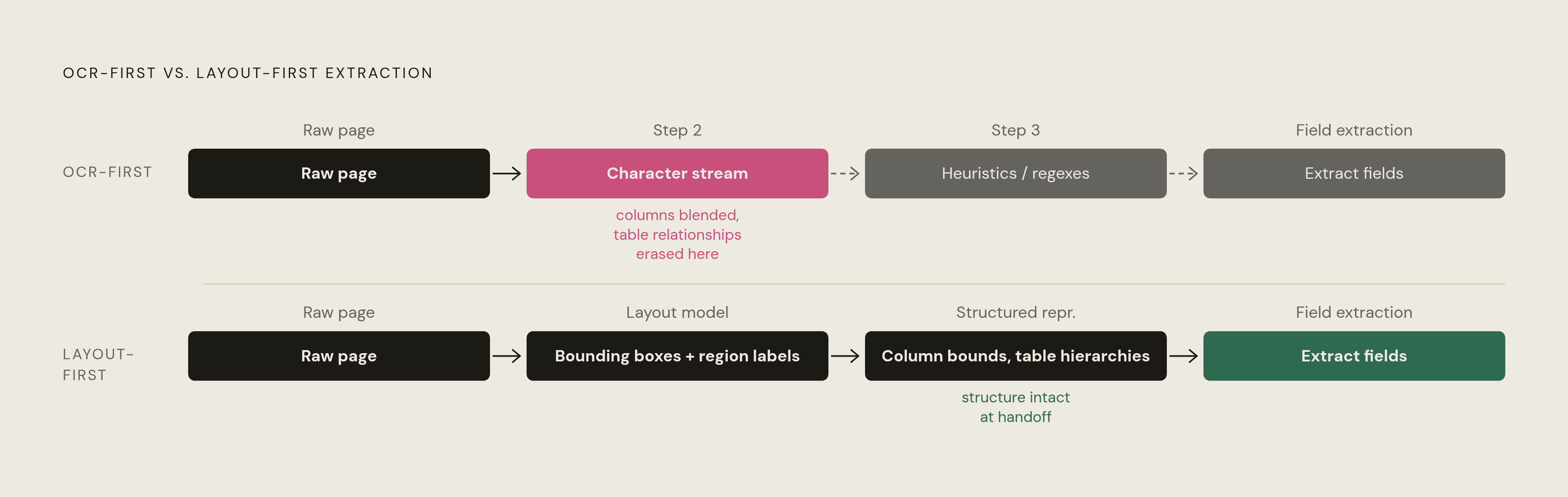
The decisive architectural choice is where spatial reasoning enters the pipeline. In an OCR-first design, text becomes a character stream before downstream components reconstruct its structure through heuristics, regexes, or rigid templates. If linearization has already blended columns or erased table relationships, a more accurate transcription does not restore those relationships.
A layout-first design reverses that dependency by recovering structure at the parsing layer. Field extraction receives a representation that already encodes column boundaries, table hierarchies, and reading order. Deep learning layout models see a page as an image and predict bounding boxes with region-type labels before extraction starts. This gives later components an explicit account of what each region is, rather than requiring them to infer it from flattened text. However, the models differ in how they retain spatial information and what inputs they require.
LayoutLM and its successors jointly encode text, layout coordinates, and visual features, but their OCR preprocessing preserves some coordinate-dependency. DiT operates on raw page images without requiring OCR input, removing the linearization step. Vision Grid Transformer (VGT) uses parallel streams to encode token-level and segment-level semantic relationships, improving detection on dense tables and multi-column layouts at higher computational cost. YOLOv8 instead trades fine-grained classification accuracy for sub-second detection per page. That speed suits high-throughput processing, but the classification trade-off matters on complex layouts.
Vision language models use the full visual page to work out which field a value belongs to. Spatial relationships, visual hierarchy, and semantic context can work together to identify a consignee location that runs over two lines beneath a merged header. Yet this ability introduces hallucination risk, because a model can invent content absent from the document. VLM-based parsing consequently requires validation and confidence scoring.
Training distribution remains a separate limit. DiT was trained primarily on tobacco-industry documents in the IIT-CDIP collection, which transfers poorly to dense financial tables and irregular business forms. High accuracy on PubLayNet, which contains biomedical research articles, likewise does not establish suitability for those documents. Selecting a model without matching its pretraining corpus to the target document type is an architectural mistake independent of recognition quality.
How these failures compound differently across financial, healthcare, and logistics documents
Financial documents amplify structural errors through density and variation. A 200-page loan packet can put income information in a different order for every originator, so coordinate-based rules break right away. Bank statements add semantic variation when one institution represents debits as signed integers and another separates debit and credit columns. Misclassified fields can then enter underwriting systems as ground truth without an extraction error. Across many extraction points, acceptable per-field accuracy can still yield a high rate of unusable records.
Forms combining typed fields with handwritten annotations stack failure modes, while insurance EOBs combine tables with dense prose that template extractors handle poorly. Separately, a tool that creates, receives, maintains, or transmits Protected Health Information on behalf of a covered entity becomes a HIPAA business associate, absent the conduit exception. Routing those documents through a third-party API without a BAA is therefore a compliance failure.
In real estate, state disclosure fields, county deed formats, and the structure of exhibits vary from place to place. Separate templates for those variations create a maintenance burden that scales with geography. Logistics exposes the same structural weakness through variable column counts in carrier documents. A column shift can become a consignee field error, with an operational consequence for each misrouted shipment.
Why standard accuracy benchmarks fail to surface layout edge case failures
Character-level accuracy measures whether text was recognized. A parser can read every character correctly and still map a shipper location into the consignee field. Field-level accuracy detects that attribution error, while structural accuracy asks whether tables, headers, columns, and multi-line entries retain their relationships. Collapsing a two-line location into one string can pass a character check while failing the structural check. No single recognition score answers all three questions.
Published document-processing benchmark results, including those associated with olmOCR-Bench, must therefore be distinguished from evidence about a particular production document mix. olmOCR-Bench (Poznanski et al., 2025) verifies simple, machine-checkable facts about document pages across seven category splits. These include old scans, old scans math, tiny text, tables, headers/footers, multi-column layouts, and ArXiv papers. That approach is closer to unit testing than composite scoring, but distribution mismatch remains a separate question.
Field-level averages can also conceal unusable documents because one wrong field may invalidate an entire downstream record. Born-digital invoices, insurance EOBs, scanned loan packages, and handwritten clinical notes occupy different accuracy tiers. A strong aggregate result does not establish performance on the multi-page tables, annotations, and variable layouts found in production. The measurement gap concerns both the relationships being tested and the documents chosen to test them.
What a real-world layout failure looks like end-to-end
A RAG deployment over factory documentation exposed this gap in a concrete production setting. Its PDF manuals had multi-page parameter tables and cross-references between chapters, and versions in 3 languages sometimes shared the same file. The manuals were cleanly printed, so poor OCR quality did not explain the failure. The parser had no way to keep structures such as tables without repeated headers, merged cells that spanned column groups, and cross-language cross-references intact.
The failure began with structural interpretation. Tables that continued across pages lost the relationships needed to reconstruct their rows in the right order. During extraction, machine parameter tables consequently emerged in the wrong order, merged cells became duplicates, and electrical diagrams were ignored entirely. These errors changed the organization and coverage of the material available to retrieval.
Retrieval then operated over documentation whose parameter relationships had already been corrupted. The deployment’s initial Hit Rate was 58%, below production-readiness for an industrial context. The same corpus had cross-page context loss along with failures in merged-cell handling and multi-column reconstruction, all at once.
What a parser needs to handle layout edge cases reliably in production
Layout-first detection must precede extraction. The model needs the full visual page so it can classify regions before their contents become a linear stream. Cross-page context must also be explicit, allowing column headers from page one to remain attached to rows on page five. With a mix of document types, model-based detection avoids the need for rule-based exception logic that grows with each new layout.
Every extracted value also needs a reliability score that can route uncertain results to human review. That score must be calibrated against the actual document mix, because thresholds that appear conservative on a test set can produce false positives in production. VLM output additionally requires validation to distinguish supported extraction from plausible hallucination. Setting the output schema before processing makes a document fail visibly if it cannot produce valid output. Precision and recall both matter, because one limits bad values while the other exposes missing ones.
Deployment constraints belong in the architecture as well. Sensitive document workflows require attention to capture, storage, transmission, and disposal, with healthcare processing subject to the business-associate requirements described above. Self-hosted and BYOC deployment options, zero data retention policies, and a HIPAA BAA address requirements identified for healthcare and financial services pipelines. They do not substitute for structural reliability, but extraction accuracy does not substitute for them either.
Open-source parsers such as PyMuPDF, pdfplumber, Camelot, and Apache Tika remain useful for clean, digitally native PDFs with predictable layouts. Their suitability depends on the specific problem rather than a blanket distinction between open-source and managed tools. Camelot, for example, detects tables through computer vision or text-alignment heuristics without requiring explicit region coordinates. Its accuracy nevertheless degrades on borderless or irregular layouts, particularly in stream mode, and scanned PDFs require a preprocessing OCR step.
How to evaluate whether a parser will hold on documents outside its training distribution
Evaluation begins with matching the parser’s pretraining corpus to the target document type, followed by building a test set around the actual failure surface. Include multi-page tables without repeated headers and documents from different sources that put the same field in different places. Add scans that have skew, low resolution, and background noise. Mixed-content pages should have tables next to dense prose, and the tables in the test set should have merged cells, spanning rows, and embedded sub-headers. These cases test the structural assumptions that clean examples leave untouched.
Measure character, field, and structural accuracy separately so correct transcription cannot conceal wrong attribution. Measure document-level pass rates as well, because approval and ingestion workflows need records they can use in full, even when field averages look good. Validate confidence calibration on the same document mix, requiring scores to predict extraction accuracy. Finally, treat fields dropped without an error as critical failures. A parser that omits a row without raising an error passes incomplete data downstream as ground truth, which is precisely the failure that better OCR alone cannot prevent.