Semantic Chunking for Document RAG Pipelines
Bad chunk boundaries tank RAG accuracy more than model choice.
Chunking, not model selection, is where most retrieval-augmented generation systems win or lose their accuracy. RAG adoption among enterprises hit 51% in 2024, up from 31% the year before, and the market is on track to reach $9.86 billion by 2030, so the scale at which a chunking mistake compounds is no longer trivial. The mechanism is simple to state and easy to get wrong: a retriever pulls chunks whose embeddings are closest to the query embedding. Retrieval quality is bounded by chunk quality from the start, and no reranker or generation model downstream fully recovers what a bad chunk boundary already lost. An embedding vector is a single compressed summary of whatever text sits inside the chunk. Stuff two unrelated topics into one chunk, a pricing clause and a security clause, say, and the resulting vector represents neither one well. Every component built on top of that vector, the retriever, the reranker, the generator, inherits the confusion. Vectara's peer-reviewed NAACL 2025 study, run across 25 chunking configurations and 48 embedding models, found that chunking configuration moved retrieval quality by as much as, or more than, the choice of embedding model itself. A separate benchmark from FloTorch held the embedding model and retrieval pipeline fixed and varied only chunking strategy, finding a 15-percentage-point accuracy gap between the best and worst approaches. This piece is not a tour of chunking tools.
What the four main chunking strategies do and cost
Four approaches are worth defining by mechanism rather than brand, since the tradeoffs live in how each one decides where to cut.
Recursive character splitting works through a priority list of separators, trying a double newline first, then a single newline, then sentence boundaries, then plain spaces, and takes the most meaningful break it can find inside a token budget. It's predictable and cheap: no embedding calls happen at ingestion, chunks come out consistently sized, and retrieval behavior stays stable. Its weakness is that it has no concept of topic. A paragraph about pricing and a paragraph about security will merge into one chunk if they both happen to fit inside the token window.
Semantic chunking computes an embedding for each sentence or paragraph, measures cosine similarity between neighbors, and splits wherever that similarity drops below a threshold. The threshold is the entire tuning knob: set it low and the pipeline splits often, producing small, tightly focused chunks; set it high and splits become rare, producing larger chunks that may quietly contain several subtopics. The workable range sits below roughly 0.75, where topic bleed starts to appear, and above roughly 0.85, where fragmentation gets excessive. A newer variant, late chunking, embeds the entire document first through a transformer and only then segments the resulting token-level embeddings, so each chunk inherits context from the whole document rather than just its local window.
Hierarchical chunking builds parent-child pairs: a large parent chunk for context, a smaller child chunk for precise matching. Retrieval works off the child, but the model that generates the answer receives the parent, so the system gets local precision and surrounding context at the same time. That comes at the cost of a more complex index and extra storage, a price worth paying when an answer needs both precision and enough surrounding material to be trustworthy.
Structure-aware chunking leans on a document's own headings, section markers, and page boundaries to group content. It produces highly coherent chunks when a document is genuinely structured, and it falls apart when the structure isn't there, in scanned PDFs, raw emails, or loose meeting notes. A page-level variant of this approach, tested by NVIDIA in 2024, hit 0.648 accuracy, the top score in that study and the lowest variance of any method tested, though only for documents that are actually paginated.
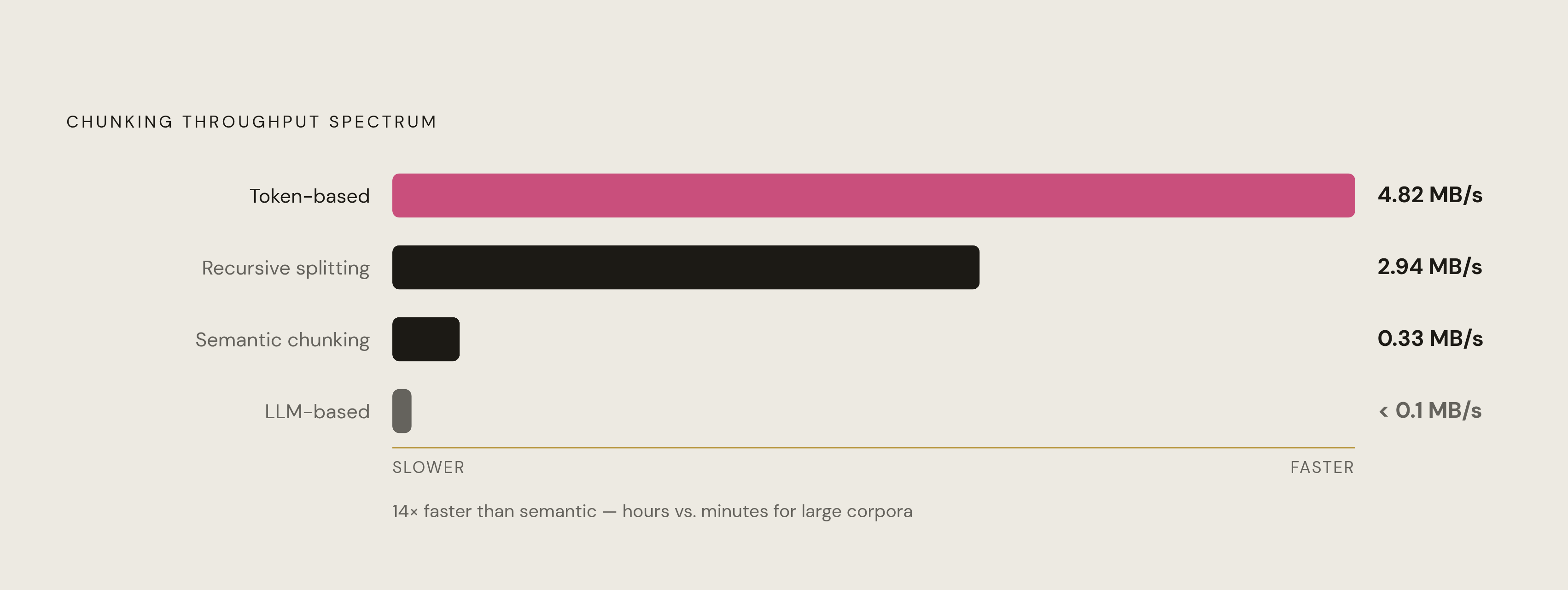
Laid end to end, the cost spectrum runs from cheapest to most expensive: token-based splitting first, recursive splitting close behind with a bit more parsing logic, semantic chunking next because it requires embedding every sentence, and LLM-based chunking last, which routes every document through a language model and buys the highest quality at the highest price. Chonkie's benchmarks show token-based chunking processing at roughly 4.82 MB/s versus roughly 0.33 MB/s for the alternative, a roughly 14x slowdown that translates to hours versus minutes for large corpora.
Semantic chunking's real-world performance in the 2026 benchmarks
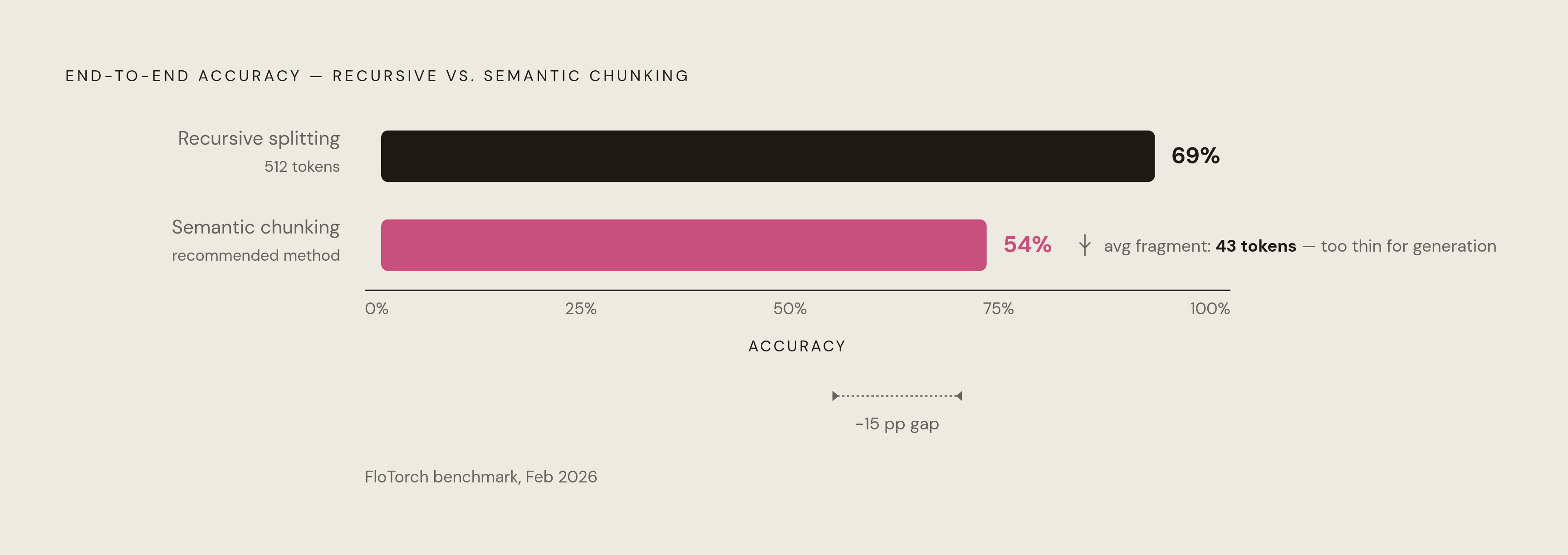
The counterintuitive result comes from the FloTorch February 2026 benchmark, which tested seven chunking strategies across 50 academic papers. Plain recursive splitting at 512 tokens scored 69% end-to-end accuracy. Semantic chunking, the method most tutorials recommend by default, scored 54%. That is not a rounding error, and it is not a fluke of one dataset.
The diagnosis is mechanical. In that same test, semantic chunking produced fragments averaging just 43 tokens. Fragments that small retrieve cleanly, because a 43-token chunk about one narrow idea matches a query embedding well, but they hand the model too little material to actually construct a correct answer. Retrieval succeeded; generation starved. The fix is almost embarrassingly simple: impose a minimum chunk floor, somewhere around 150 to 200 tokens, and when semantic splitting produces a fragment under that floor, merge it with its neighbor. That single adjustment recovers most of the lost accuracy without giving up the semantic coherence the method was built to provide.
Chroma's retrieval-only testing showed semantic chunking reaching 91.9% retrieval recall versus 85–89% for recursive splitting. Semantic chunking can retrieve the right material more often and still produce worse final answers, if the chunks it retrieves are too thin to reason over.
There is also a ceiling on how much context helps. A January 2026 arXiv analysis found a context cliff around 2,500 tokens, past which response quality degrades regardless of chunking method, and found that sentence-based chunking matched semantic chunking's performance up to roughly 5,000 tokens at a fraction of the compute cost. So for a wide swath of general use, the expensive method is buying very little.
Clinical and legal text breaks the pattern because of specific, identifiable reasons. A study published in MDPI Bioengineering found adaptive chunking aligned to logical topic boundaries reaching 87% accuracy on a clinical decision task, against 50% for a fixed-size baseline (whose retrieval precision, separately, was 13%), a gap confirmed at p = 0.001. Separate research on semantic entanglement, run on a real healthcare knowledge base of more than 2,000 documents spanning roughly 25 operational sub-domains, found Top-K retrieval accuracy rising from about 32% under fixed-token chunking to about 82% under a semantic disentanglement pipeline, alongside a drop in the mean Entanglement Index from 0.71 to 0.14. Context is the entire argument.
A 2026 enterprise AI survey found that 70% of RAG systems in production still run without any systematic evaluation framework. Most published figures, including vendor figures, come from curated internal tests rather than production-representative data. Treat every benchmark, this article's included, as a starting hypothesis to test against actual data. The gap between 32% and 82% is domain-specific, tied to healthcare, multi-subdomain, and long procedural documents, and generalizing this to all use cases is the same reasoning error as generalizing the FloTorch 54% result.
Document structure and choosing a starting chunking strategy
Document structure is the first filter, because it's the one thing knowable before a single query has been logged or a single eval has been run.
Well-structured documents, technical manuals, research papers, policy documents with clear headings, should start with structure-aware chunking, because the headings already encode the semantic boundaries a fixed splitter would have to guess at. Pair it with recursive splitting for any section that runs long, and add metadata to each chunk: section title, document type, date. That one addition, with no change to the retrieval architecture at all, lifted QA accuracy from roughly 50 to 60% up to 72 to 75% in Microsoft's Azure Architecture Center research.
Homogeneous, short-form content, support tickets, product blurbs, news copy, ordinary emails, calls for the opposite instinct. Start with recursive character splitting at 512 tokens with 10 to 20% overlap, a configuration FloTorch's February 2026 benchmark validated directly. Semantic chunking on this kind of corpus adds embedding overhead for a return that isn't there, since the documents are already topically uniform paragraph to paragraph.
Long, heterogeneous documents, clinical guidelines, legal contracts, financial filings, research papers building a complicated argument across many pages, are where fixed splitting starts to actively damage meaning, since it will cut a clause or an argument mid-thought. This is the category where semantic chunking earns its computational cost, and it's the same category the clinical and legal benchmarks above were drawn from.
Scanned PDFs, mixed-format archives, and documents without dependable headings, emails, meeting notes, intake forms, are the fourth category, and they invert the usual advice. Structure-aware chunking degrades badly here, since there's no heading to anchor against, so semantic chunking, which works off content similarity rather than structural markers, tends to hold up better. If the parser feeding the pipeline has already dropped or garbled the source text, no chunking strategy, semantic or otherwise, can recover meaning that was never captured; that is the hard limit produced by parsing quality, and it constrains every downstream chunking decision. For a corpus that mixes document types in the same index, Fastio's recommended starting point is semantic chunking with a minimum chunk floor of roughly 200 tokens. Chroma's research confirmed 85–89% retrieval recall at 400–512 tokens for this class. For financial documents, multi-hop analytical queries need chunks of 512–1,024 tokens per NVIDIA research, and fixed splitting at that size often outperforms semantic chunking for structured filings.
Query patterns and refining the chunking choice
Document type sets the starting point.
Getting chunk size wrong by one bracket degrades context precision by 15–30%, a figure that appears across multiple 2026 benchmark sources, though no primary NVIDIA research document for this specific figure has been identified. For high-value, small-corpus, complex reasoning tasks, LLM-based chunking or contextual retrieval is justified despite its cost.
Cross-document queries change the shape of the problem. Agentic RAG breaks a query into sub-queries, retrieves for each one separately, checks whether it has gathered enough context, and decides on its own whether to go fetch more, which is essentially the ReAct pattern applied to retrieval instead of to tool use. It belongs in the pipeline when queries span multiple documents, require comparing claims across sources, or carry conditional logic, and it should be left out entirely for simple lookups, where it adds latency and token cost with nothing to show for it. Agentic loops burn through meaningfully more tokens than a standard retrieve-then-generate pass, so the quality gain has to appear on the workload in question, measured against that spend, before the spend is worth it. Fact-based lookups call for recursive splitting at 256–512 tokens, with no overlap or minimal overlap, and benchmarking before adding semantic chunking. Analytical queries requiring multi-paragraph context call for recursive splitting at 512–1,024 tokens or page-level splitting for paginated documents.
Overlap, the practice of letting adjacent chunks share a slice of text at their boundary, turns out to be more contested than most guides suggest. The conventional wisdom calls for 10 to 20% overlap to preserve context across a chunk boundary. A January 2026 systematic analysis, run with SPLADE retrieval and a Mistral-8B generator on Natural Questions, found the opposite: overlap produced no measurable benefit and simply added indexing cost. Yet NVIDIA's own testing on FinanceBench, at 1,024-token chunks, tested 10%, 15%, and 20% overlap and landed on 15% as the optimum for that domain. Both results are correct for their own setting, which is the real lesson: overlap is domain- and query-dependent, not a universal constant, and the only responsible move is to validate it against actual data rather than importing a default. Factoid queries, or single-fact lookups, perform best at 256–512 tokens per NVIDIA research, with smaller, more precise chunks improving match specificity. Semantic chunking's retrieval precision advantage matters most for these queries. Multi-hop analytical queries involving comparison, synthesis, or conditional logic benefit from 512–1,024 tokens and broader context windows, making hierarchical chunking with parent-child structure often the right answer, since the child chunk retrieves precisely while the parent chunk provides the LLM with enough context to reason.
The ceiling parsing quality sets on chunking strategy
None of the above matters if the text entering the chunker is already wrong. Chunking only ever operates on what a parser handed it, and a deleted clause, a fused term, or a dropped table row enters the index looking exactly as legitimate as a correctly extracted one. Retrieval has no way to flag it, and neither does generation.
The distance between legacy OCR and newer, AI-native document parsing has become the single most consequential upstream decision a RAG builder makes, arguably more consequential than the choice of chunking strategy itself. Traditional OCR tends to output plain Unicode text with almost no layout metadata and no real reconstruction of tables or forms, and once that structure is gone, structure-aware and semantic chunking have nothing left to work with, no matter how well-tuned their thresholds are. Newer, AI-native parsers instead reconstruct the semantic shape of a page, multi-column layouts, nested tables, embedded charts and equations, actually comprehending a document's structure rather than merely extracting characters.
A production parser worth trusting for RAG needs a specific, checkable set of properties: preserved reading order across multi-column and multi-section layouts, table reconstruction that keeps row and column relationships intact rather than flattening a table into a loose sequence of cells, structural or bounding-box metadata that a structure-aware chunker can actually consume, and confidence scoring at the level of individual elements, since a parser that can't flag its own weak extractions passes those errors downstream silently. For sensitive material, that list extends further: self-hosted or zero-data-retention deployment options, and compliance postures covering SOC 2, HIPAA, or GDPR as the sensitivity of the documents demands, because parsing quality is never worth buying at the cost of exposing the data being parsed. Independent benchmarking on this front is still catching up to the pace of the field, though testing efforts covering multiple specialized document parsers across large question sets are already underway as they mature.
Chunking strategy decides how well a system uses the text it's given. Parsing decides whether that text was ever true to begin with. Get the second one wrong, and no amount of tuning on the first will show it.
Sources
- Best Chunking Strategies for RAG Pipelines (2026) | Fastio
- Best Chunking Strategies for RAG (and LLMs) in 2026
- Semantic Entanglement in Vector-Based Retrieval: A Formal Framework and Context-Conditioned Disentanglement Pipeline for Agentic RAG Systems
- Query-Adaptive Semantic Chunking for Retrieval-Augmented Generation: A Dynamic Strategy with Contextual Window Expansion
- Efficient RAG with Intent-Aware Retrieval and Semantics-Preserving Chunking